7.01a, 8.01g - Coordinates in four quadrants
Can changing the order of two numbers move you to a different place? Use the four-quadrant coordinates in 7.01a to locate points, then apply 8.01g to solve shape problems and describe movements accurately.
Coordinates as ordered pairs
A treasure map marks a point as . Would following take you to the same place? Coordinates work because everyone agrees which direction each number describes.
Two perpendicular number lines form the coordinate axes. The horizontal line is the -axis and the vertical line is the -axis. They meet at the origin, . On ordinary axes, positive is to the right and positive is upwards.
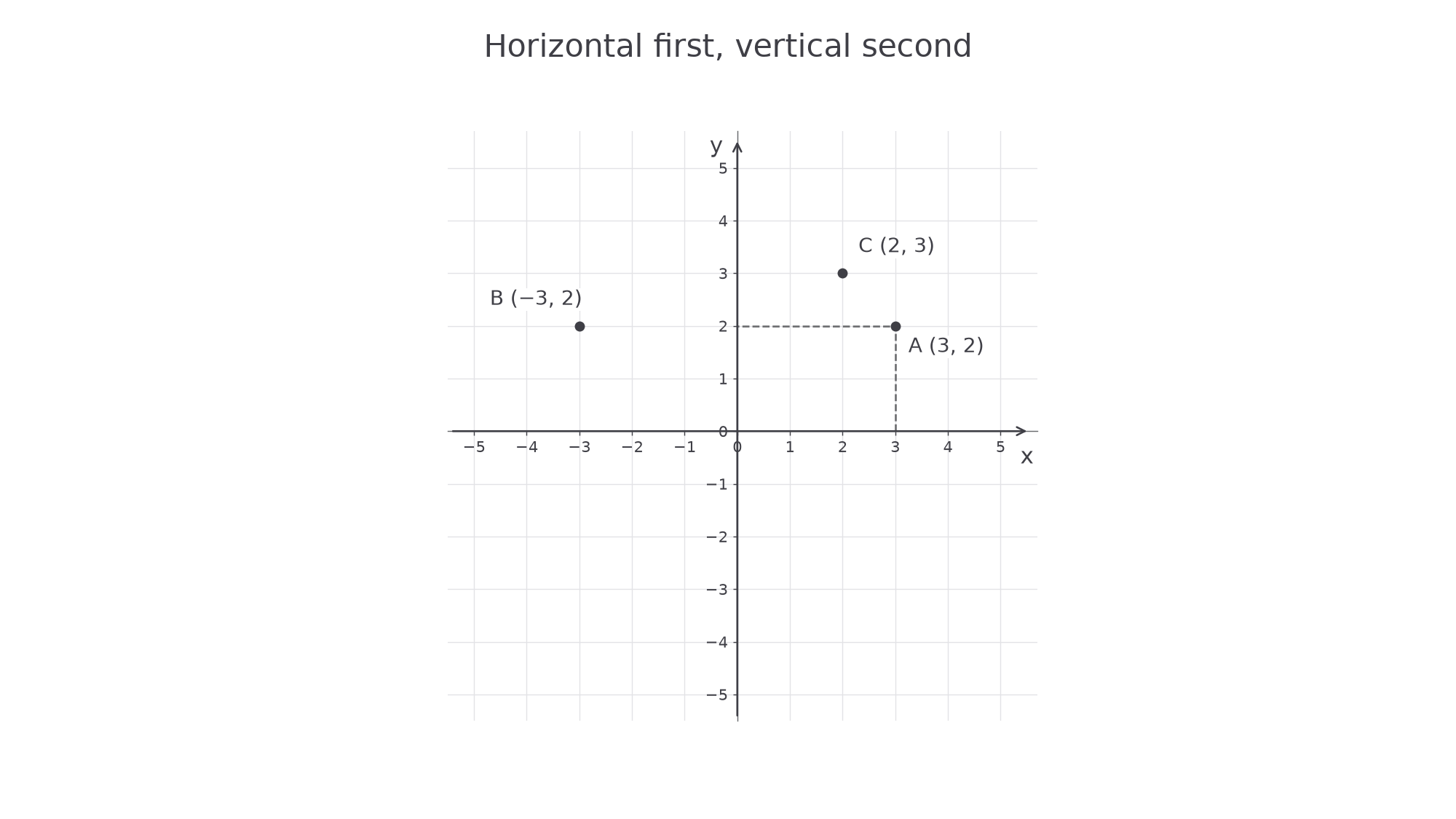
[DIAGRAM: asset_name: Reading ordered coordinates; asset_slug: ordered-coordinate-grid; caption: Read horizontal position first, then vertical position. Check the unit scale on each axis.; description: Equal-scale x and y axes from negative five to five. Points A at three, two and B at negative three, two share a horizontal line. Point C at two, three shows that reversing A's coordinates gives a different point. Dashed guide lines connect A to its axis values.]
Ordered pair
The coordinates give a point's horizontal position first and vertical position second. The pair is ordered: and are generally different points. They coincide only when the two coordinates are equal.
To plot a point, locate its -value along the horizontal axis, then move vertically to its -value. To read a plotted point, project it to each axis and read the values in that order. Check the scale: one small square might represent , , or another amount.
Worked example 1: both coordinates positive
Question. Point is three units right and two units above the origin. Write its coordinates and describe how to plot it.
Plan. Record the horizontal position, then the vertical position.
Answer. . Move to on the -axis, then two units up, and mark the point.
Check. Its horizontal guide meets the -axis at , while its vertical guide meets the -axis at .
Change only the horizontal direction. The vertical position stays the same.
Worked example 2: a negative x-coordinate
Question. Point is three units left and two units above the origin. Write its coordinates and describe how to plot it.
Plan. Use a negative horizontal coordinate for left of the origin.
Answer. . Move to on the -axis, then two units up.
Check. and are on the same horizontal line because both have , but they are on opposite sides of the -axis.
Coordinates need not be whole numbers. On a scale marked in halves, a point halfway between and has coordinate . Count values on the axis, not just grid squares.
Watch out
The origin is the starting reference, not necessarily the bottom-left corner of the diagram. A point left of the -axis has negative , even if it lies to the right of the page edge.
Read the two directions in the agreed order.
The four quadrants
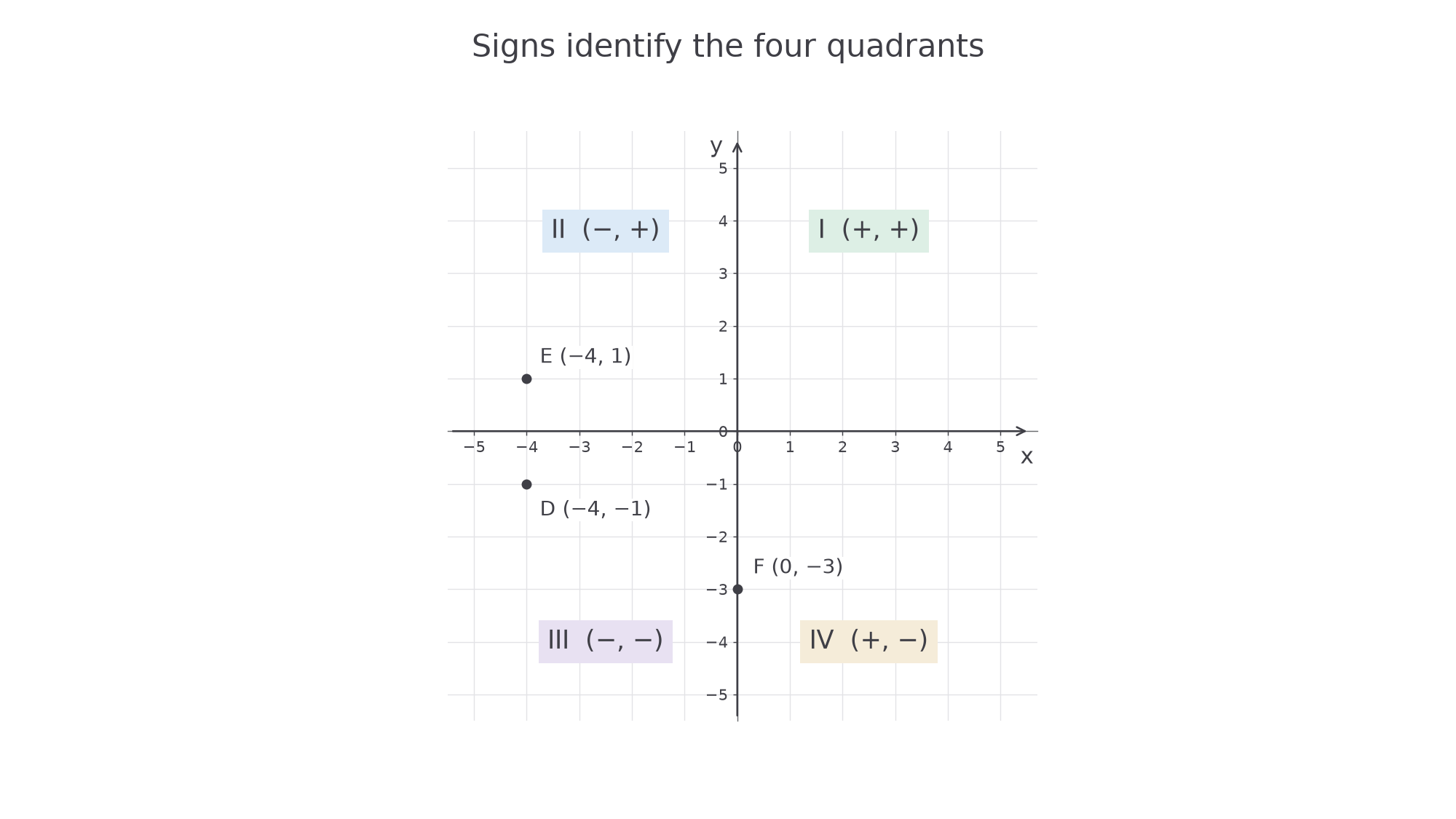
Extending both axes in both directions splits the plane into four quadrants. They are numbered anti-clockwise from the top-right region. The signs tell you which region contains a point.
| Quadrant | Position | Signs of |
|---|---|---|
| I | top right | |
| II | top left | |
| III | bottom left | |
| IV | bottom right |
A point on an axis is not inside any quadrant. If , it is on the -axis. If , it is on the -axis. The origin belongs to both axes.
[DIAGRAM: asset_name: The four quadrants; asset_slug: quadrant-signs; caption: Axis points are boundaries, not members of a quadrant.; description: A coordinate grid shows quadrant I in the top right, II top left, III bottom left and IV bottom right, with their coordinate sign pairs. Points D at negative four, negative one and E at negative four, one show a change in only the vertical sign. Point F at zero, negative three lies on the y-axis.]
Worked example 3: locating a point by its signs
Question. State the quadrant containing , and describe its position from the origin.
Plan. Interpret each negative sign before choosing a quadrant.
Answer. Quadrant III, four units left and one unit down.
Check. Both coordinates are negative, matching the bottom-left region in the diagram.
Change only the sign of the vertical coordinate. The point crosses the -axis while staying on the left.
Continue this lesson.
You’re previewing NovaLearn without an account. Create a free account to read the rest.
Create free account