6.03d, 7.01b, 7.01c - Quadratic graphs
Can two different inputs give the same output, and can a curve cross an axis twice? Plot quadratic curves and use their symmetry, intercepts and turning points to connect a picture with an equation.
Plotting a quadratic
For , the inputs and both give . What shape could pass through those points while dipping below them?
A quadratic has an term as its highest power, with a non-zero coefficient. Its graph is a smooth parabola. The changing gradient means you must not join neighbouring points with straight segments. Calculate enough points across the stated range, particularly near the bottom or top, then draw a smooth curve through them.
Put negative substitutions in brackets. For example, at , the square is while .
In the working below, is shorthand for the output when .
Worked example 1: plotting an upward curve
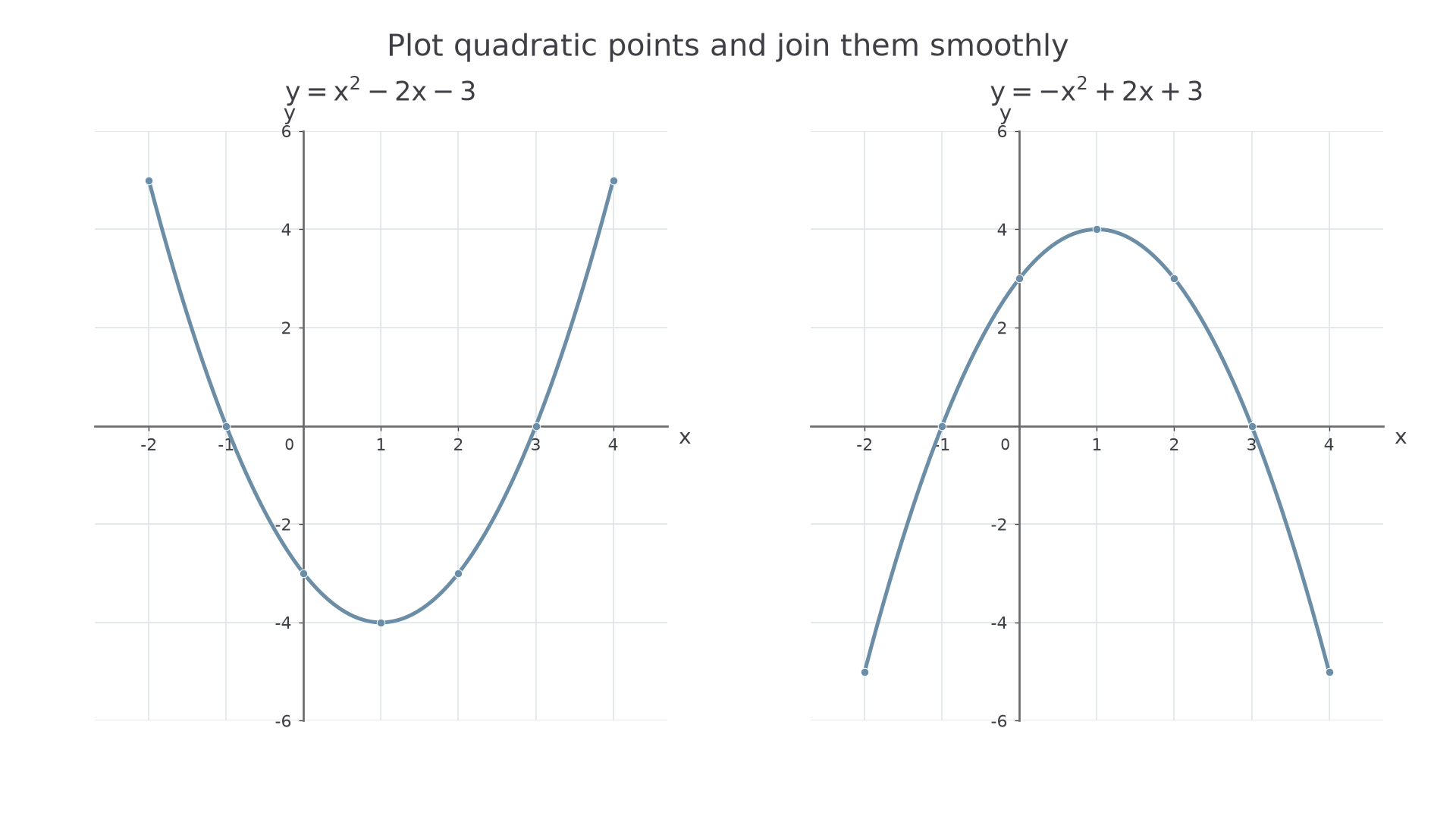
Question. Make a table and plot for , using integer inputs.
Plan. Substitute each input, plot all the points on a scale, then join with a smooth curve.
Answer. The output row is . The curve is U-shaped, with its lowest point at .
Check. Inputs equally far from have equal outputs: and , and , and and . The plotted points have the same symmetry.
Negate the whole expression. Only the sign of every output changes; each input stays where it is.
Worked example 2: plotting a downward curve
Question. Plot over the same input range.
Plan. Calculate the negative of each previous output, then draw a smooth curve through the new points.
Answer. The curve opens downwards and has highest point .
Check. Direct substitution at gives , matching the plotted endpoint. The two zeros remain unchanged because the negative of zero is zero.
[DIAGRAM: asset_name: Plotting two quadratic tables; asset_slug: quadratic-tables; caption: A smooth parabola passes through the calculated points.; description: Separate scaled grids show y equals x squared minus two x minus three and its negative for x from negative two to four. All seven integer-input points are marked on each curve.]
Watch out
For , writing loses the brackets. Use . A wrong point can spoil the whole curve, so check any point that breaks an otherwise symmetric pattern.
Your response can give the table and shape without drawing on a screen.
Symmetry and the turning point
A parabola folds onto itself along a vertical line, so pairs of equal-height points can locate its middle.
Turning point and line of symmetry
The turning point of a quadratic graph is its minimum or maximum point. The vertical line of symmetry passes through it. For an upward-opening parabola it is a minimum; for a downward-opening parabola it is a maximum.
If equal outputs occur at distinct inputs and , the middle input is . Substitute that input into the equation to find the turning point's height. A table may miss the turning point when it lies between listed inputs: do not automatically choose the lowest entry in the table.
Worked example 3: symmetry between equal outputs
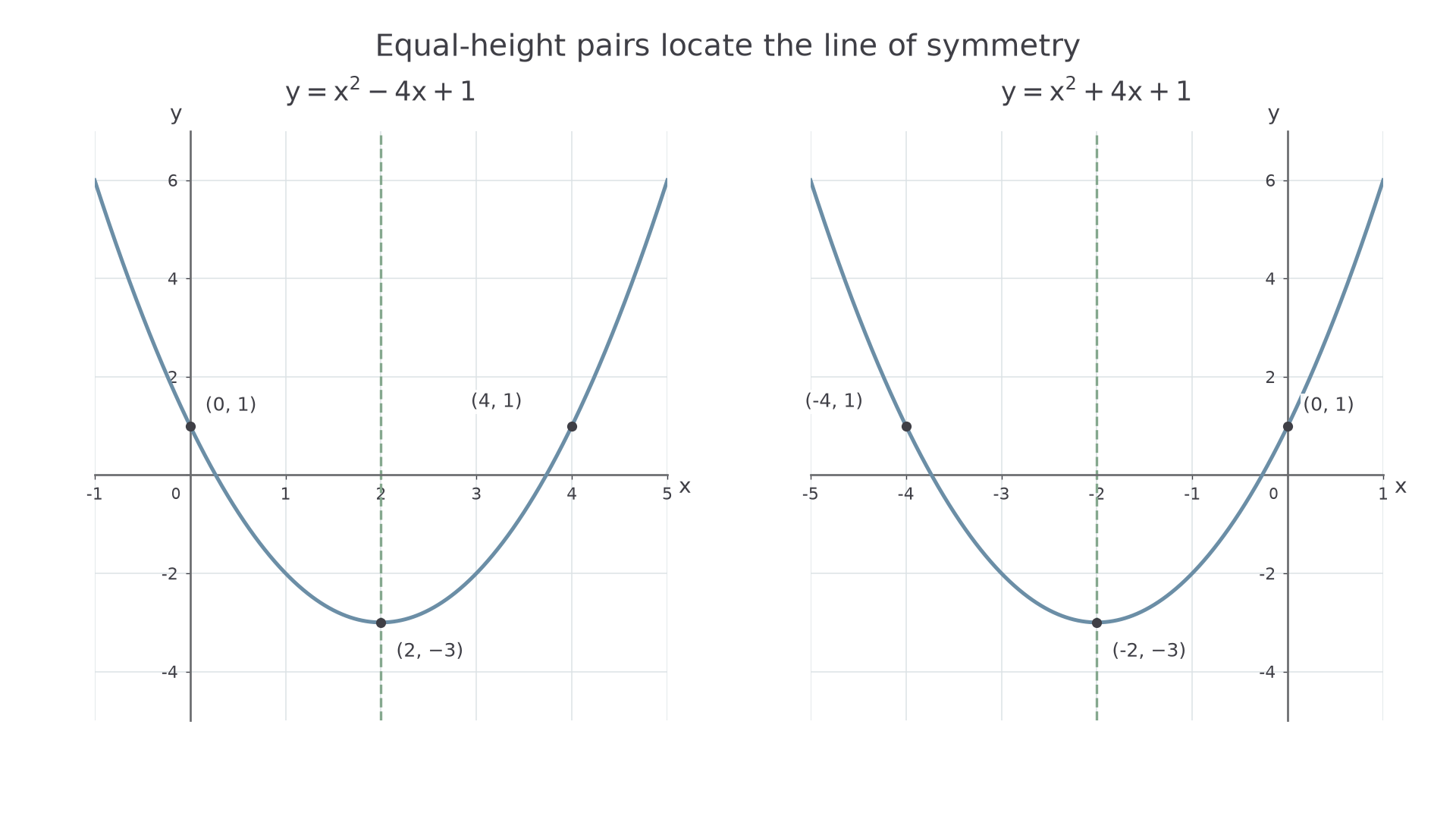
Question. For , the points and lie on the curve. Find its line of symmetry and turning point.
Plan. Find the midpoint of the equal-height inputs, then calculate the output there.
Answer. The symmetry line is ; the turning point is the minimum .
Check. The neighbouring inputs and both give , one unit above the minimum and symmetrically placed.
Change only the sign of the linear term. The matching points and the centre now lie on the other side of the vertical axis.
Worked example 4: symmetry left of the axis
Question. For , the points and lie on the curve. Find its line of symmetry and turning point.
Plan. Average the two inputs and calculate the corresponding height.
Answer. The symmetry line is ; the minimum is .
Check. At and , the output is in both cases. Those inputs are equally far from .
[DIAGRAM: asset_name: Quadratic symmetry from matching heights; asset_slug: quadratic-symmetry; caption: Equal-height pairs lie equally far from the vertical line of symmetry.; description: Two grids show upward parabolas x squared minus four x plus one and x squared plus four x plus one. The equal-height pairs and minimum points are marked, with vertical dashed symmetry lines at x equals two and x equals negative two.]
The line and the point are different kinds of answer: one gives an entire vertical line, while the other gives a single position.
Roots and intercepts
Where a curve meets the -axis, its height is zero, so that input solves the equation obtained by setting the expression equal to zero.
Continue this lesson.
You’re previewing NovaLearn without an account. Create a free account to read the rest.
Create free account