1.02b - Prime factorisation
Prime numbers are the indivisible building blocks of whole-number multiplication. You will recognise primes beyond twenty, split composite numbers into prime factors, and use powers to record the unique collection of prime factors in a positive integer greater than one.
Recognising prime numbers
If two people start a factor tree for in different ways, can they finish with different prime factors? First we need to know which factors are genuinely prime.
A prime is a positive integer greater than one with exactly two positive factors. The primes below twenty are . One is not prime, and two is the only even prime.
To test a larger positive integer, look for a divisor other than one and itself. You need only test prime divisors: if a composite number divides it, at least one of that divisor's prime factors also divides it. You can also stop at the square root, including the root itself when it is an integer. Why? In a factor pair, if both factors were greater than the square root, their product would be greater than the number. Any composite number therefore has a factor no larger than its square root.
Problem-solving
Test prime divisors up to and including the square root. One exact divisor proves that the number is composite; to conclude prime, rule out all the prime divisors in that range.
Use nearby squares to find the range; you do not need a decimal square root.
Worked example 1: recognising a larger prime
Question. Decide whether is prime. Give a reason.
Plan. Locate its square root and test every prime below it.
There are no other primes below seven.
Answer. is prime: it has no prime divisor at most its square root.
Check. Any factor pair would have a smaller member at most six. The composite possibilities four and six would require a factor of two or three, already ruled out.
Change only the number to forty-nine. Its square root is an integer, so the endpoint must be tested.
Worked example 2: the square-root boundary
Question. Decide whether is prime. Give a reason.
Plan. Test primes up to and including seven.
Two, three and five do not divide forty-nine, but the factor seven is enough to settle the question.
Answer. is composite, not prime.
Check. Its positive factors are : three factors rather than two.
The repeated factor in a square is still an extra factor even though the two members of the pair are equal.
Watch out
Stopping strictly before the square root would wrongly declare prime. Include because .
Rule out the full required range for the next candidate.
Splitting into prime factors
A factor tree repeatedly replaces a composite number by two factors whose product equals it.
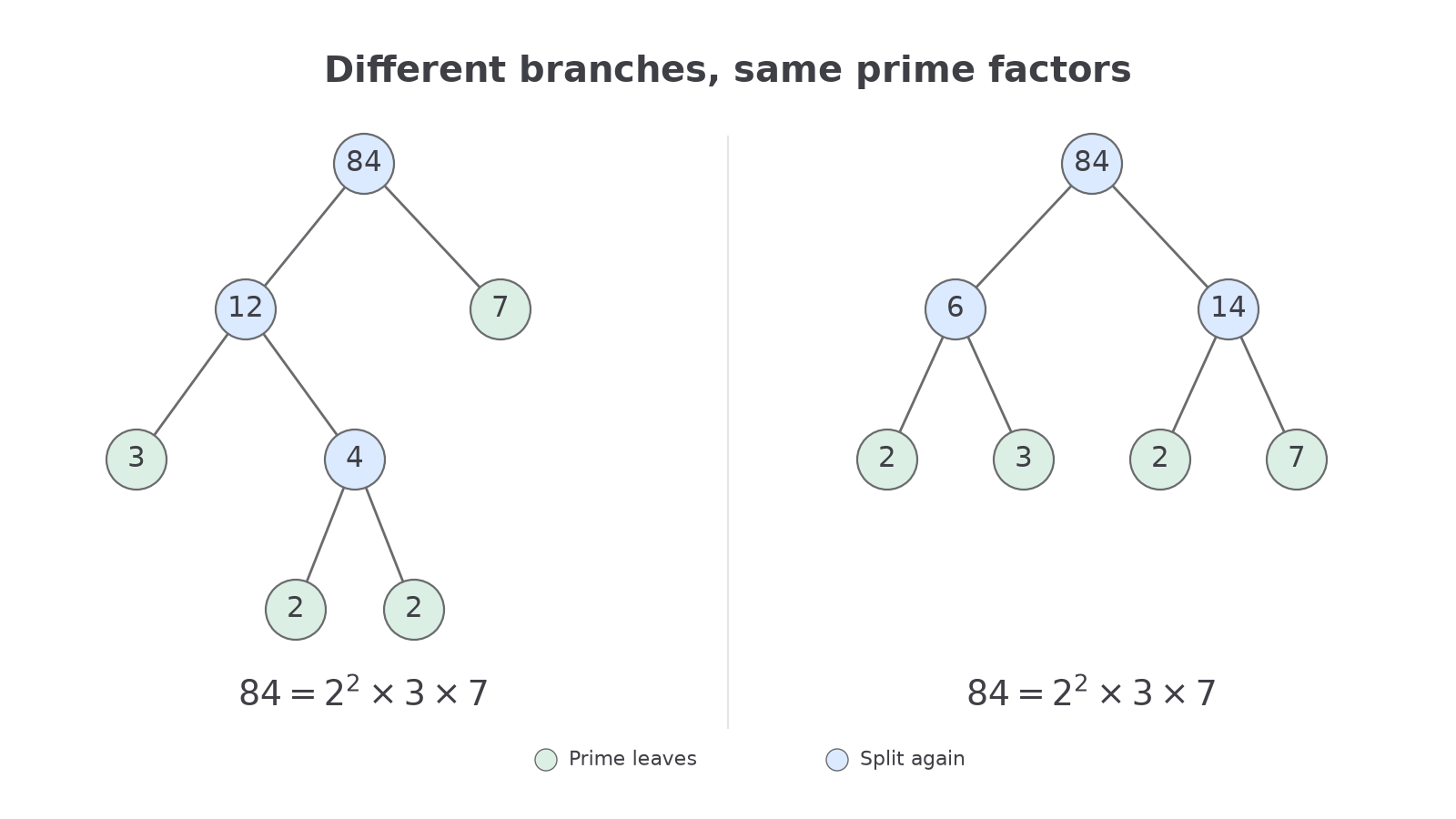
For , you could begin with or . Keep splitting every composite branch. Stop a branch only when it reaches a prime; the final prime leaves multiply to the original number.
[DIAGRAM: asset_name: Two factor trees for eighty-four; asset_slug: two-factor-trees-84; caption: Different first splits give the same prime leaves: two, two, three and seven.; description: Two labelled factor trees for eighty-four. The left tree splits eighty-four into twelve and seven, twelve into three and four, and four into two and two. The right tree splits eighty-four into six and fourteen, six into two and three, and fourteen into two and seven. Prime leaves have pale green circles, composite intermediate nodes have pale blue circles. Each tree has the final product two squared times three times seven below it.]
Prime factorisation
A prime factorisation writes an integer greater than one as a product containing only prime factors. Repeated primes can be written using powers: .
Each split preserves the total product. Replacing twelve by changes how the factors are grouped, not their product.
Worked example 3: starting with twelve and seven
Question. Express as a product of prime factors, starting with . Use power notation.
Plan. Split the composite factors until every factor is prime.
Answer. .
Check. Every displayed factor is prime, and .
Keep the number eighty-four and change only the first split. We can now test the opening question.
Worked example 4: starting with six and fourteen
Question. Express as a product of prime factors, starting with . Use power notation.
Plan. Split both composite branches and collect the prime leaves.
Answer. , exactly as before.
Check. . The final primes match the other tree, including both copies of two.
You may also divide repeatedly by prime factors instead of drawing a tree. For example, divide by two until that no longer works, then try three, five and so on. Record every division, including repeats.
Watch out
is a correct factorisation but not a prime factorisation: four is composite. Also, , not .
Use a new number and retain every repeated prime.
One prime factorisation
The two trees for eighty-four reached the same prime factors, although their branches looked different.
This is a general property of the positive integers: every integer greater than one has a prime factorisation, and that collection of primes is unique apart from their order. The number of copies matters. and are the same collection; removing one of the twos changes the number.
One has no prime factors and is not included in this “greater than one” statement. It is not prime. If one were counted as prime, inserting any number of factors of one would spoil the uniqueness of the list. Zero is also outside the statement: no finite product of positive primes is zero.
Key idea
Different valid splitting routes give the same prime factors with the same repetitions. Standard power notation records that unique collection compactly; the order of the prime factors may vary.
Reading a prime product backwards recovers the integer and checks that the index counts repeated factors correctly.
Worked example 5: reconstructing a number
Question. A number has prime factorisation . Find the number.
Plan. Evaluate each power, then multiply the resulting factors.
Answer. .
Check. Dividing successively by gives . Every prime factor has been used exactly once.
Change only the final prime from five to seven. The new prime collection must describe a different integer.
Worked example 6: changing one prime factor
Question. A number has prime factorisation . Find the number.
Plan. Keep the first two power values and replace the final factor.
Answer. .
Check. , then : replacing the final prime gives the same result by a second route.
The opening question is answered. The first split in a tree is a choice, but the final collection of prime factors is fixed. That is why prime products are useful for comparing divisibility and finding common factors later.
Watch out
and are different prime collections: their powers count different repetitions. Their values are and , not the same number.
Recover a new integer from its collection of prime factors.
Quick Recap
- To test primality, check prime divisors up to and including the square root.
- Keep splitting composite factors; stop only at prime leaves.
- Power notation records the number of copies of each prime.
- Every integer greater than one has one prime factorisation, apart from the order of its factors. One and zero are outside that statement.
Different factor trees for both finish at .