10.01c - Scale drawings and bearings
A small map can locate a place kilometres away, but only if length and direction are read correctly. Convert map scales, measure clockwise bearings from north and build scale drawings that preserve both. Find the bearing for the return journey too.
Reading a map scale
Two paths measure and on the same map. How much longer is the second in real life? The centimetres alone cannot tell us: we need the map's scale.
Scale
A scale compares drawing length with actual length. A ratio scale means one drawing unit represents of the same unit in real life. All lengths in an accurate scale drawing have the same scale factor; angles stay unchanged.
For example, means on the map represents , which is . It does not mean . Recall that and ; we will examine unit conversions more fully next lesson.
With scale to , multiply the drawing length in centimetres by to get metres. Divide the actual length in metres by to get drawing centimetres. Match the units before calculating.
Worked example 1: map length to actual length
Question. A map has scale . A straight path measures on it. Find its actual length in kilometres.
Plan. Convert one map centimetre to a convenient actual unit, then multiply.
Answer. .
Check. Four map centimetres represent , so should represent .
Keep the scale and change only the direction of conversion. An actual length must be made smaller to fit the map.
Worked example 2: actual length to map length
Question. A straight path is long. How long is it on a map with scale ?
Plan. Express the actual length in metres, then divide by the metres represented by one centimetre.
Answer. on the map.
Check. , recovering the actual distance.
These scales apply to lengths. If a model has lengths divided by ten, a square face has both dimensions divided by ten: its area is divided by one hundred. Do not apply a length factor once to an area or volume.
The opening paths differ by . On a map that represents .
Measuring bearings from north
A bearing gives a direction from a named starting point. “The bearing of from ” means stand at , face north, then turn towards .
Bearing
A bearing is an angle measured clockwise from north, written with three digits. East is , south , west , and north is usually written (a full turn is ).
Put the centre of the protractor at the starting point and align its zero with north. Read clockwise to the direction line. For a bearing greater than , either use a full-circle protractor or measure the smaller anticlockwise angle from north and subtract it from . “” means forty degrees, not four.
[DIAGRAM: asset_name: Clockwise and return bearings; asset_slug: clockwise-return-bearings; caption: The bearing of B from A is 065 degrees. The reverse direction from B is 245 degrees.; description: A lies southwest of B. Parallel north arrows rise from A and B. A clockwise arc from north at A to AB is labelled 065 degrees. At B a clockwise reflex arc from north to BA is labelled 245 degrees. The arrows on the arcs show the clockwise sense.]
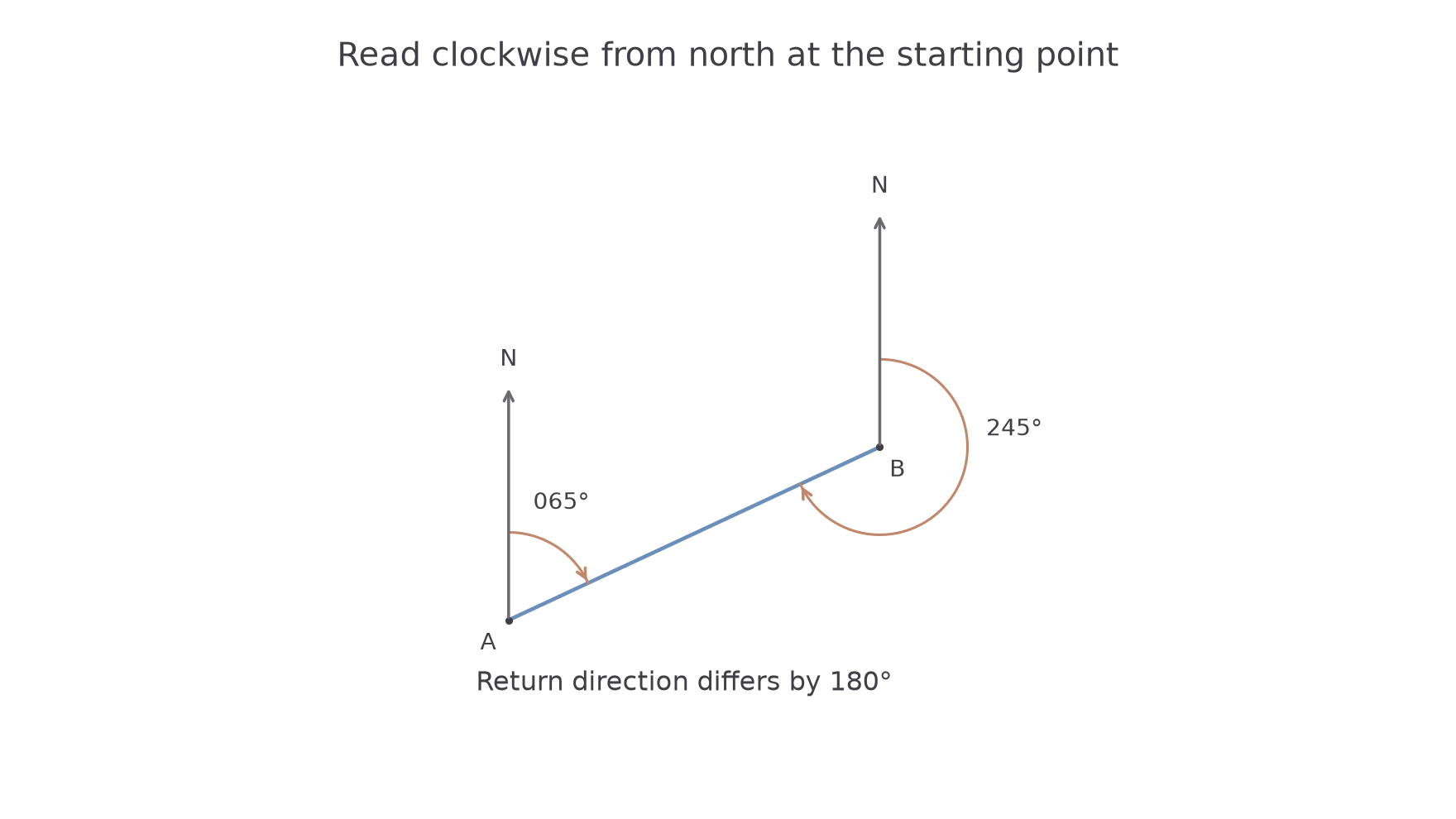
A return bearing reverses the direction, so it differs by . If the original bearing is below , add . If it is at least , subtract . This keeps the answer between and just below . The north lines at different places are treated as parallel on an ordinary local scale drawing.
Worked example 3: returning from a northeast direction
Question. The bearing of from is . Find the bearing of from .
Plan. Reverse the direction by half a turn.
Answer. .
Check. points southwest, opposite the original northeast direction. Subtracting recovers .
Change only the original bearing so it is now above . Subtract the half-turn to keep the answer in range.
Continue this lesson.
You’re previewing NovaLearn without an account. Create a free account to read the rest.
Create free account