7.01e - Sine, cosine and tangent graphs
A rotating point can travel round a circle while its height rises and falls. Use that motion to understand the sine and cosine curves, then see why tangent has repeating breaks. All angles in this Higher-tier lesson are in degrees.
The sine graph
How can a circular motion produce a wave-shaped graph? Imagine a point going anticlockwise round a circle of radius one, starting at its right-hand edge.
In a right triangle, sine is opposite divided by hypotenuse. With hypotenuse one, sine is the point's height. Extending this idea round the whole unit circle defines sine for angles beyond an acute triangle: the vertical coordinate is , and the horizontal coordinate is . Negative angles turn clockwise.
[DIAGRAM: asset_name: Trigonometry on the unit circle; asset_slug: trig-unit-circle; caption: On a circle of radius one, cosine is horizontal position and sine is height.; description: An equal-scale diagram shows the unit circle, a radius at forty degrees, and horizontal and vertical coordinate projections. The point is labelled cosine theta comma sine theta. The four quarter-turn points are labelled with angles and coordinates.]
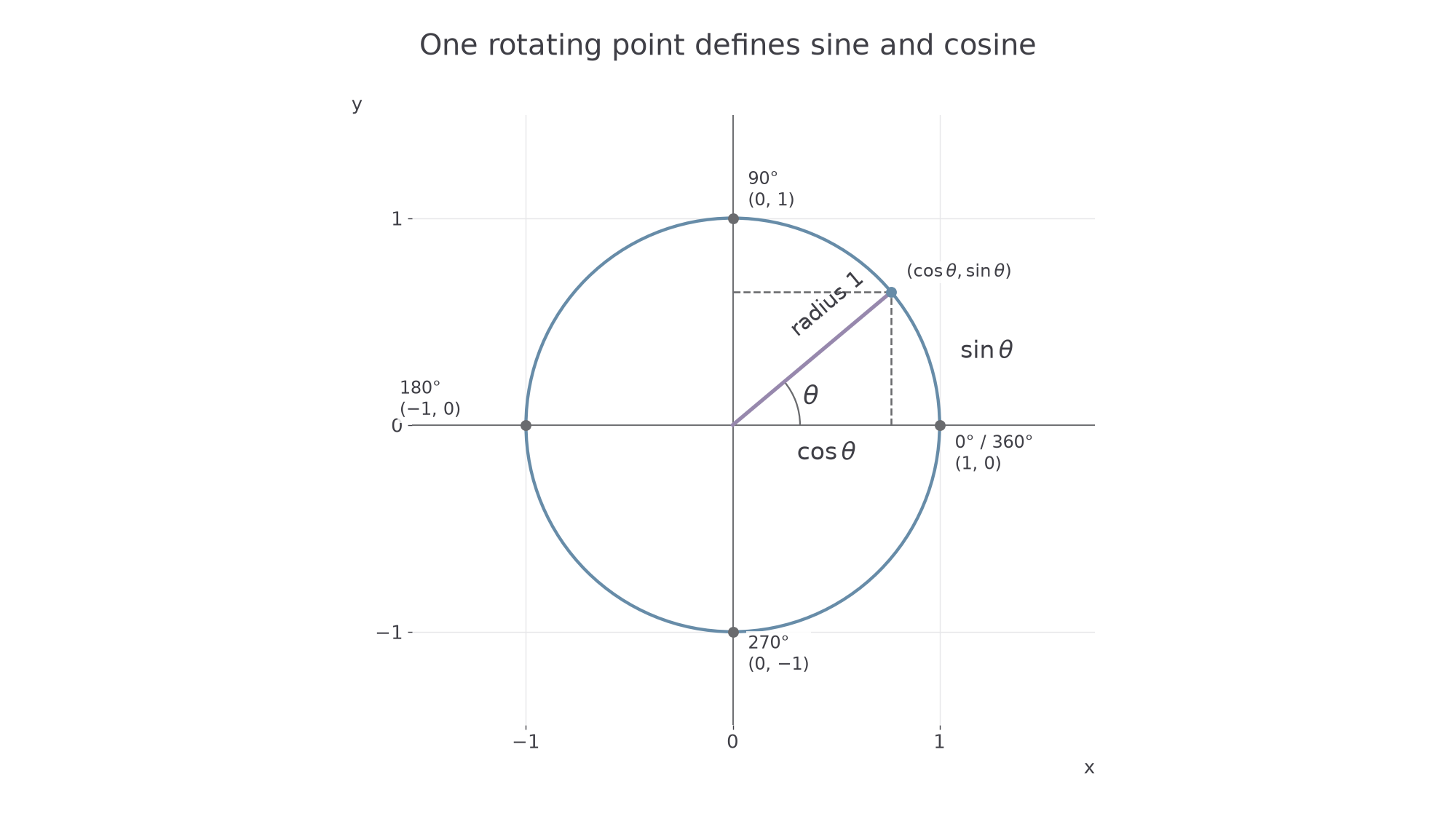
At the height is zero; at it is one; at it is zero; at it is negative one. Plot the angle along the horizontal axis and that height vertically to make .
Period
The period is the smallest positive horizontal shift that repeats the entire graph. Sine repeats after a full turn, so its period is . Its outputs lie between and , inclusive.
A sketch should show the correct shape and key coordinates, without requiring a precise grid. Use smooth curves between the key points, not straight-line zigzags.
Worked example 1: one sine cycle
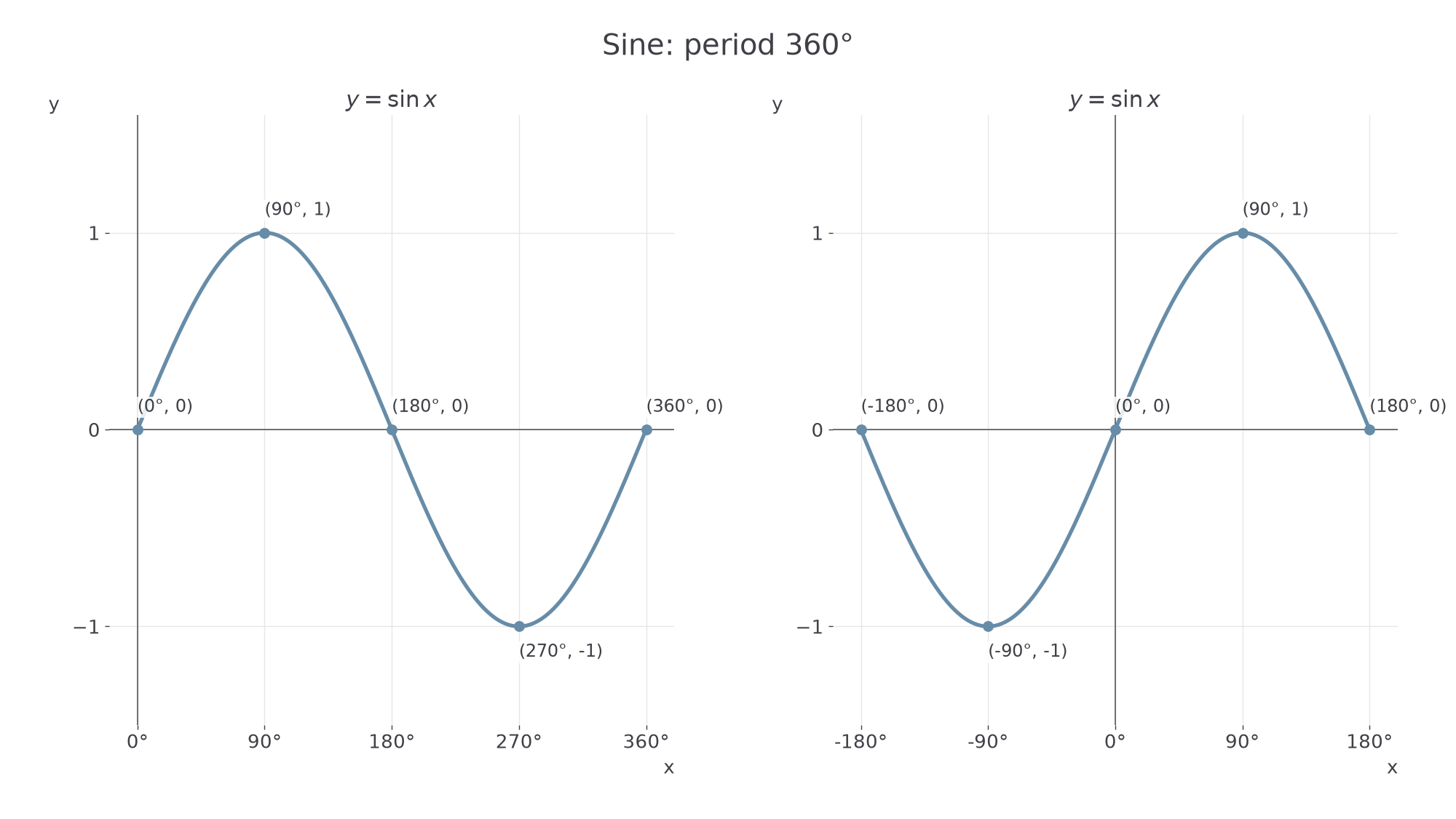
Question. Sketch for , marking its zeros and turning points.
Plan. Use quarter-turn heights from the unit circle.
Answer. Draw a smooth wave through , , , , . The maximum is , and the minimum is .
Check. The first half-turn gives positive heights, and the second gives negative heights. Both endpoints have height zero after one complete cycle.
Change only the interval. The graph does not restart its pattern at the left edge of the chosen window.
Worked example 2: a cycle across zero degrees
Question. Sketch for , marking its zeros and turning points.
Plan. Use clockwise quarter turns for the negative angles.
Answer. The key points are , , , , , joined smoothly.
Check. and differ by a full turn, so both outputs must be . This agrees with the first sketch.
The same wave is visible through two different windows.
[DIAGRAM: asset_name: Sine over two angle intervals; asset_slug: sine-cycles; caption: A full sine cycle repeats every three hundred and sixty degrees.; description: Two coordinate panels show sine from zero to three hundred and sixty degrees and from negative one hundred and eighty to positive one hundred and eighty degrees. Every quarter-turn point is marked, with zeros, maxima and minima at the taught coordinates.]
Watch out
Sine does not have a maximum at : . Keep the starting height connected to the unit-circle picture.
Use the repeating pattern in a new interval.
The cosine graph
Cosine tracks the same rotating point's horizontal position, so it starts at one rather than zero.
At the point is at the far right of the unit circle. A quarter turn puts it on the vertical axis, with horizontal coordinate zero. Half a turn puts it at the far left, with horizontal coordinate negative one. That gives the main features of .
Key idea
Cosine has period , maximum value and minimum value . In a cycle from to , its zeros are and .
Sine and cosine describe the same circular motion from two directions. Their waves have the same shape, with a quarter-turn horizontal offset.
Worked example 3: a cosine cycle
Question. Sketch for , marking its zeros and extreme values.
Plan. Record the horizontal position at each quarter turn.
Answer. Join , , , , with a smooth wave.
Check. A full turn returns the horizontal coordinate to one. The curve crosses zero exactly when the rotating point lies on the vertical axis.
Change only the interval, keeping cosine's starting position tied to the angle zero.
Continue this lesson.
You’re previewing NovaLearn without an account. Create a free account to read the rest.
Create free account