4.01c - Bounds in calculations
Rounded inputs create a range of possible answers. You will choose endpoints for sums, differences, products and quotients, then distinguish the largest possible count from an excluded limit for a continuous measurement.
Choosing endpoints for calculations
If a tank holds “ litres”, is its greatest possible volume the same kind of answer as the greatest possible number in “ tickets”? First learn how input intervals control a calculation; later we will return to that difference.
For positive lengths and , increasing either one increases and . For , increasing decreases the result. Think about the operation before choosing endpoints.
Lower and upper bounds
A lower bound is a value the quantity cannot go below; an upper bound is a value it cannot go above. In accuracy questions, we find the tight limiting values from the stated input intervals. A limiting bound need not be an attainable answer.
Write the input endpoints as . The endpoint choices are:
| Calculation | Lower limiting value | Upper limiting value |
|---|---|---|
| , for non-negative inputs |
The product row needs its sign condition: multiplying negative values can change which endpoint choices work. In this lesson the product and quotient measurements are positive. Also assume the inputs can vary independently; a stated connection between them could restrict possible combinations.
Worked example 1: three operations, three endpoint choices
Question. and , each correct to the nearest whole number. Find the lower and upper bounds of , and .
Plan. Write both intervals, then choose endpoints separately for each operation.
Answer. The intervals are , and .
Check. The central values give , and , all inside the intervals. The difference cannot reach , because that would require the excluded value .
Now change only the accuracy of . The central calculations are unchanged, while each output interval becomes narrower.
Worked example 2: one input measured more precisely
Question. to the nearest whole number and to one decimal place. Find the same three pairs of bounds.
Plan. Keep the interval for , replace the interval for , and use the same endpoint choices.
Answer. , and .
Check. Each new interval lies within its earlier interval. Better information about one input has reduced the uncertainty without changing the central values.
The endpoint arithmetic finds limiting values; the input inclusion signs tell you whether those values can be reached.
Watch out
For a lower bound of , “use both lower bounds” is wrong. Subtract the largest possible from the smallest possible .
Choose both endpoints appropriate to a positive product.
Bounds for quotients
For positive inputs, a quotient increases when its numerator increases, but decreases when its denominator increases.
For example, , while . A larger divisor makes each share smaller. Therefore the largest numerator and smallest positive denominator give the upper bound.
Positive quotient bounds
For independent intervals with and ,
These are limiting bounds. Check endpoint inclusion separately. A denominator interval reaching zero needs separate analysis; do not substitute zero into a division.
Not in the 2027 formula sheet: learn the endpoint reasoning.
You can use the same rule for a rate if its formula is supplied. Here the questions define ; the distance and time are positive.
Worked example 3: a rate from two rounded inputs
Question. to the nearest whole number and to the nearest whole number. Find the bounds of .
Plan. Divide the smallest distance by the largest time for the lower bound, and reverse the choices for the upper bound.
Answer. The lower bound is ; the upper bound is . Exactly, .
Check. The central calculation is , between the bounds. Neither endpoint is reached: each calculation uses an excluded upper input endpoint.
Change only the accuracy of the time. Keep full values until the end of the calculation.
Worked example 4: a more precise denominator
Question. to the nearest whole number and to one decimal place. Find the bounds of .
Plan. Keep the distance interval and use the narrower time interval.
Answer. The bounds are and , with both limiting endpoints excluded.
Check. These are closer to than the previous bounds, as expected from the more precise time. Multiplying by reconstructs .
A rounded decimal for a bound is a reported approximation to the limiting value. Keep the exact quotient when writing an exact inequality; an inward-rounded endpoint could exclude possible answers.
Watch out
The upper bound of is not . A large denominator would reduce the quotient. Use when both inputs are positive.
Use opposite endpoint choices for numerator and denominator.
Discrete counts and continuous measurements
A whole-number count has a largest permitted integer below an excluded endpoint; a continuous measurement need not have a largest permitted value.
Discrete and continuous quantities
A discrete count, such as the number of tickets sold, takes whole-number values. A continuous quantity, such as a volume, can take values between the whole numbers. Reported precision limits what we know; it does not make a continuous quantity discrete.
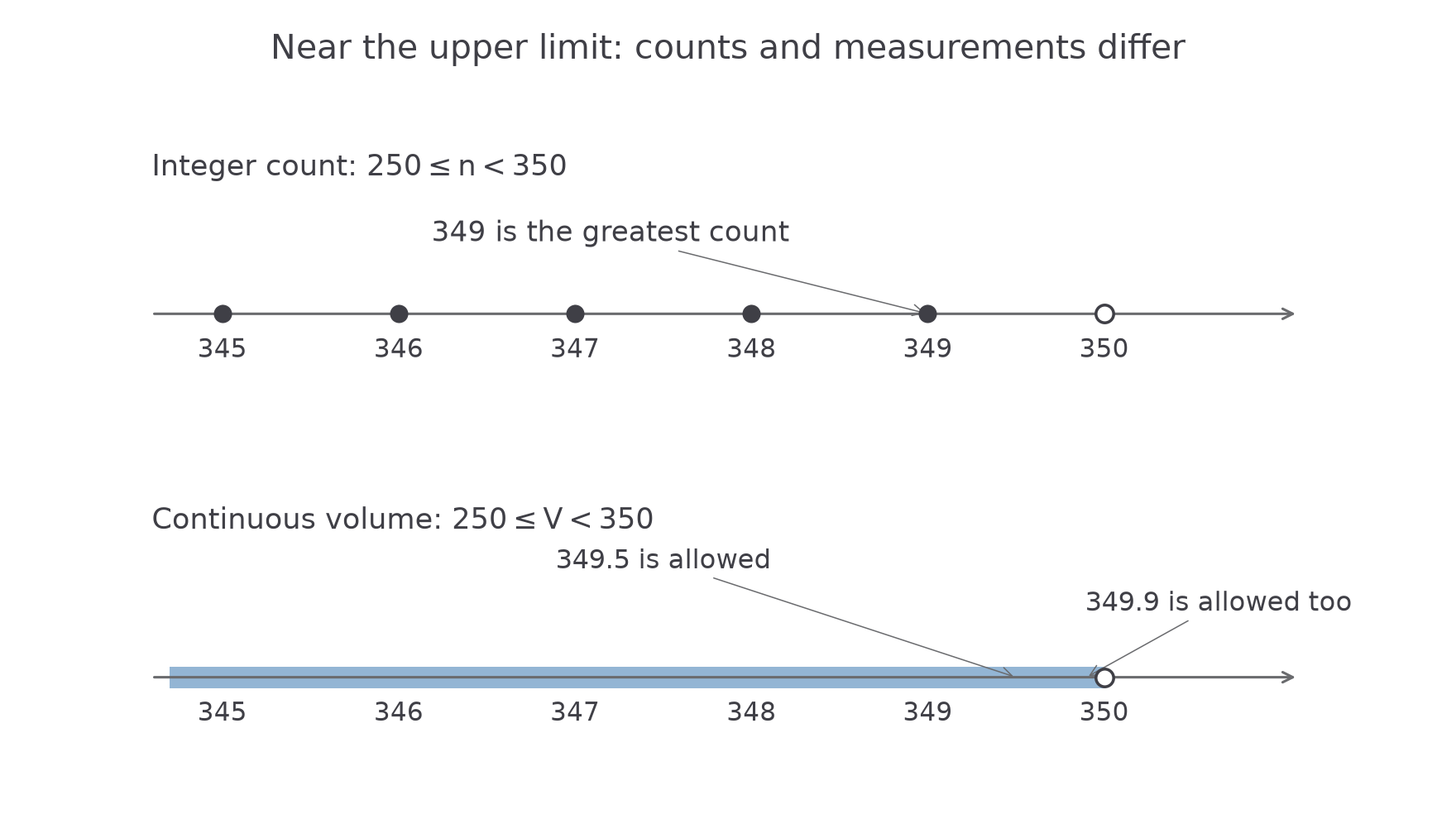
For , an integer count has greatest value . But for , a continuous volume can be , , or closer still to . None is greatest: any value below can be increased slightly while staying below it.
[DIAGRAM: asset_name: Discrete and continuous upper limits; asset_slug: discrete-continuous-bounds; caption: The last whole-number count is 349, while a continuous measurement can approach 350 without reaching it.; description: A close-up near the upper endpoint of the interval from 250 inclusive to 350 exclusive. The upper panel shows separate integer dots ending at 349, with an open marker at 350. The lower panel shows a solid continuous strip approaching an open endpoint at 350, with sample labels 349.5 and 349.9.]
Worked example 5: the largest possible count
Question. Ticket sales are reported as , correct to the nearest hundred. Write the error interval and state the greatest possible number sold.
Plan. Find the rounding interval, then restrict it to integer values.
Answer. Both intervals describe the count; the greatest possible number is .
Check. rounds to to the nearest hundred; rounds to . There is no integer between and .
Now change only the kind of quantity: the displayed number and rounding step stay the same.
Worked example 6: a limit with no greatest value
Question. A tank's volume is litres, correct to the nearest hundred litres. Give its error interval and explain whether litres is the greatest possible volume.
Plan. Use the same rounding endpoints, but allow continuous values.
Answer. . The upper bound is litres, but it is excluded. There is no greatest possible volume in this interval; litres is not the greatest.
Check. litres rounds to to the nearest hundred litres and is larger than litres. It is a direct counterexample to that proposed maximum.
We can now answer the opening question. The greatest possible count of tickets is ; the continuous volume has upper bound litres and no attained greatest value. The rounding interval is the same, but the permitted values within it differ.
Key idea
Use or for the integer count. Replacing by for a continuous measurement wrongly discards values such as .
Identify the kind of quantity before interpreting the last permitted value.
Quick Recap
- For positive products, use both lower or both upper endpoints.
- For differences and positive quotients, the endpoints play opposite roles.
- Check whether limiting values can actually be attained.
- An integer count can have a largest value below an excluded upper endpoint; a continuous interval of this form does not.
“ tickets” can mean at most tickets; “ litres” to the same precision can include litres.