4.01c - Error intervals
A displayed measurement does not usually tell you the exact size of an object. You will recover the interval of possible values from rounding or truncation, use the correct inequality signs and decide what a measurement guarantees.
Intervals for rounded values
Will a cupboard advertised as wide definitely fit into a gap recorded as ? The answer depends on how accurately those widths were reported.
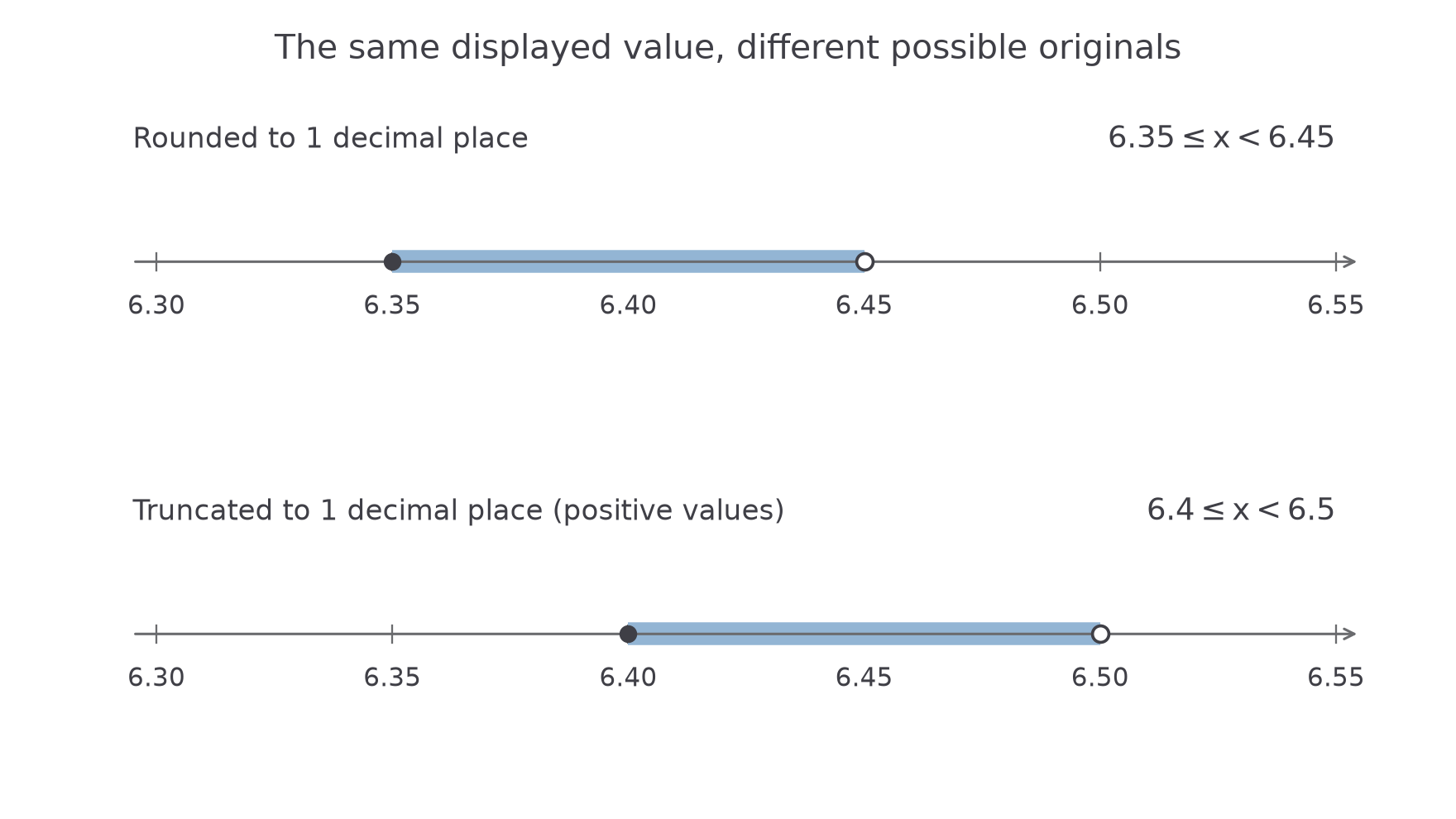
Start with a positive length recorded as , correct to one decimal place. Lengths from up to, but not including, round to . The endpoints are halfway to the neighbouring displayed values, and .
Error interval
An error interval is the range of possible original values consistent with a rounded or truncated value. In , the symbol includes , while excludes .
For a positive value rounded to the nearest unit , go half a unit below and above the displayed value :
Here “unit” means the rounding step: for one decimal place, for the nearest ten, and so on. Use the usual convention that an exact halfway positive value rounds upwards.
[DIAGRAM: asset_name: Rounded and truncated intervals; asset_slug: rounding-truncation-intervals; caption: Rounding to one decimal place uses half a tenth on either side, while truncating a positive value uses a full tenth above it.; description: Two number lines compare values reported as 6.4. The rounded interval is shaded from a filled endpoint at 6.35 to an open endpoint at 6.45. The positive truncated interval runs from a filled endpoint at 6.4 to an open endpoint at 6.5.]
Worked example 1: one decimal place
Question. A length centimetres is , correct to one decimal place. Write its error interval.
Plan. Find half the rounding step and place it on either side of .
Answer. .
Check. rounds to , but rounds to , so the different endpoint signs are needed.
Now keep the displayed size but change its stated precision. A final zero can carry information.
Worked example 2: two decimal places
Question. A length centimetres is , correct to two decimal places. Write its error interval.
Plan. Use half a hundredth, because the rounding step is now .
Answer. .
Check. The interval has width , ten times narrower than the interval in the first example, matching the extra decimal place.
Significant figures use the same half-step idea. For correct to two significant figures, the last retained digit is hundreds, so .
Watch out
Do not use for every interval. Half the rounding step is for one decimal place and for two decimal places.
Use the stated precision to select the step.
Intervals for truncated values
Truncation discards digits beyond a stated place, so it does not use the halfway rule.
For positive numbers, , and all become when truncated to one decimal place. Their interval starts at and stops before .
Truncation
To truncate a decimal, cut off the digits after the stated place without rounding. For example, truncated to one decimal place is ; becomes . For negative values this moves towards zero.
For a positive value truncated with step , the interval is . For a negative value, inspect which digits were discarded: values are at or below the reported negative value, rather than above it. Do not blindly copy the positive interval rule.
Worked example 3: a positive truncated value
Question. A number is , truncated to one decimal place. Write its error interval.
Plan. Start with and find the next tenth.
Answer. .
Check. truncates to , while stays and must be excluded.
Change only the sign. Cutting off digits still works, but the included endpoint is now on the right.
Worked example 4: a negative truncated value
Question. A number is , truncated to one decimal place. Write its error interval.
Plan. List which negative decimals lose their extra digits to give .
Answer. .
Check. The interval contains , which truncates to . It excludes , which would truncate to .
At zero, check the actual truncation rather than applying a positive or negative rule without thought. For instance, numbers strictly between and truncate to at one decimal place; either endpoint would retain a nonzero tenth.
Watch out
describes rounding to , not truncating to it. Read the word “rounded” or “truncated” before choosing endpoints.
Keep the order of negative numbers clear in your answer.
What rounded measurements guarantee
You can guarantee that an object fits by showing that its possible widths are all smaller than the possible gap widths.
Assume the object and gap are straight, measured in the same direction and that a smaller object width is sufficient to fit. Compare the intervals themselves. If they overlap, the labels alone may leave both a fitting and a non-fitting possibility. One valid non-fitting pair is enough to show that fit is not guaranteed.
Worked example 5: guaranteed fit
Question. A gap is wide to the nearest centimetre. A cupboard is wide to the nearest centimetre. Must it fit under the stated width assumption?
Plan. Compare the cupboard's upper limit with the gap's lower endpoint.
Answer. Yes. Every possible cupboard width is smaller than every possible gap width.
Check. Even is smaller than the smallest gap, . The cupboard cannot attain in its stated interval.
Now change only the cupboard's reported measurement. The central values still look comfortable, but that is not enough.
Worked example 6: possible failure
Question. The same gap is to the nearest centimetre. A cupboard is to one decimal place. Show that the cupboard may not fit.
Plan. Write both intervals and choose a valid cupboard width larger than a valid gap width.
Answer. The cupboard may not fit: and satisfy the reported measurements, but the cupboard is wider.
Check. rounds to at one decimal place, and rounds to to the nearest centimetre. Both chosen values are permitted.
This answers the opening question: the cupboard is not guaranteed to fit. Greater precision gives a narrower interval, but the relative positions of both intervals decide the fit.
Key idea
“May not fit” asks for a possible failure, not a claim that failure is certain. Support the conclusion with endpoint comparisons or a valid pair of possible measurements.
Choose possible values that obey both stated accuracies.
Quick Recap
- Rounding a positive value uses half the rounding step on either side.
- Truncation cuts off digits; check negative values separately.
- An included endpoint uses or ; an excluded endpoint uses or .
- Compare possible measurements, rather than just their displayed values, when deciding fit.
A cupboard labelled can be wider than a gap labelled when their accuracies differ.