4.01a - Rounding to useful accuracy
How can the same measurement round to or , and why might the extra zero matter? Learn to round to a place value, decimal places and significant figures, then choose sensible accuracy for money, measurements and practical decisions.
Rounding to a place value
A measurement is . Why might one answer be and another ? We will return to these equal values after exploring what a rounding instruction says about accuracy.
Rounding replaces a number with a nearby value on a chosen scale. To round to the nearest hundred, compare the neighbouring hundreds and . The midpoint is , so is nearer .
[DIAGRAM: asset_name: Choosing the nearest hundred; asset_slug: nearest-hundred-line; caption: The midpoint separates numbers nearer to 2400 from numbers nearer to 2500.; description: A horizontal number line from 2400 to 2500, with ticks every ten. The endpoints and midpoint 2450 are labelled. Points at 2430 and 2470 are shown with arrows to their nearer hundred, 2400 and 2500 respectively.]
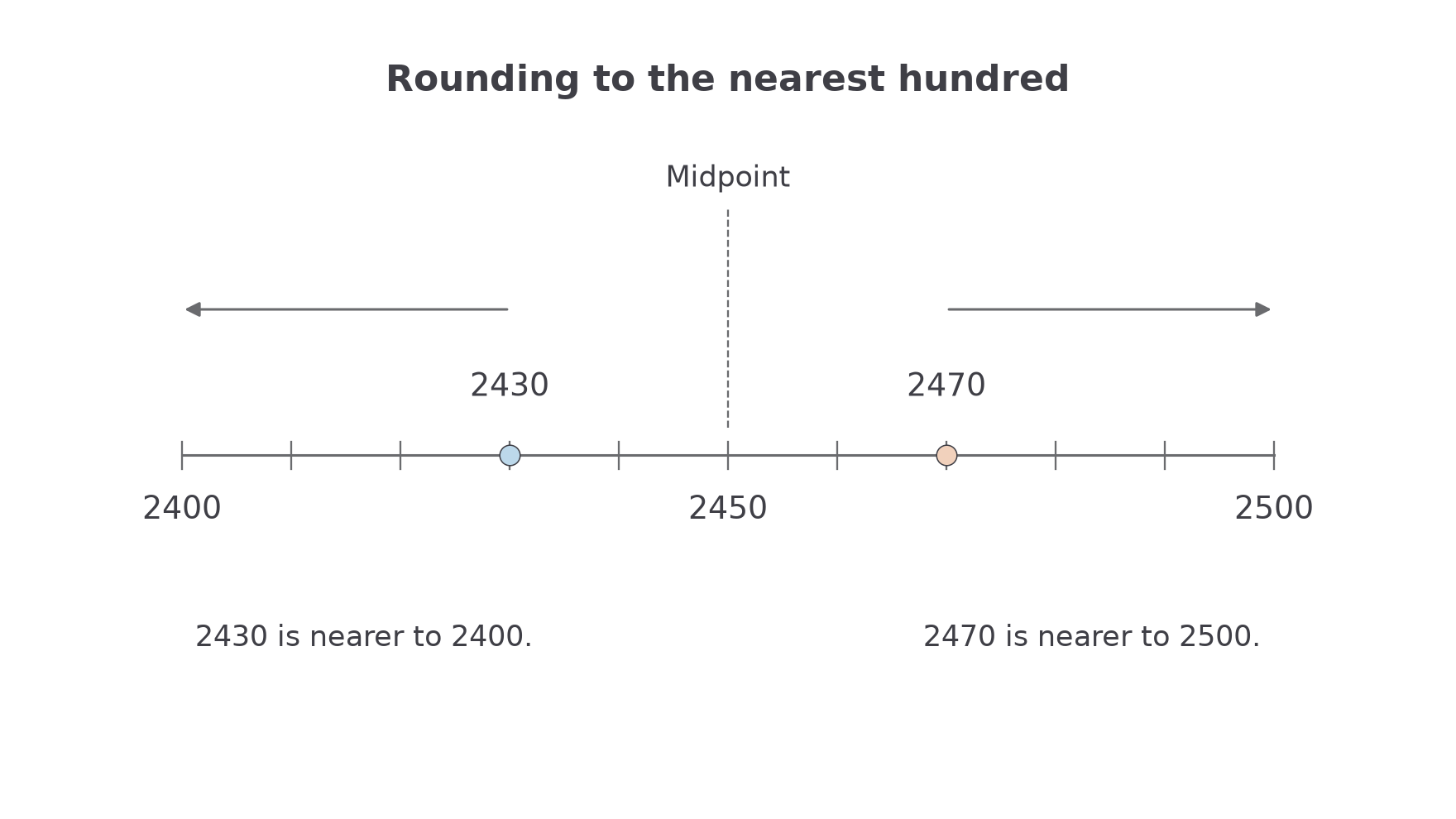
Rounding to the nearest
To round to the nearest chosen place value, select the closest multiple of that place value. For a positive number exactly halfway between two choices, use the larger one: rounds to to the nearest hundred.
The same method works for the nearest unit, ten, thousand or million. After finding the target column, inspect the next digit: – keeps the target digit; – increases it by one. Replace smaller whole-number places with zeros. For a negative number, compare its position with the two neighbouring choices; for example, is nearer than . For exactly halfway negative values, this lesson uses rounding away from zero, so rounds to .
Worked example 1: below the midpoint
Question. Round to the nearest hundred.
Plan. Compare the distances to the two neighbouring hundreds.
Answer. , because .
Check. The tens digit is , so the hundreds digit stays the same.
Change only the tens digit from to . This moves the number to the other side of the midpoint.
Worked example 2: above the midpoint
Question. Round to the nearest hundred.
Plan. Compare with the same neighbouring hundreds.
Answer. , because .
Check. The tens digit is , so the hundreds digit increases from to .
Use the approximation symbol when showing that rounding has changed the value: to the nearest hundred. The equals sign would claim the two original values were identical.
Watch out
to the nearest hundred is , not . The zeros preserve the places of the retained digits.
Try the exact midpoint.
Decimal places
Decimal places count digits after the decimal point, starting immediately after it, including zeros.
Rounding to one decimal place means choosing the nearest tenth; two decimal places means the nearest hundredth. The next digit decides which way to round. Discard all later digits in one step: do not round the number repeatedly through intermediate places.
Decimal places
An answer to decimal places, written dp, has digits after the decimal point, where is a non-negative whole number. For example, is written to dp; is written to dp. They have the same numerical value but communicate different requested precision.
Keep a final zero if it is needed to show the requested number of decimal places.
Worked example 3: keeping the last digit
Question. Round to decimal places.
Plan. Retain through the hundredths digit and inspect the thousandths digit.
Answer. .
Check. It is from and from , so is closer.
Change only the thousandths digit from to . The retained digits are the same, but the rounding decision changes.
Worked example 4: increasing the last digit
Question. Round to decimal places.
Plan. Inspect the thousandths digit to decide the nearest hundredth.
Answer. .
Check. The distances are to and to ; the second is nearer.
Rounding can carry into an earlier column. For the opening measurement, to dp becomes : increasing nine hundredths gives ten hundredths, which exchanges for one tenth. To dp it becomes . Both have the same value; the written zero records the two-place instruction.
Watch out
Do not turn into , then use that rounded value to find dp. Directly inspecting the original hundredths digit gives to dp. Repeated rounding can change an answer.
Practise the carrying step with a new value.
Significant figures
Significant figures count from the first nonzero digit, wherever that digit occurs.
In , the zeros before the locate the value but do not count as significant figures. The first two significant figures are and . Zeros between nonzero digits do count: has three significant figures. A final decimal zero can also record precision: has three significant figures.
Significant figures
To round a nonzero number to significant figures, written sf, where is a positive whole number, start at its first nonzero digit, keep digits, and use the next digit to round. Preserve the place values of the retained digits. Zero itself remains zero; it has no first nonzero digit.
The key difference from decimal places is the starting point. Significant figures start at the first nonzero digit, while decimal places always start just after the point.
Worked example 5: a small decimal
Question. Round to significant figures.
Plan. Start counting at , keep and , then inspect .
Answer. .
Check. The neighbouring two-figure values are and . The distances are and , so is nearer.
Multiply the original number by ten, changing only its scale. Its significant digits stay the same, so its rounded value should also be ten times larger.
Worked example 6: the same digits at a different scale
Question. Round to significant figures.
Plan. Keep and , inspect , and preserve their new places.
Answer. .
Check. , matching the tenfold change in the original value.
The same digit rule works for large values: to sf is . The zeros keep the in the ten-thousands column. If a question asks for significant figures, an integer answer's trailing zeros may be needed as placeholders rather than additional significant digits.
Watch out
to sf is , but to dp it is . Always identify where counting begins.
Change the scale once more.
Choosing useful accuracy
Useful accuracy depends on what the answer represents, as well as on its digits.
Follow an accuracy instruction when one is supplied. Otherwise use the context: a quoted price normally uses two decimal places in pounds; a count of people is a whole number; a measured length may sensibly use a stated number of significant figures. Keep unrounded values through a calculation and round the final result. A calculator's many displayed digits do not mean a measurement is known that precisely.
Worked example 7: a price per item
Question. Seven identical notebooks cost in total. Calculate the average price per notebook, to the nearest penny.
Plan. Divide the total by seven and round the final pounds amount to two decimal places.
Answer. per notebook, to the nearest penny.
Check. , which is only below the total. The exact average was pounds; rounding explains the small difference.
Change only the total cost from to . The division and accuracy choice stay the same.
Worked example 8: the same accuracy decision
Question. Seven identical notebooks cost in total. Calculate the average price per notebook, to the nearest penny.
Plan. Divide first and round only the final price.
Answer. per notebook, to the nearest penny.
Check. , only from the total. Using would give , a larger discrepancy.
Practical decisions may require a direction rather than ordinary rounding. If people need transport in minibuses seating each, . Three minibuses seat only , so you need four. Conversely, buys only three whole tickets: the remaining pound does not buy another ticket. Check the capacity or budget rather than rounding automatically.
This also explains why rounding and exact equality have different jobs. , but writing the second form answers a two-decimal-place instruction. The number is equal; the communicated precision differs.
Watch out
Keep guard digits until the end. In a capacity question, a nearest-whole-number answer may be too small; check whether the rounded answer actually meets the stated need.
Choose the accuracy from the money context.
Quick Recap
- Round to the nearest chosen place by comparing its neighbouring values.
- Decimal places count after the point; significant figures start at the first nonzero digit.
- Preserve placeholder zeros, and keep final decimal zeros when accuracy requires them.
- Round the final answer, then check that the context's practical conditions are met.
rounds to at dp and at dp: equal values, with different stated precision.