6.04b, 7.02a - Regions defined by inequalities
An inequality can describe a whole side of a line rather than one line. In 7.02a you will draw solid and dashed boundaries, then in 6.04b you will combine conditions to find a common region and its integer points. These are Higher-tier graph skills.
Drawing inequality boundaries
How can a point lie on a drawn edge but still fail the inequality? The line's style records whether its points are included.
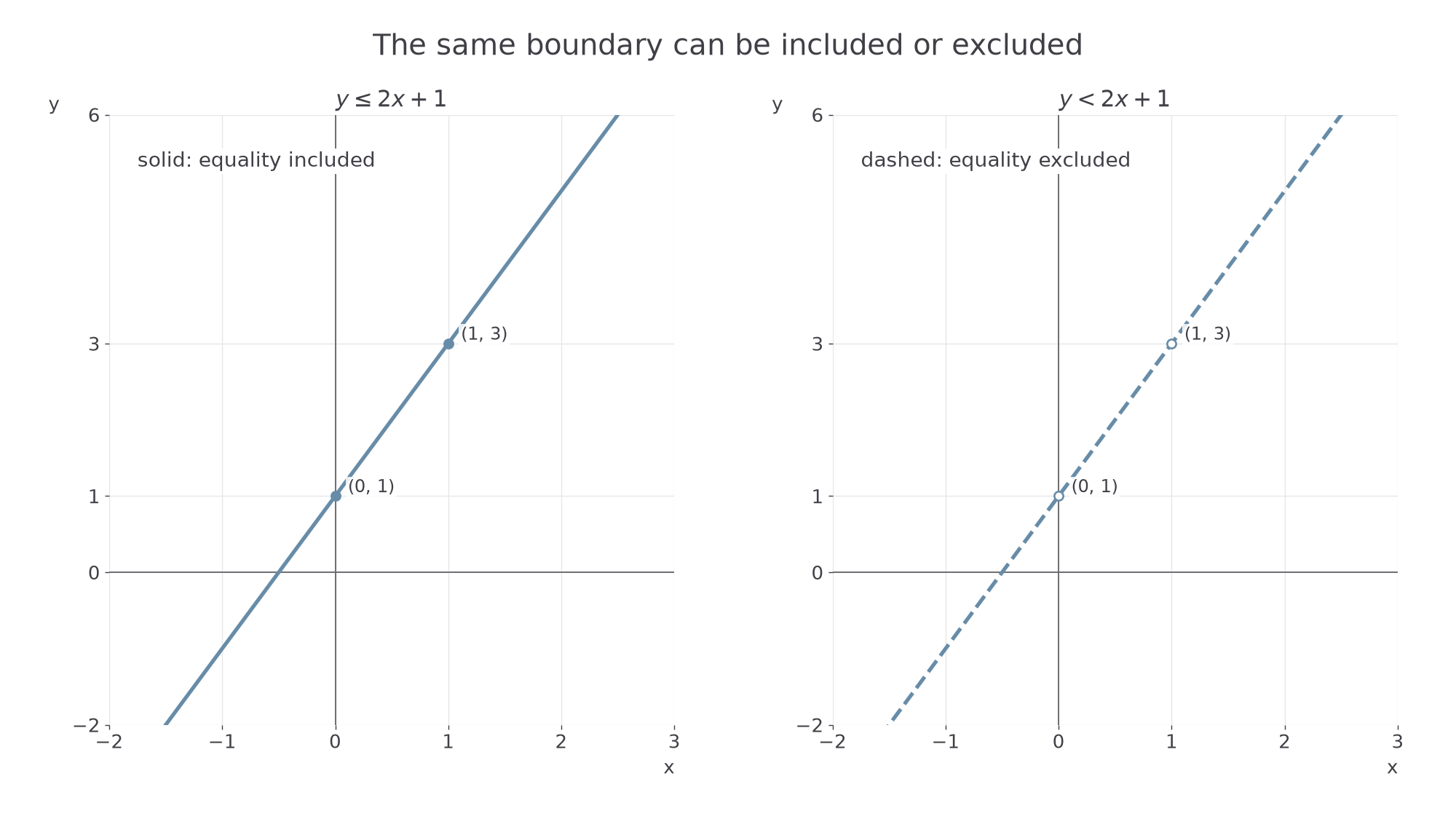
The inequality allows many points. Its boundary occurs where equality holds, so start with . A point such as satisfies equality and is included. For , that same point is excluded even though the boundary equation stays the same.
Boundary line
The boundary line separates the two sides of a linear inequality. Draw it solid for or , because equality is allowed. Draw it dashed for or , because equality is excluded.
To draw an oblique boundary, replace the inequality sign by equals, find two distinct points, and join them with a ruled line. A vertical boundary has fixed horizontal coordinate; a horizontal boundary has fixed vertical coordinate.
Worked example 1: an included boundary
Question. Draw the boundary for . Give two points on it and explain the line style.
Plan. Plot the equality line, then use the inequality sign to decide whether it is included.
Answer. Draw a solid straight line through and , because includes equality.
Check. At , becomes , which is true. A solid line correctly includes that point.
Change only the inequality from non-strict to strict.
Worked example 2: an excluded boundary
Question. Draw the boundary for . Give two points on it and explain the line style.
Plan. Keep the equality line but exclude its points.
Answer. Draw a dashed line through the same points, because excludes equality.
Check. At , is false. The dashed style correctly excludes the boundary point.
The position alone does not tell you whether the boundary belongs to the answer.
[DIAGRAM: asset_name: Solid and dashed boundaries; asset_slug: inequality-boundary-styles; caption: The equality line stays fixed while the inequality sign changes whether it is included.; description: Two identical coordinate grids show the line y equals two x plus one through zero comma one and one comma three. The left line is solid for y less than or equal to two x plus one, and the right is dashed for y strictly less than two x plus one. No half-plane shading is used yet.]
The same inclusion rule applies to a boundary without a finite gradient.
Worked example 3: a vertical boundary
Question. Draw the boundary for .
Plan. Hold the horizontal coordinate fixed.
Answer. Draw the solid vertical line .
Check. Both listed points satisfy with equality, so the boundary is included.
Change only the inclusion of the boundary.
Worked example 4: a strict vertical boundary
Question. Draw the boundary for .
Plan. Use the same vertical line and exclude equality.
Answer. Draw the dashed vertical line .
Check. The point satisfies , whereas does not. The next part chooses which side of the dashed line to keep.
A horizontal boundary works in the corresponding way: has the solid horizontal boundary .
Watch out
Dashed does not mean “below”, and solid does not mean “above”. Line style records inclusion. The inequality itself decides the side.
State the boundary information without needing a drawing tool.
Choosing the correct half-plane
A boundary splits the plane into two half-planes, and a point away from the boundary tells you which one satisfies the inequality.
Choose a simple test point, often , and substitute both coordinates into the original inequality. If it gives a true statement, keep the side containing that point. If it gives a false statement, keep the opposite side. Do not use a point on the boundary: it cannot distinguish the two sides.
Problem-solving
For an oblique boundary written , selects above the line and selects below it. A test point also works when the inequality is not yet in this form.
Shade the solution side clearly and label it. Some questions shade unwanted regions instead: follow their instruction and make the region you mean unambiguous.
Worked example 5: a test point that works
Question. Identify the half-plane satisfying .
Plan. Draw the dashed boundary and test the origin, which is not on it.
Answer. Keep the side containing the origin: below the dashed line .
Check. Another point below the line, , gives , true. A point above it, , gives , false.
Reverse only the inequality. The test changes truth value, so the solution side reverses.
Worked example 6: a test point that fails
Question. Identify the half-plane satisfying .
Plan. Use the same boundary and the same test point.
Answer. Keep the side not containing the origin: above the dashed line.
Check. now works, since , while does not, since is false.
Continue this lesson.
You’re previewing NovaLearn without an account. Create a free account to read the rest.
Create free account