10.02c, 10.03e - Composite perimeters and areas
Two gardens begin as identical rectangles. One gains a semicircle, and the other loses a semicircle: could their perimeters still be equal? Use 10.02c to trace composite boundaries and 10.03e to add or subtract the areas of simpler regions.
The exposed outer boundary
Start with two rectangles measuring by . Attach a semicircle along a complete end of one, and cut the same semicircle out of an end of the other. Which needs more fencing?
The perimeter is the total length round the shape's boundary. Trace that boundary with your finger. A joining line inside a shape is not exposed, so it does not need fencing. A cut-out can create a new exposed curved boundary.
[DIAGRAM: asset_name: Semicircle attached or removed; asset_slug: composite-exposed-boundaries; caption: Each outline contains the same three straight sides and one semicircular arc. The dashed diameter is not exposed.; description: Two twelve-metre by six-metre rectangles. On the left a semicircle is attached externally along the complete right-hand six-metre end. On the right an equal semicircle is cut inward from the same end. Dark outlines show the exposed boundary. A dashed line marks the six-metre diameter in each, and the twelve-metre length and six-metre height are labelled.]
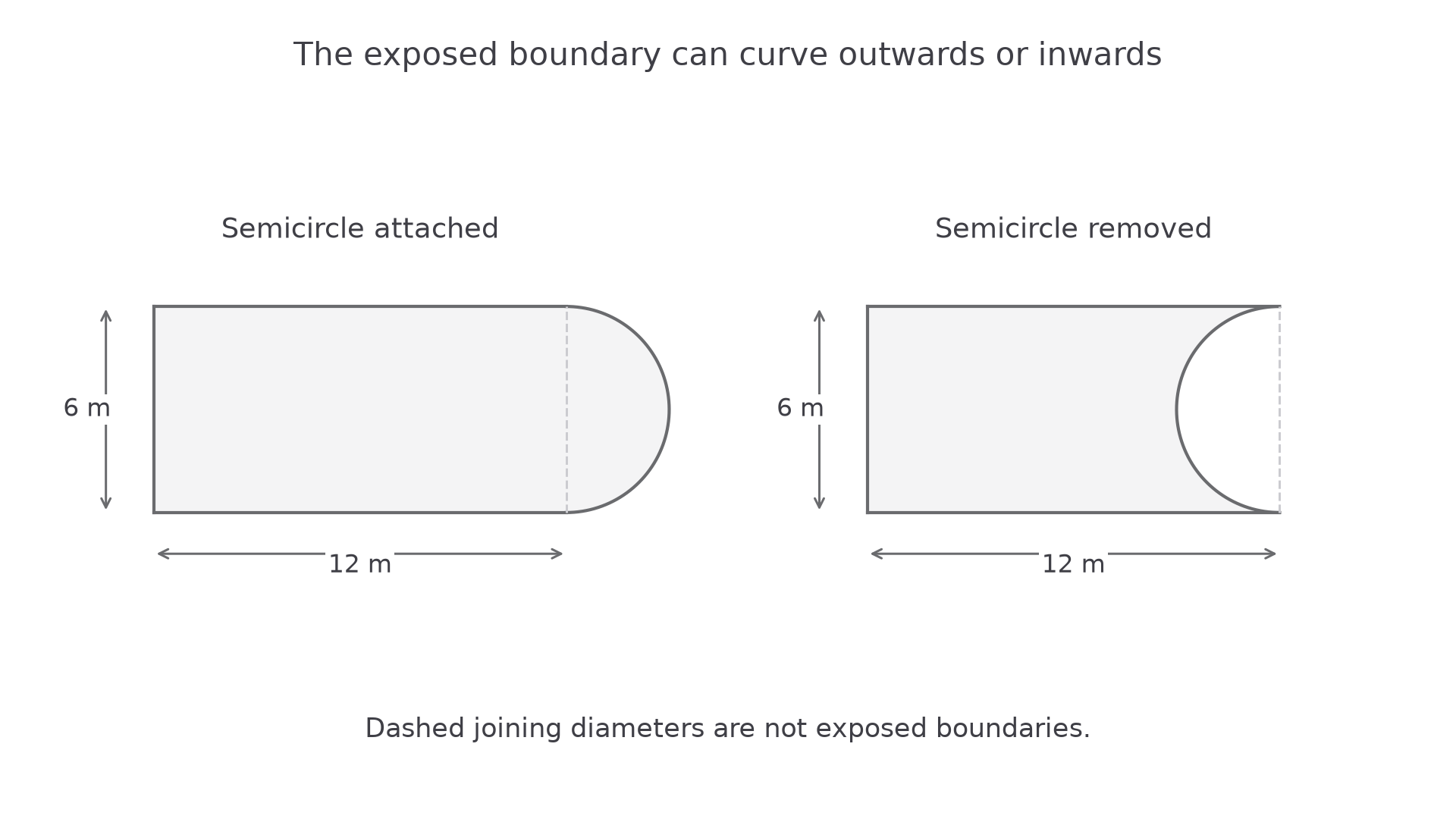
For a semicircle of radius , the curved part has length . The perimeter of a separate semicircle would also include its straight diameter. When it is joined to another region, decide whether that diameter remains exposed.
Problem-solving
Mark each exposed straight or curved piece once, find its length, then add. Work out any missing diameter before finding a curved length. Internal joining or construction lines contribute nothing to the perimeter.
We can now calculate the boundary of each garden.
Worked example 1: an attached semicircle
Question. A by rectangle has a semicircle attached externally along a complete end. Find its perimeter in terms of , and then correct to decimal place.
Plan. Add the three exposed rectangle sides and the semicircular arc.
Answer. , approximately .
Check. The original rectangle had perimeter . Replacing one side with an arc gives , the same result.
Change only whether the semicircle bulges out or cuts in. The exposed curved length stays the same.
Worked example 2: a semicircular cut-out
Question. A semicircle is cut from a complete end of a by rectangle. Find the remaining shape's perimeter in terms of , and then correct to decimal place.
Plan. Trace the remaining outline, including the inward curve.
Answer. , approximately .
Check. The inward arc has exactly the length of the outward arc in the first garden. The other three sides also match, so the perimeters must agree.
Surprisingly, cutting material away has increased the perimeter from , just as attaching the semicircle did. Area and perimeter need separate calculations. If a region contains an enclosed hole and a question asks for its total boundary length, include the hole's boundary too.
Watch out
Adding the complete rectangle perimeter to a semicircle's perimeter counts the shared diameter twice. Neither copy is exposed here. Trace the final outline rather than adding the original perimeters.
The next description supplies every dimension needed; you can trace the boundary mentally.
Splitting composite regions
To find area, cover the whole region with simpler shapes which do not overlap. Their areas add, even when the lines used to split them are not exposed boundaries.
For an L-shaped region, a line from the inward corner can split it into two rectangles. A sloping boundary may suggest a triangle or trapezium. A curved addition may be a semicircle or a sector. Choose pieces whose dimensions you know or can find by subtraction.
[DIAGRAM: asset_name: Two ways to split an L-shaped region; asset_slug: composite-l-shape-splits; caption: Both splits cover the same L-shape without gaps or overlap. Missing lengths come from subtraction.; description: Two copies of an L-shaped region formed from a ten-by-seven centimetre rectangle with a four-by-three centimetre upper-right corner removed. One copy is split vertically into a six-by-seven rectangle and a four-by-four rectangle. The other is split horizontally into a ten-by-four rectangle and a six-by-three rectangle. Overall and cut-out dimensions are labelled, with derived six and four lengths shown in dark text.]
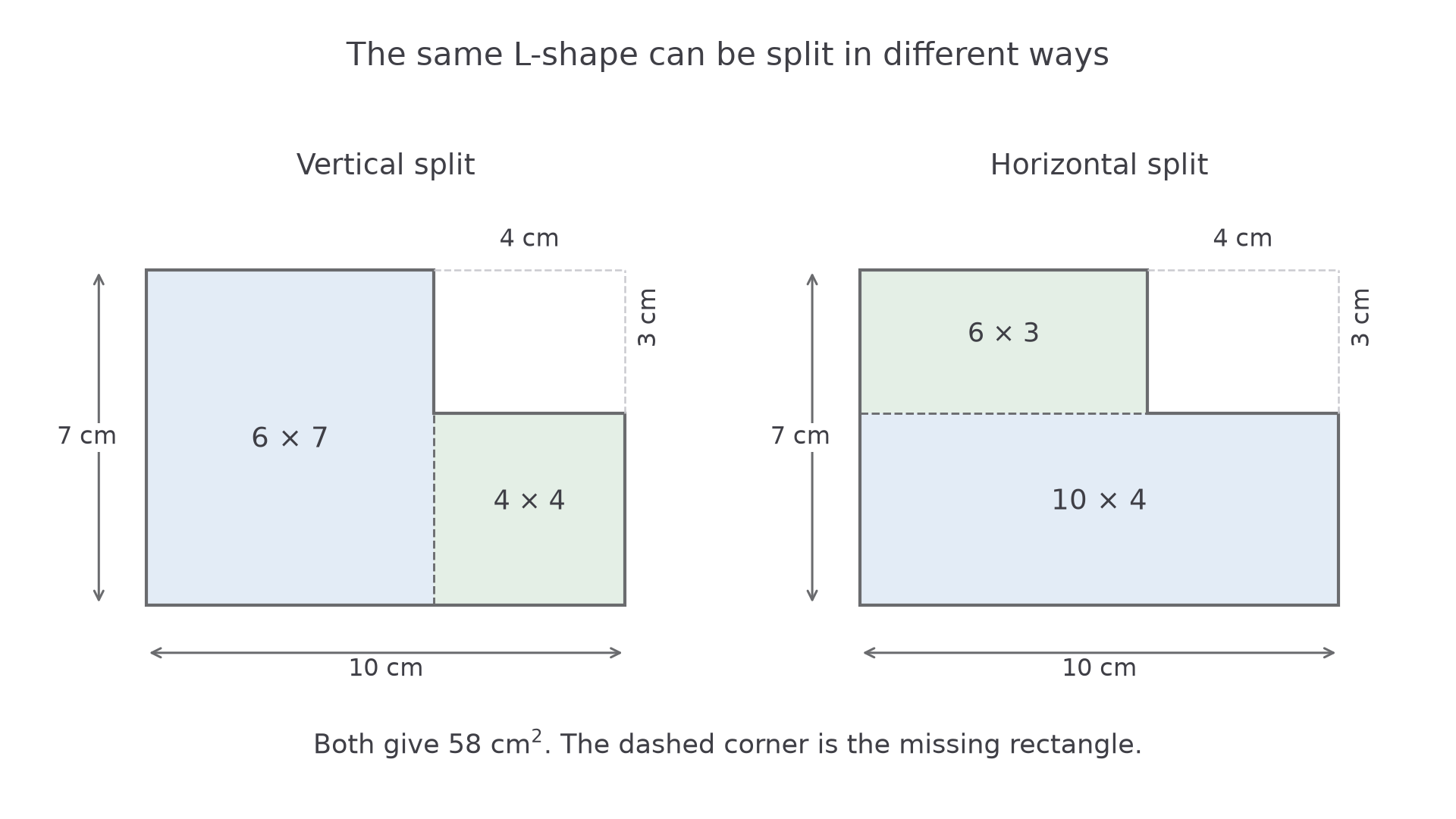
In this L-shape, the missing lengths are and . The vertical split gives . The horizontal split gives . Different valid splits agree because they cover exactly the same region.
You already know
A rectangle has area length times width. A triangle has area . A semicircle has half the area of its full circle. Convert lengths to one unit before using any of these rules.
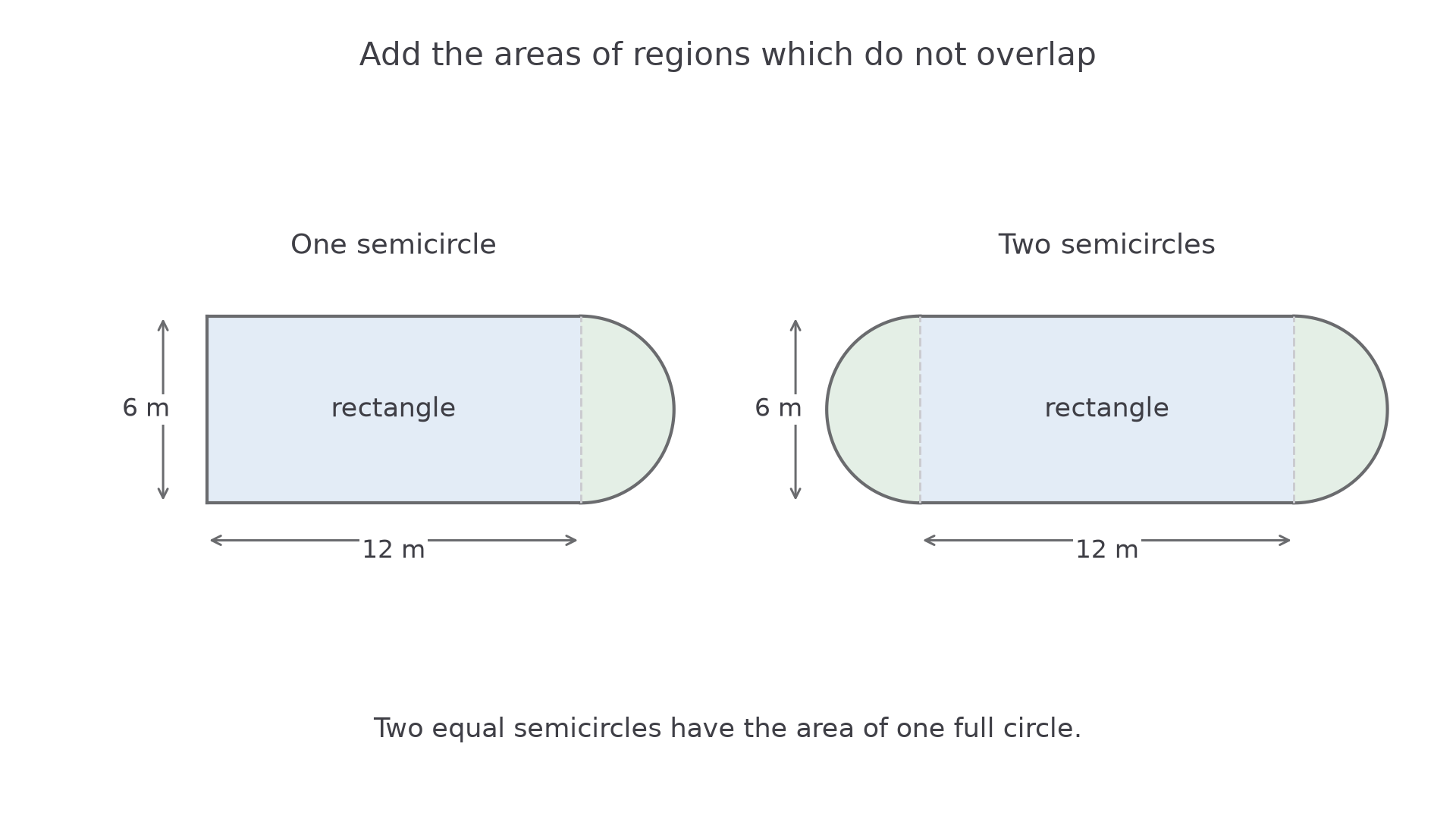
The garden's joining line is useful for area: it separates the rectangle from the semicircle without leaving gaps or creating overlap.
[DIAGRAM: asset_name: Adding non-overlapping component areas; asset_slug: composite-added-areas; caption: The dashed joins split each region into a rectangle and one or two semicircles. Add every component area once.; description: Two shapes use a twelve-by-six rectangle shaded pale blue. The first has one externally attached semicircle of diameter six on the right. The second has equal semicircles at both six-unit ends. The semicircles are shaded pale sage. Shared diameters are dashed, and rectangle dimensions are labelled in metres.]
Continue this lesson.
You’re previewing NovaLearn without an account. Create a free account to read the rest.
Create free account