8.02d - Loci and equidistance
Where could a lamp stand if it must be near one doorway and equally far from two walls? Turn distance conditions into circles, bisectors and shaded regions. Combine them carefully, including only the boundaries the wording allows.
Points at a fixed distance
A sprinkler can reach exactly from its centre. Where are the points just at the edge of its reach? There are infinitely many: turning the sprinkler through a full rotation traces a circle.
Locus
A locus is the set of all points satisfying a stated condition. Loci is the plural. A locus can be a line, a curve, several separate points or a region.
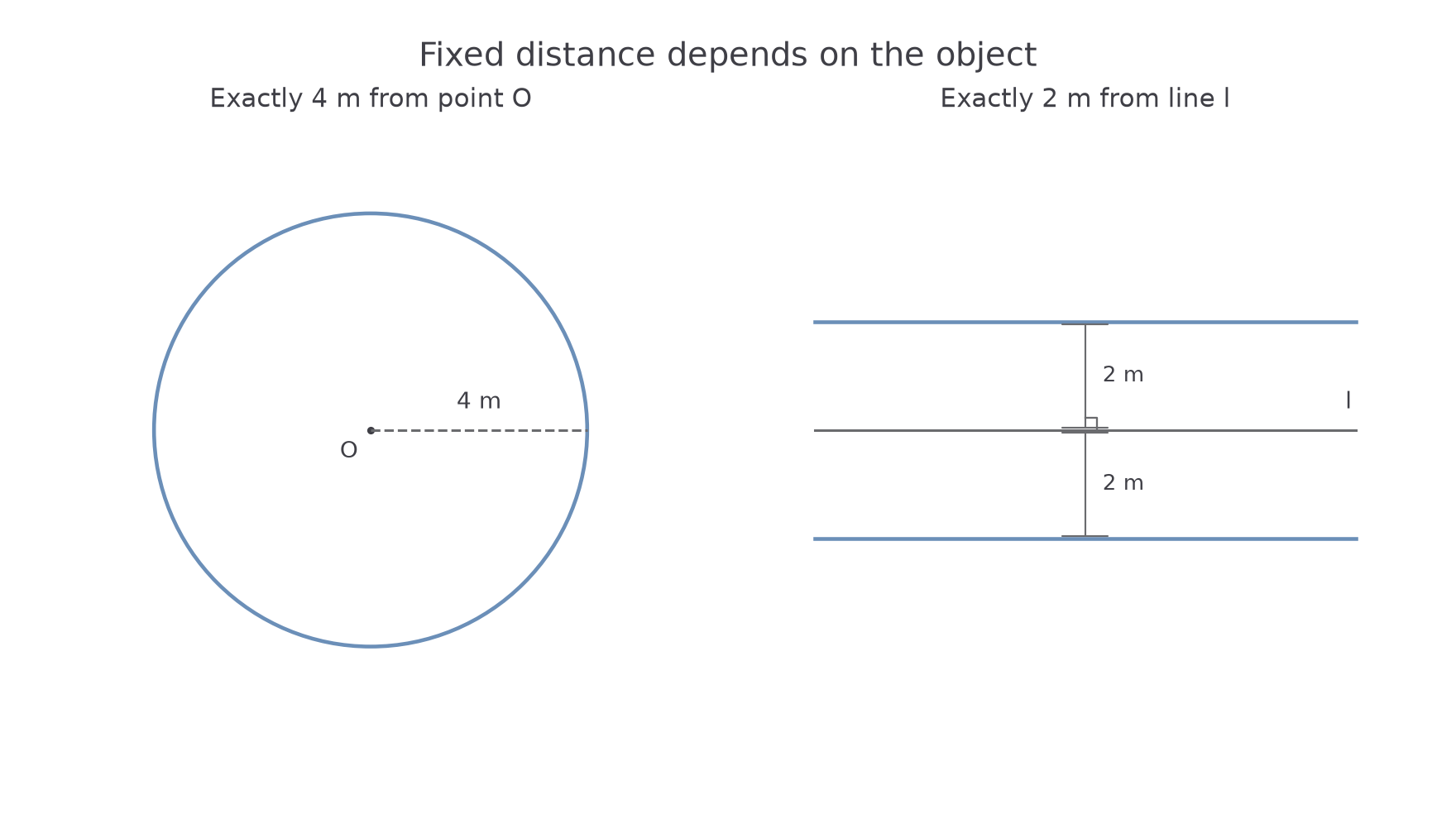
All points exactly from a fixed point form a circle with centre and radius , for . The distance is from the centre, not from the edge. At distance zero, the only point is itself.
“At most ” means inside and on the circle; “less than ” excludes the circle itself. “At least ” means outside and on it. Use a solid boundary when equality is allowed and a dashed boundary when it is excluded, stating the inclusion in words if needed.
For an infinitely long straight line, points exactly away form two parallel lines, one on each side, measured perpendicularly. At most away gives the strip between them, including its edges.
[DIAGRAM: asset_name: Fixed-distance loci; asset_slug: fixed-distance-loci; caption: Distance from a point gives a circle. Distance from an infinite line gives two parallel lines.; description: Left panel shows centre O and a circle of radius four metres, with a labelled radius. Right panel shows horizontal line l and two parallel lines two metres above and below it. Perpendicular distance markers show two metres on each side.]
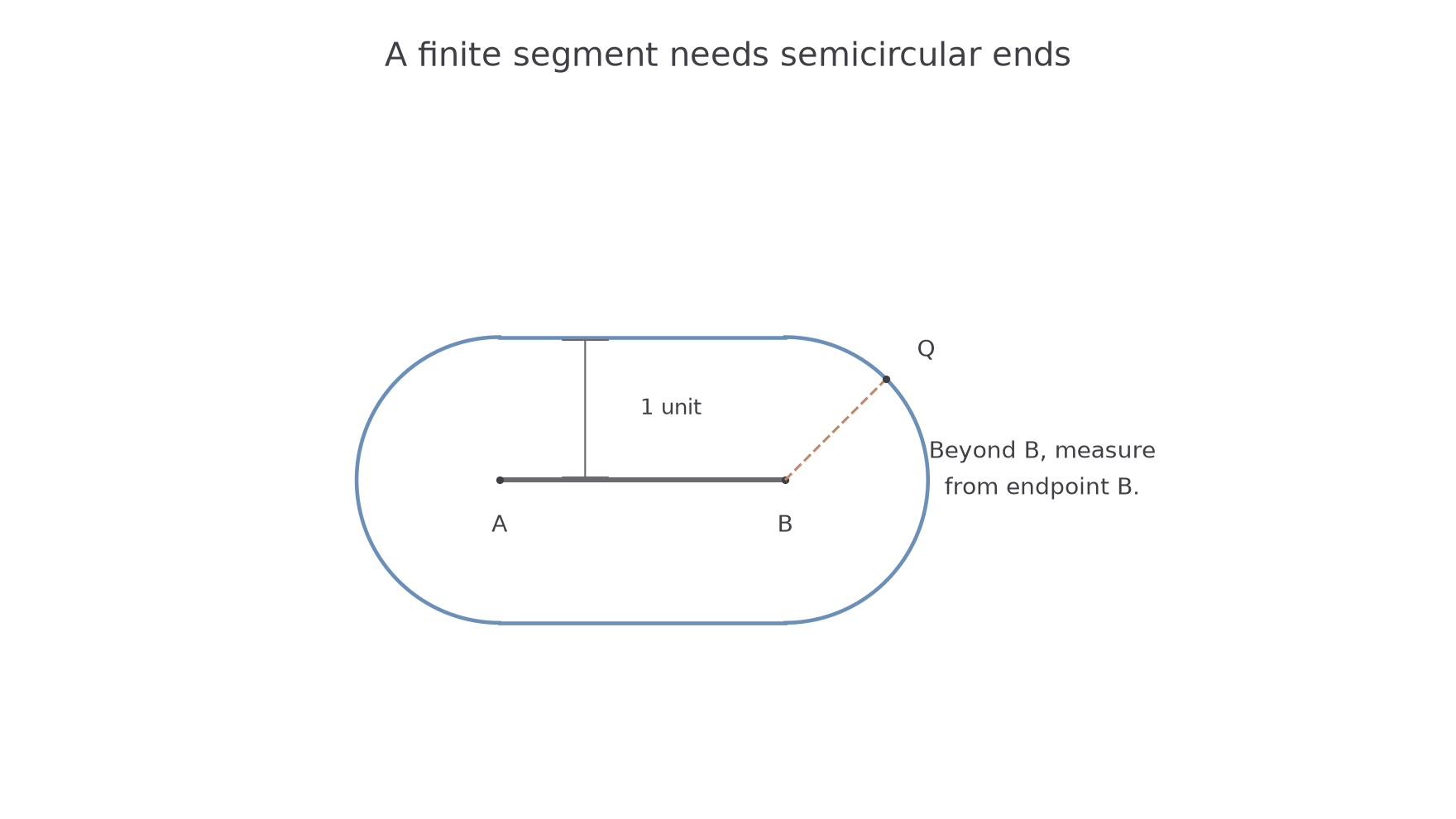
A finite segment is different. Directly alongside it, the fixed-distance locus has two parallel segments. Beyond each endpoint, the nearest point is that endpoint, so semicircular ends complete the boundary. The resulting rounded shape is often called a capsule.
[DIAGRAM: asset_name: Distance from a finite segment; asset_slug: segment-distance-locus; caption: A finite segment needs rounded ends: beyond A or B, distance is measured to the nearest endpoint.; description: Horizontal finite segment AB, two units long, lies inside a capsule boundary at distance one unit. Its straight parts are parallel to AB at perpendicular distance one. Semicircles of radius one centred at A and B form the outward ends. A labelled point beyond B has its nearest point at B.]
Worked example 1: an exact distance
Question. Describe and construct the locus exactly from a tree , using a plan where represents .
Plan. Convert the required radius, then draw a full circle.
Put the compass point at , open it to on the ruler, and draw the circle.
Answer. The circle centred at , radius on the plan. The inside is not part of this exact-distance locus.
Check. Any point on it is from . The centre is zero metres away, so cannot qualify.
Change only “exactly” to “at most”. The radius stays the same; the set of allowed points changes.
Worked example 2: a whole region
Question. Describe the region at most from on the same scale, to .
Plan. Use the same circle as a boundary, then include shorter distances.
Draw a solid circle centred at , radius , and shade its inside.
Answer. The closed circular region: inside and on the circle.
Check. A point away qualifies, one away qualifies, and one away does not.
Do not shade an interior when the question asks only for points at an exact distance.
Points equally distant from objects
“Equidistant” means equally far away; it does not prescribe one particular distance. A point can be equally far from two homes while being much further away than their midpoint.
Equidistant
A point is equidistant from two objects when its distances to those objects are equal. Distances to lines are measured perpendicularly.
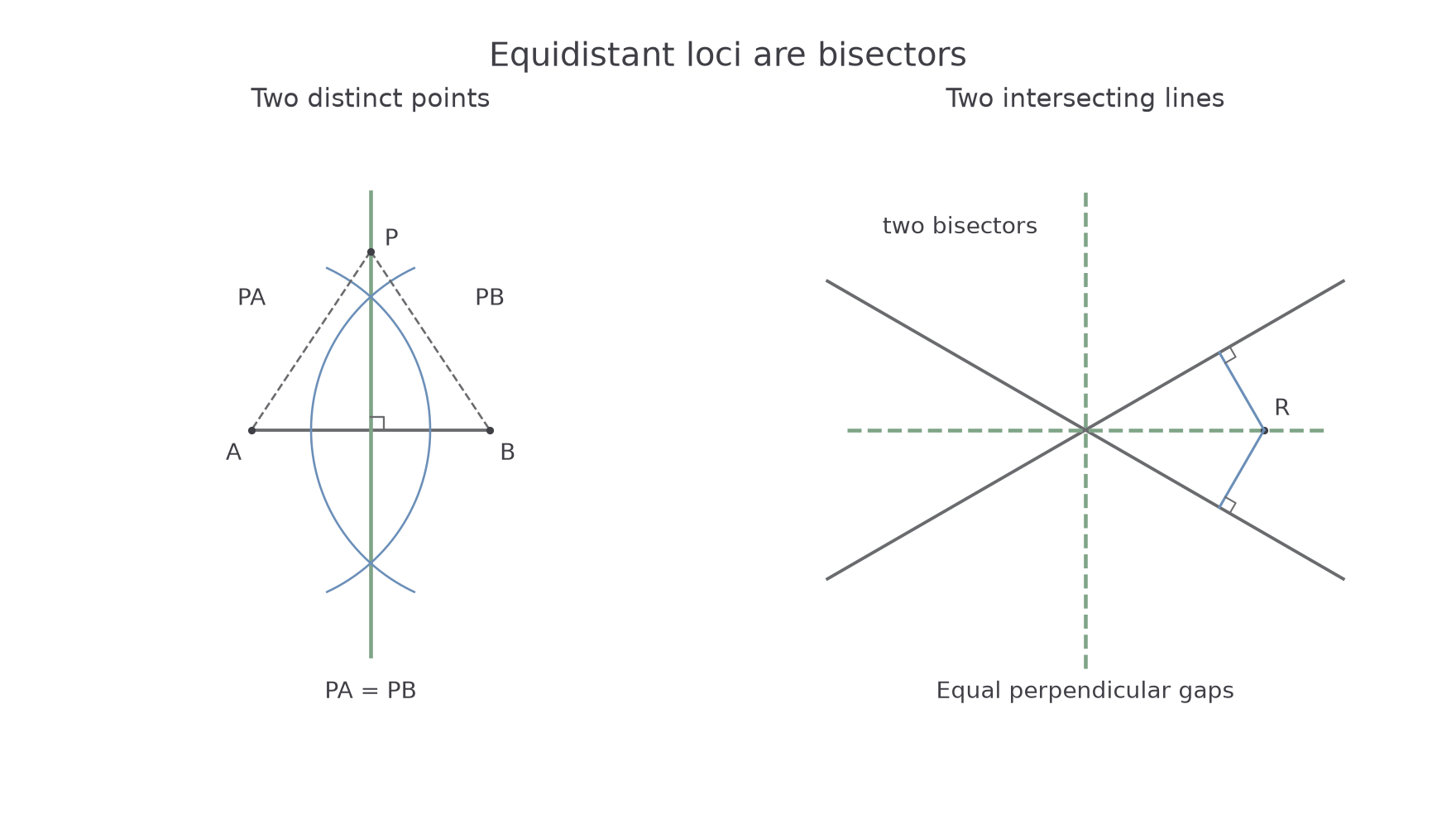
For two distinct points and , the complete equal-distance locus is their perpendicular bisector. The midpoint is just one point on it. Construct it with equal arcs on both sides and join the crossings, as in the previous lesson.
For two intersecting straight lines, there are two angle-bisector lines, one for each pair of opposite angles. Every point on either is equally far from the lines. If a problem restricts you to the inside of one chosen angle, use only the bisector ray inside that angle. For two distinct parallel lines, the equidistant locus is the parallel line halfway between them. Reflection in an angle bisector exchanges its two lines, which is why corresponding perpendicular gaps are equal. These statements concern whole lines; for finite wall segments, check that the perpendicular feet lie on the walls, or use the nearest endpoint.
[DIAGRAM: asset_name: Equidistant point and line loci; asset_slug: equidistant-bisectors; caption: Left: all points on the perpendicular bisector are equally far from A and B. Right: two intersecting lines have two equal-distance bisectors.; description: Left panel shows A and B separated horizontally, their vertical perpendicular bisector, equal dashed connections from a point P on it to A and B, and equal construction arcs. Right panel shows two intersecting lines, two perpendicular angle-bisector lines, and matching perpendicular gaps from a point on one bisector to the given lines.]
Continue this lesson.
You’re previewing NovaLearn without an account. Create a free account to read the rest.
Create free account