1.01a - Adding and subtracting integers
Can subtracting a number make your answer bigger? Learn to add and subtract positive and negative integers, using a number line to explain every sign.
Numbers on both sides of zero
Can be larger than ? Keep that question in mind: the two minus signs do different jobs, and understanding those jobs will unlock the calculation.
Start with something easier to picture. A temperature of is four degrees above zero; is four degrees below zero. The number without its sign tells you the distance from zero. The sign tells you which side of zero to use.
[DIAGRAM: asset_name: Signed integers on a number line; asset_slug: signed-number-line; caption: Numbers increase to the right; opposite integers are equally far from zero.; description: A horizontal number line from negative eight to positive eight. Negative four and positive four are marked, with equal four-unit distances from zero. A right-pointing arrow shows the direction of increasing value.]
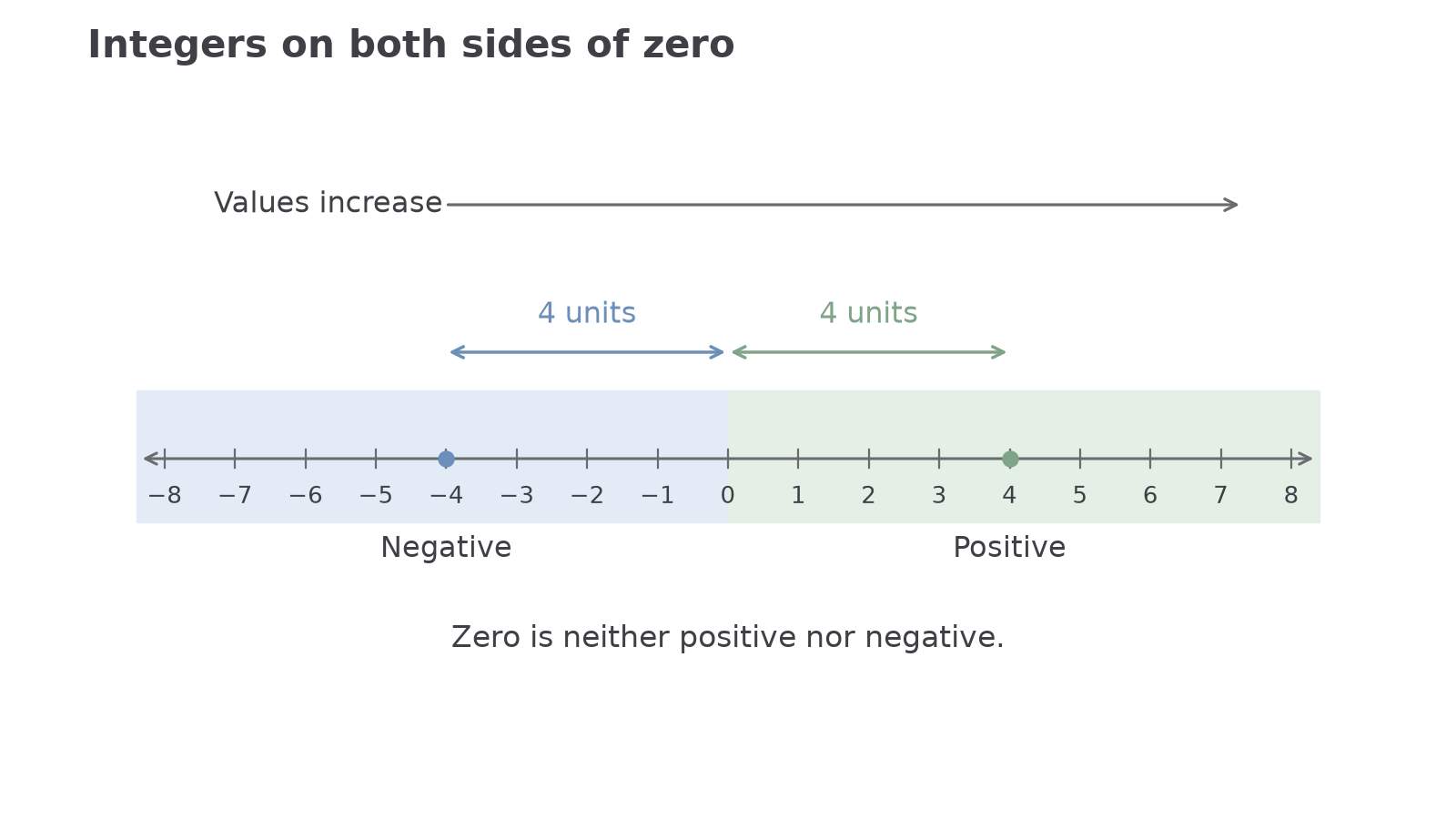
Integer
An integer is a whole number, its negative, or zero. For example, , and are integers. and are not integers.
On a number line, moving right increases the value; moving left decreases it. So is greater than : it is further right, even though its distance from zero is smaller. Zero is neither positive nor negative.
Two numbers the same distance from zero on opposite sides are opposites. The opposite of is , and the opposite of is . Zero is its own opposite. You can write a positive integer as , but usually we leave off the plus sign and write .
In , the minus sign is an instruction to subtract. In , it belongs to the number: negative three. Brackets make that distinction visible in a calculation such as .
Key idea
A minus sign can name a negative number or tell you to subtract. Read its job before deciding which way to move.
Use the number line to check this claim before choosing an answer.
Adding signed integers
Adding tells you to combine the starting value with a change: a positive change moves right, and a negative change moves left.
For example, starting at and adding means moving five units right: three units reach zero and the remaining two reach . Starting at and adding means moving five units left, to . The second number decides the direction; the starting number does not.
Sum
The sum of two numbers is the result of adding them. Adding a positive integer increases the starting value; adding a negative integer decreases it. Adding zero leaves it unchanged.
You do not have to draw every small step. When a move crosses zero, split it into the distance to zero and the distance left to travel.
Worked example 1: crossing zero
Question. Work out .
Plan. Start at , move right, and split the eight-unit move at zero.
Answer. .
Check. The positive amount is larger. The difference between the distances from zero is , so the answer should be positive three.
Now change only the sign of the number being added. The starting point and size of the move stay the same; the direction reverses.
Worked example 2: moving further below zero
Question. Work out .
Plan. Start five units left of zero and move another eight units left.
Answer. .
Check. Moving eight units right from returns to . That reverses the change we made.
The signs explain the answer more reliably than a slogan about “two minuses”.
Watch out
The line is wrong. Both numbers are negative, so their sum lies further left of zero: . Two negative numbers do not make a positive sum.
Try the same move with a different negative amount.
Subtracting a positive integer
Subtracting a positive integer moves you left, and the number line continues past zero.
You already know . The same four-unit move works from any starting point: , because two units reach zero and two more reach . There is no stopping rule at zero.
The difference is the result of subtraction. The order matters: and have different answers. If a question asks how far apart two values are, the distance is non-negative; first decide which subtraction represents that distance.
Worked example 3: subtracting past zero
Question. Work out .
Plan. Move nine units left from , using zero as a stopping point on the way.
Answer. .
Check. Adding back the amount subtracted gives , the original value.
Change only the sign of the starting number. Subtracting nine still moves left.
Worked example 4: starting below zero
Question. Work out .
Plan. Start seven units left of zero and move another nine units left.
Answer. .
Check. . Adding back nine restores the starting value.
An answer can be negative even when the number being subtracted is positive.
Watch out
The line gives the distance between the numbers, but not this subtraction. From , moving nine units left ends at , so .
Reverse your move to check the next calculation.
Subtracting a negative integer
Subtracting reverses addition, so subtracting a negative change reverses a move to the left.
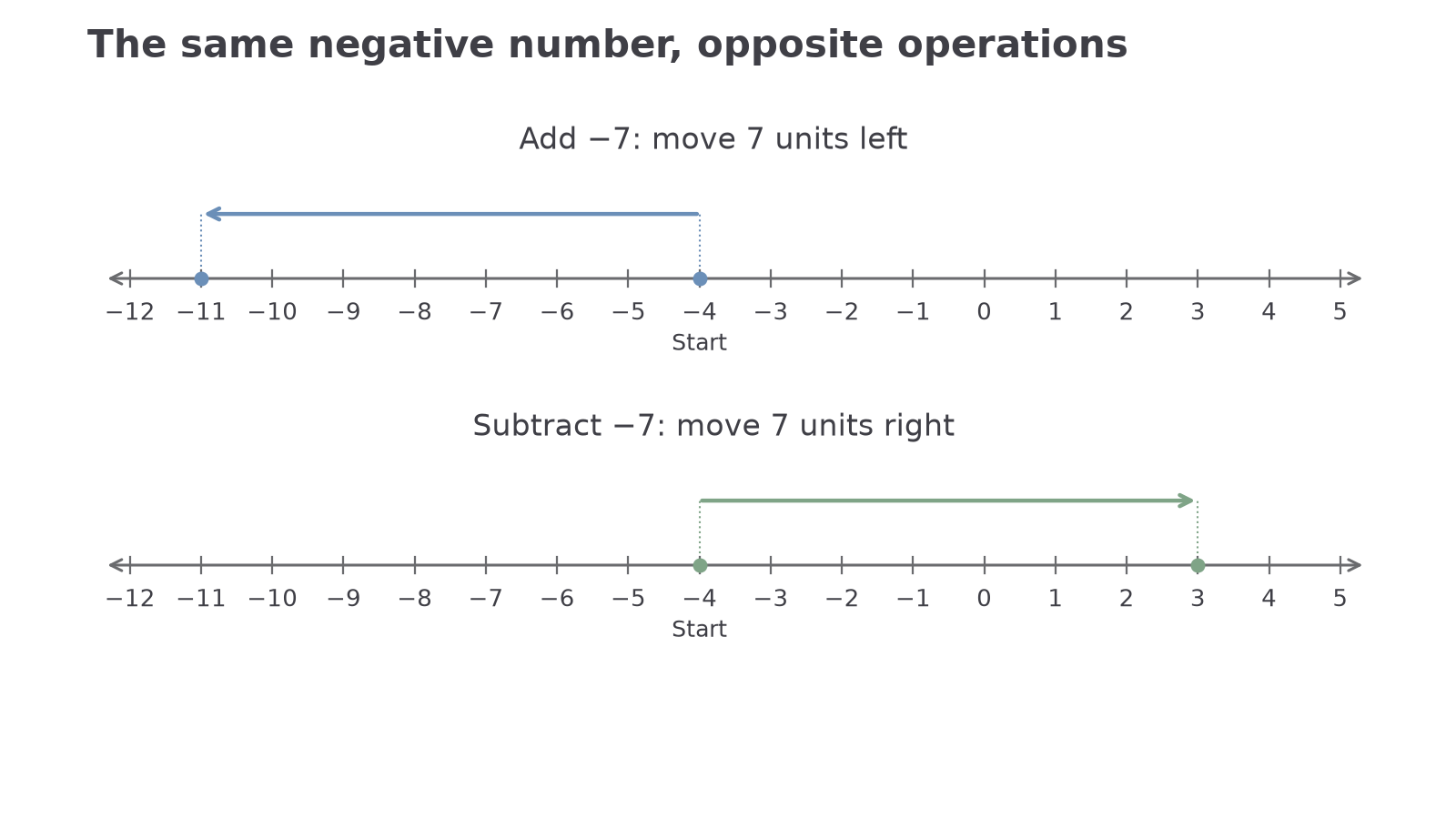
Adding moves seven units left. Undoing that addition must move seven units right. That is why subtracting has the same effect as adding . This is about the operation and the sign together, not about any two minus signs appearing somewhere in a calculation.
[DIAGRAM: asset_name: Adding and subtracting a negative number; asset_slug: subtracting-negative; caption: Adding negative seven moves left; subtracting negative seven reverses that move.; description: Two aligned horizontal number lines. On the upper line an arrow goes from negative four to negative eleven, labelled add negative seven. On the lower line an arrow goes from negative four to positive three, labelled subtract negative seven. Each arrow has length seven units.]
Key idea
To subtract an integer, add its opposite. For example, , while . Subtracting zero leaves the number unchanged.
We can now answer the opening question by reading both minus signs carefully.
Worked example 5: subtraction makes the answer bigger
Question. Work out .
Plan. Replace subtraction of negative seven with addition of its opposite.
Answer. .
Check. Add back the number subtracted: . We recover the starting value, so the subtraction is consistent.
Subtracting a negative always increases the starting value, but it need not make the answer positive. Change only the size of the number subtracted to see why.
Worked example 6: a larger answer can still be negative
Question. Work out .
Plan. Add the opposite of negative two, then move right from .
Answer. .
Check. . Adding back the number subtracted restores the original value. Also, is greater than , although both are negative.
The surprise is now explained: subtraction can make a number larger, because the number subtracted can be negative. Later, this same idea will help you rearrange equations without losing a sign.
Watch out
Do not replace with . That changes the number being subtracted from negative two to positive two. Keep the brackets until you have written the equivalent addition: .
Use the inverse check as well as the sign rule.
Quick Recap
- Integers include negative whole numbers, zero and positive whole numbers. Zero is neither positive nor negative.
- Adding a positive integer moves right; adding a negative integer moves left.
- To subtract an integer, add its opposite. Subtraction order matters.
- Check a subtraction by adding back the number you subtracted.
Yes, subtraction can make an answer bigger: , because subtracting negative seven moves seven units right.