3.03a, 3.03b - Exact answers with surds
An exact root can be more useful than a rounded decimal. In 3.03a you will keep surds in exact calculations; in 3.03b you will extract square factors, collect related surds and multiply numerical surd expressions.
Roots that do not terminate
Can two different expressions containing irrational roots multiply to give a whole number? Keep that question in mind while we learn how exact roots behave.
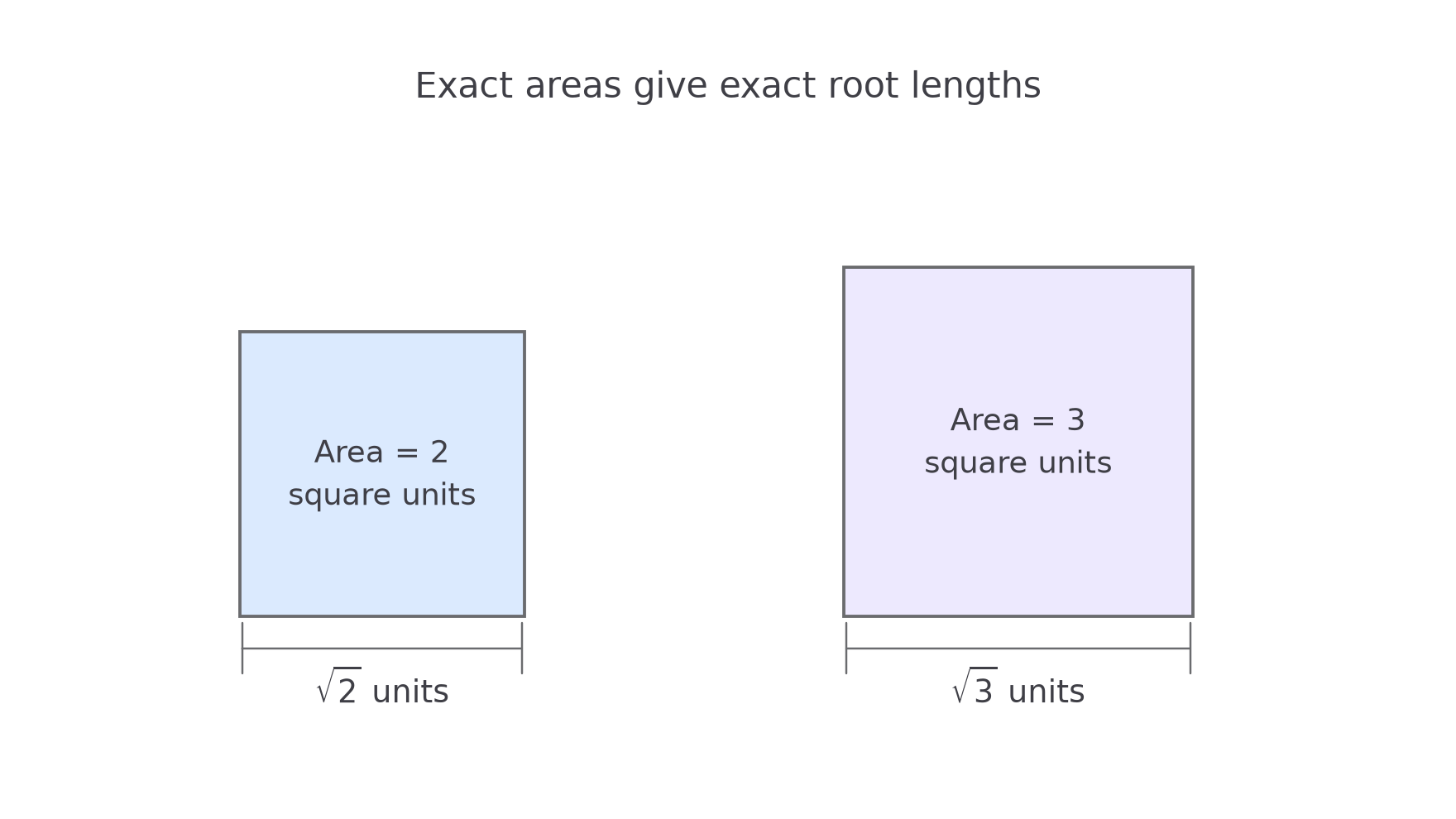
A square with area square units has a side whose square is . Its exact side length is units. A calculator may show , but that finite decimal is an approximation: squaring it does not give exactly .
[DIAGRAM: asset_name: Exact side lengths from square areas; asset_slug: exact-square-sides; caption: The side of a square with area 2 is exactly the square root of 2, while area 3 gives the square root of 3.; description: Two squares drawn to the same scale. The smaller has area 2 square units and side label square root of 2 units. The larger has area 3 square units and side label square root of 3 units.]
Surd
A surd is an irrational root retained in exact root notation, such as or . An irrational number cannot be written as a ratio of integers; its decimal expansion neither terminates nor repeats. is not a surd. Neither is , even though its decimal repeats forever.
For a positive integer that is not a perfect square, its square root is irrational. The root sign names its exact value without writing an infinite decimal. Equivalent exact forms can exist; surd notation is a convenient one, not the only possible description. A terminating decimal can itself be exact, as in .
Worked example 1: an exact square perimeter
Question. A square has area . Find its side length and perimeter exactly.
Plan. Take the non-negative square root for the side, then multiply by four.
Answer. Side ; perimeter .
Check. , restoring the area. Also , so in centimetres, consistent with the perimeter.
Change only the square's area. The method stays exact even though its decimal values change.
Worked example 2: a different irrational root
Question. A square has area . Find its side length and perimeter exactly.
Plan. Take the square root of the new area, then use four equal sides.
Answer. Side ; perimeter .
Check. The side squared is . Since , the perimeter lies between and centimetres, consistent with .
The principal real square root is non-negative, including . A negative input has no real square root. A length also cannot be negative, so no extra minus sign belongs in either side length above.
Watch out
If an exact answer is requested, is not a replacement for . It can check the size, but it is a rounded approximation.
Keep the root intact as you calculate the perimeter.
Extracting square factors
A square factor inside a square root can be replaced by an integer factor outside it.
For instance, . Why does this work? The non-negative number has square , so it is the principal square root of .
Square-root product law
For real and ,
Both sides are non-negative and square to . These conditions guarantee the real-number rule, including zero.
Not in the 2027 formula sheet: learn it.
Look for the largest perfect-square factor you can recognise. Prime factors help: every pair of equal prime factors contributes one copy outside the root. A smaller square factor is also valid, but may leave more simplification to do.
Worked example 3: extracting a square factor
Question. Simplify .
Plan. Split into a square factor times a remaining factor with no square factor greater than one.
Answer. .
Check. , and is non-negative, so it is the correct root.
Change only the number under the root. The remaining surd stays , but the square factor changes.
Worked example 4: a larger square factor
Question. Simplify .
Plan. Extract the square factor .
Answer. .
Check. . Also , consistent with .
For a numerical square inside a root, the sign after rooting is non-negative: , not . More generally , where is the non-negative distance of from zero.
Watch out
. The square factor must itself be rooted: , giving .
Check both the square and the sign of your simplified answer.
Adding and multiplying surds
Collect identical surds like identical units, but multiply their values using the root laws.
After simplifying, . This is five lots of . By contrast, has no matching root terms to collect; leave it as a sum. In particular, it is not : squaring the sum gives , which exceeds .
For products, multiply the coefficients and the roots:
For a quotient, is valid for and . For example, . The denominator condition avoids division by zero.
To multiply numerical brackets, multiply each term in the first bracket by each term in the second, then collect like terms. Keep roots exact throughout.
Worked example 5: the cross terms add
Question. Work out exactly.
Plan. Form all four products and collect the identical surds.
Answer. .
Check. Since , the original product lies between and . The answer is about , within this interval.
Change only the sign of the root in the second bracket. The middle products now cancel rather than add.
Worked example 6: the cross terms cancel
Question. Work out exactly.
Plan. Make the same four products and keep the signs visible.
Answer. . Two different expressions containing irrational roots have produced a whole number.
Check. Working backwards, , matching the two square contributions. A decimal check, , agrees.
Expressions such as and are a conjugate pair: the root term has opposite signs. Here their product is rational because the cross terms cancel and the remaining numbers and are rational. Such a product need not be positive: . This cancellation will be useful when you later simplify denominators containing surds.
Watch out
. Squaring the whole bracket includes two cross products, giving . Cancellation occurs in the opposite-sign pair above, not in the repeated positive bracket.
Use the sign change to look for cancellation.
Quick Recap
- Surds retain irrational roots exactly; a rounded finite decimal loses exactness.
- Extract square factors using the product law for non-negative real inputs.
- Simplify before collecting identical surds; multiply roots with the correct domain conditions.
- Opposite-sign numerical brackets can cancel their surd cross terms.
Yes, the opening surprise is possible: .