8.02a–8.02c - Ruler and compass constructions
How can you find an exact middle without measuring the length? Use equal compass radii to construct perpendicular bisectors (8.02a), angle bisectors (8.02b) and perpendicular lines (8.02c). Understand why the perpendicular gives the shortest distance to a line.
Bisecting a line segment
Two homes need a meeting point halfway between them. Can you locate it without reading a ruler scale? Compasses can copy distances accurately, so equal distances can do the measuring for you.
A construction uses a straight edge to join points and compasses to copy lengths or draw arcs. When a question says “ruler and compasses only”, do not use a protractor or estimate the midpoint by measuring. Draw lightly, keep the compass opening fixed when instructed, and leave the arcs visible.
Perpendicular bisector
The perpendicular bisector of a segment passes through its midpoint at a right angle. Every point on this line is equally distant from the two endpoints.
For a segment , open the compasses to more than half its length. Draw arcs above and below the segment, first centred at , then at , using the same radius. The arcs must cross at two distinct points and . Join to ; its intersection with is the midpoint.
[DIAGRAM: asset_name: Constructing a perpendicular bisector; asset_slug: segment-bisector-arcs; caption: Equal-radius arcs from A and B meet at C and D. Their joining line crosses AB at its midpoint M.; description: Segment AB has endpoints at minus three zero and three zero. Compass arcs of radius four from A and B cross above and below at C and D. The line CD is perpendicular to AB at midpoint M. Dashed radii AC and BC show equal lengths and a right-angle marker appears at M.]
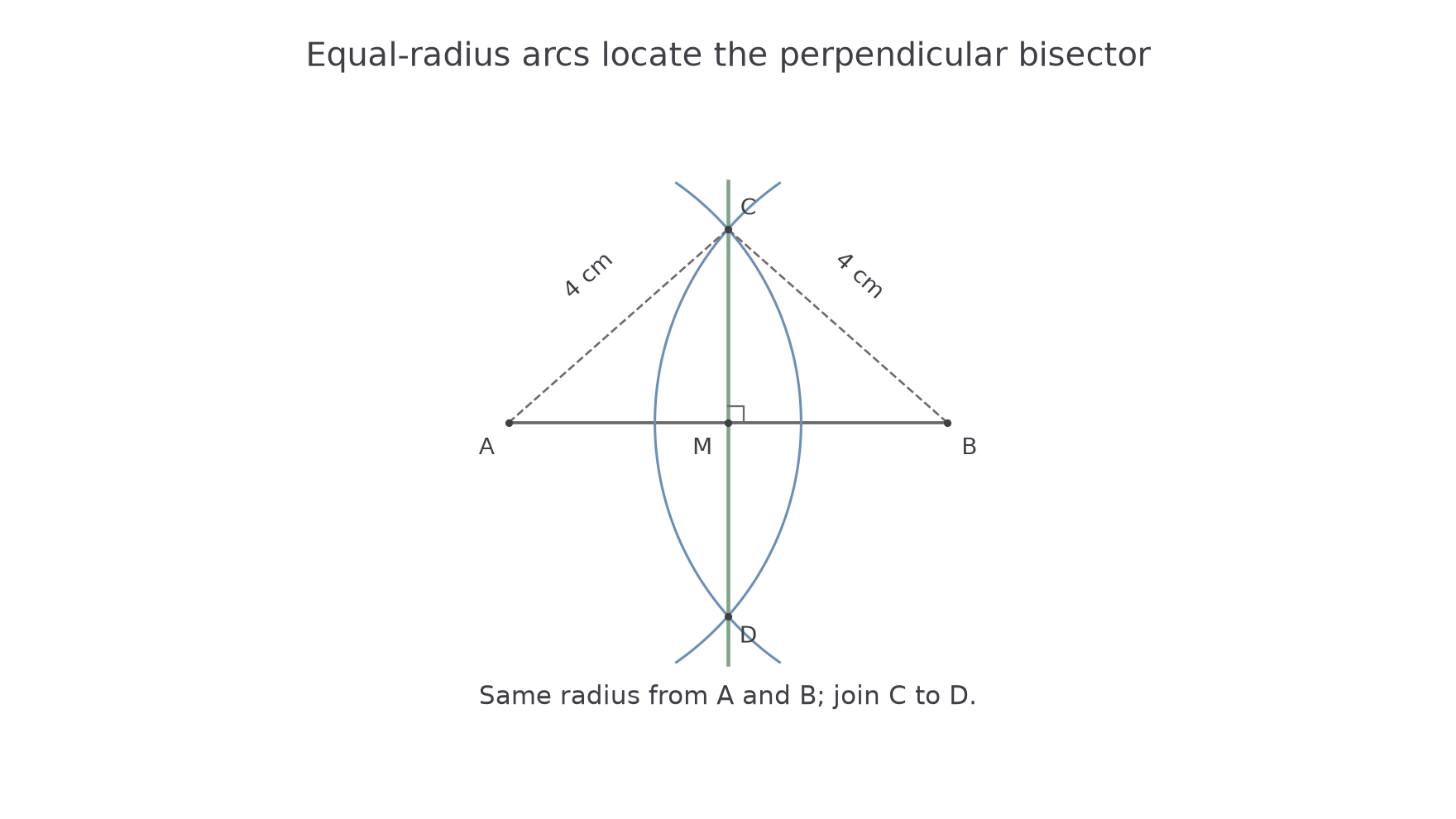
Why does it work? and , because each pair comes from equal compass radii. Triangles and match by SSS, using their shared side , so their angles at are equal. Then triangles and match by SAS: , is shared, and the included angles are equal. Thus and the two equal angles at total , so each is . You locate a right angle without measuring one.
Worked example 1: a horizontal segment
Question. A horizontal segment is long. Describe how to construct its midpoint using a compass radius of .
Plan. Find two points equally distant from the endpoints, then join them.
Draw those arcs from and , keeping the radius fixed. Rule , and label its intersection with as .
Answer. is the midpoint and is the perpendicular bisector. Leave all four crossing arcs visible.
Check. Measuring afterwards should give . Measurement checks the construction; it did not locate .
Change only the direction of the segment. “Above and below” now means on its two sides; the method does not depend on a horizontal page.
Worked example 2: a sloping segment
Question. Segment slopes upwards and is long. Describe a ruler-and-compass construction of its perpendicular bisector with radius .
Plan. Use equal-radius arcs on both sides of the sloping segment.
Keep the compass opening unchanged while drawing arcs from and . Rule through the two crossings.
Answer. Line , with its construction arcs, is the required perpendicular bisector.
Check. Fold mentally along : and exchange places. A vertical line on the page would generally fail this check for a sloping segment.
If the radius equals half the segment length, the arcs touch at only one point. If it is smaller, they do not meet. Neither gives the two crossings needed to rule the line reliably.
Bisecting an angle
To divide an angle fairly, copy distances on its two arms before drawing its middle ray.
Angle bisector
An angle bisector divides a chosen angle into two equal angles. The construction below finds the bisector inside an angle between and .
Put the compass point at the vertex . Draw an arc crossing the two arms at and , so . Next draw equal-radius arcs centred at and that cross at inside the angle, away from . Rule the ray .
[DIAGRAM: asset_name: Constructing an angle bisector; asset_slug: angle-bisector-arcs; caption: The first arc makes OA equal OB. Equal arcs from A and B locate C inside the angle.; description: Two rays from O make an angle of sixty degrees. An arc of radius three centred on O meets the arms at A and B. Equal arcs from A and B intersect at C inside the angle. The ray OC bisects the angle. Dashed AC and BC radii and matching angle arcs show the equalities.]
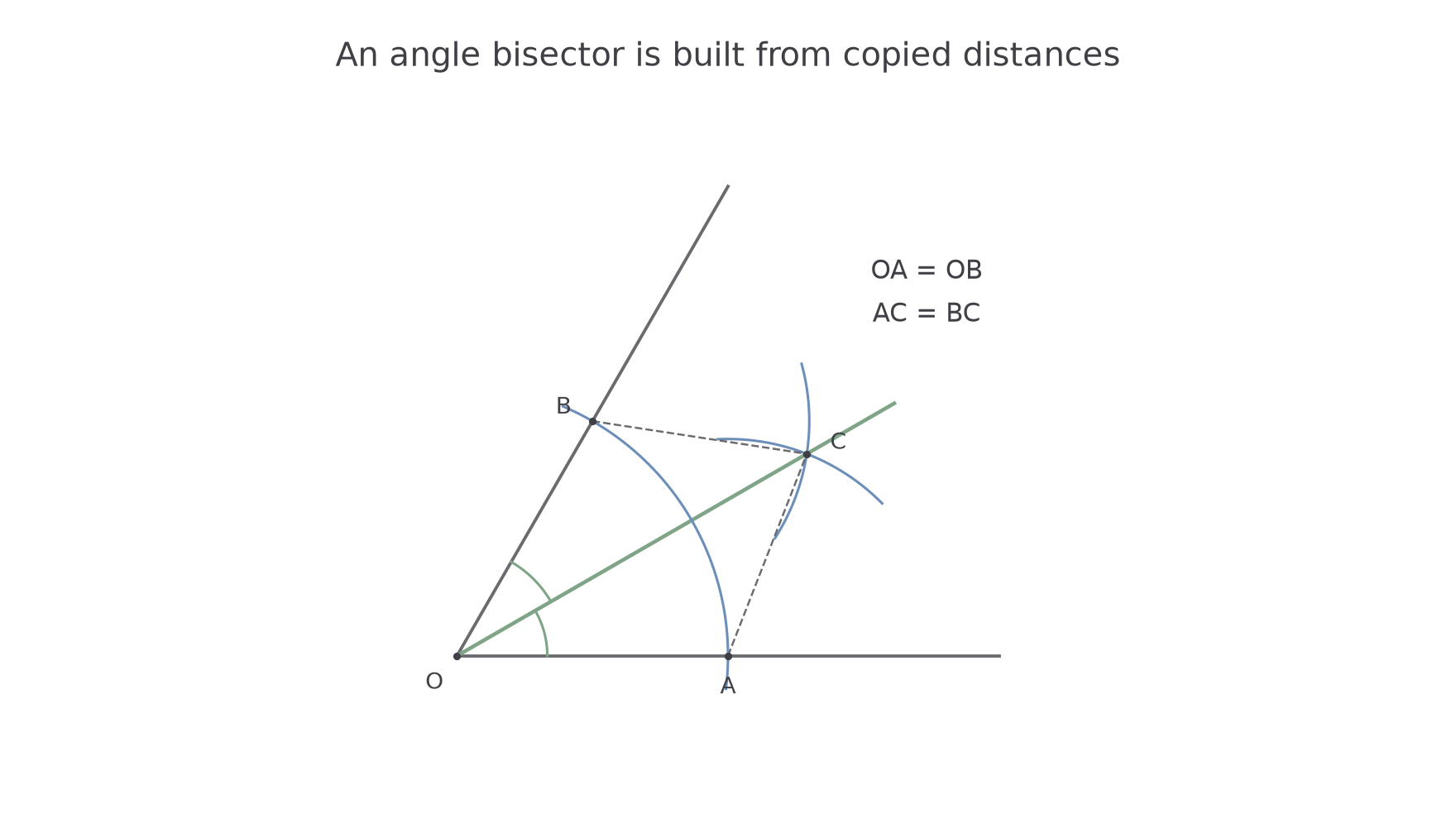
The second compass radius need not equal the first. It must be the same for the arcs from and , large enough to cross in a useful position. Triangles and match by SSS: two copied pairs of lengths and the shared side . Their angles at are equal.
Worked example 3: bisecting an acute angle
Question. Describe how to bisect an angle of using ruler and compasses. State each resulting angle.
Plan. Copy equal distances along the arms, then locate an equal-distance crossing inside.
Draw an arc from the vertex to mark and on the arms. With one fixed new radius, draw arcs from and crossing at inside. Rule the ray from the vertex through .
Answer. The ray through bisects the angle; each half is .
Check. . The two arms should be mirror images in the new ray.
Now change only the angle from acute to obtuse. Choosing the crossing inside the given angle still matters.
Worked example 4: bisecting an obtuse angle
Question. Describe how to bisect an angle of using ruler and compasses. State each resulting angle.
Plan. Repeat the equal-distance construction inside the wider angle.
Mark and with an arc centred at the vertex. Draw equal-radius arcs from and to meet inside at . Join the vertex to , keeping the arcs.
Answer. The constructed ray gives two angles of .
Check. Two angles total , and both lie within the original angle.
A line that only looks central is not a ruler-and-compass construction. The arc crossings explain why it is central.
Continue this lesson.
You’re previewing NovaLearn without an account. Create a free account to read the rest.
Create free account