2.03c, 5.03a - Interest and repeated percentage change
Distinguish interest calculated from the original investment from interest calculated on a growing balance. Use one percentage multiplier for each period, including changing rates and depreciation, and reverse the changes to recover an original amount.
Simple interest
If £800 earns 5% interest each year, does the second year add another £40? With simple interest, yes. With compound interest, the answer changes because the first year's interest becomes part of the balance. We will compare both by the end of the lesson.
The principal is the original amount invested or borrowed. Simple interest is calculated from that same principal in every period. For £500 at 3% simple interest per year, each year's interest is £15, even after earlier interest has been added. After four years the total interest is , so the total value is £560.
Simple interest
Here is the principal, is the percentage rate per period, is the number of periods and is total interest. is the final amount. Use matching time units, for example an annual rate with time in years. The simple-interest formula is not supplied on the 2027 formula sheets.
For whole years, this is repeated addition of the same yearly interest. If a question specifies that simple interest accrues proportionally through part of a year, the time may also be a fraction of a year. Follow the stated agreement rather than assuming when interest is paid.
Worked example 1: finding a final amount
Question. £1500 is invested at 4% per year simple interest for 3 years. Find the total value of the investment.
Plan. Calculate one year's interest, multiply by the years, then add the principal.
Answer. £1680.
Check. Three lots of 4% make 12% of the original principal. .
Keep the rate and duration, but change the unknown from the final amount to the principal. The final amount is 112% of the principal, not 100%.
Worked example 2: recovering the principal
Question. After 3 years at 4% per year simple interest, an investment has a total value of £2016. Find the original investment.
Plan. Express the final value as a multiplier of the principal, then divide.
Answer. £1800.
Check. Each year's interest is . Three years add £216, giving .
The same relationship can find an unknown rate or time. First subtract the principal to get ; then undo the known factors in . For example, £900 earning £135 simple interest over five years has rate
so the rate is 3% per year. At that rate, earning £81 interest instead would take years. Dividing by the total balance would use the wrong base.
Watch out
“Interest earned” and “total value” are different. In the first example the interest is £180, while the total is £1680. Read which one the question asks for before stopping.
Recover an original investment from a new total.
Repeated percentage multipliers
Compound change uses the amount at the start of each new period, so the base of the percentage changes.
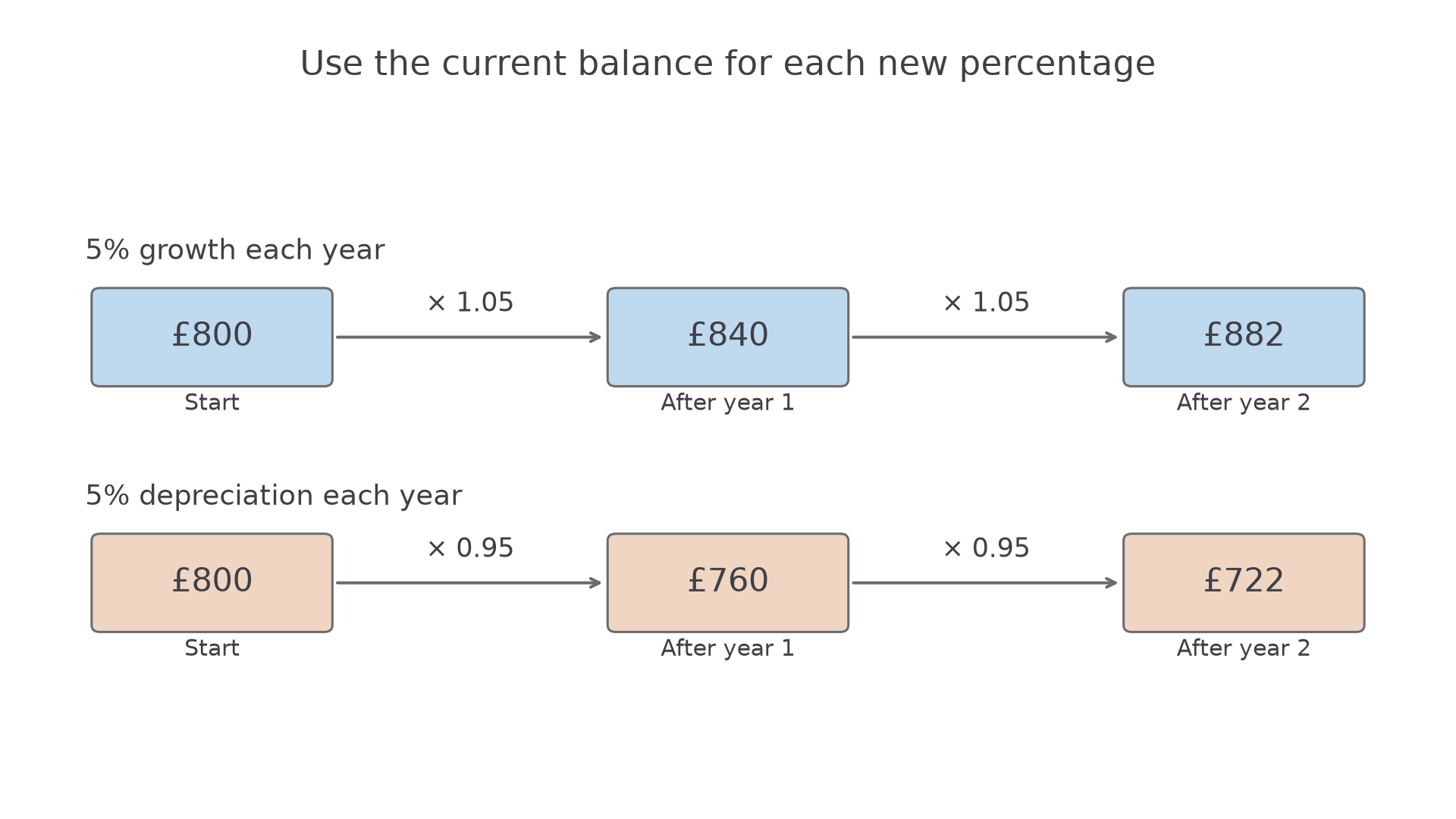
For the opening £800 investment at 5%, the first year adds £40 and gives £840. In the second year, 5% of £840 is £42, so the balance becomes £882. The percentage rate stayed the same; the amount of interest increased.
Compound interest and depreciation
Compound interest is interest calculated on the current balance, including interest already added. Depreciation is a decrease in value; percentage depreciation is calculated from the current value each period when stated that way.
Increase by 5% means multiply by 1.05. Decrease by 5% means multiply by 0.95. Repeat that multiplier once for each stated interval. Two years of 5% growth are two multiplications by 1.05, not a single increase of 10%.
[DIAGRAM: asset_name: Two periods of compound change; asset_slug: compound-change-timeline; caption: Each year's percentage applies to the balance reached at the end of the previous year.; description: Two horizontal timelines starting at eight hundred pounds. The upper growth timeline multiplies by one point zero five to reach eight hundred and forty pounds, then again to reach eight hundred and eighty-two pounds. The lower depreciation timeline multiplies by zero point nine five to reach seven hundred and sixty pounds, then again to reach seven hundred and twenty-two pounds. Each arrow is labelled with its multiplier.]
Continue this lesson.
You’re previewing NovaLearn without an account. Create a free account to read the rest.
Create free account