10.04b, 10.04c - Cones, spheres and pyramids
Why does joining two solids remove some of their surface area? Use the supplied cone and sphere formulae in 10.04b, build pyramid calculations in 10.04c, and distinguish the space inside a composite solid from the surfaces you can actually touch.
Cones and spheres
A cone is joined to the top of a cylinder like a pointed roof. Can we simply add their volumes and their surface areas? We will return to this after learning how to measure the curved pieces.
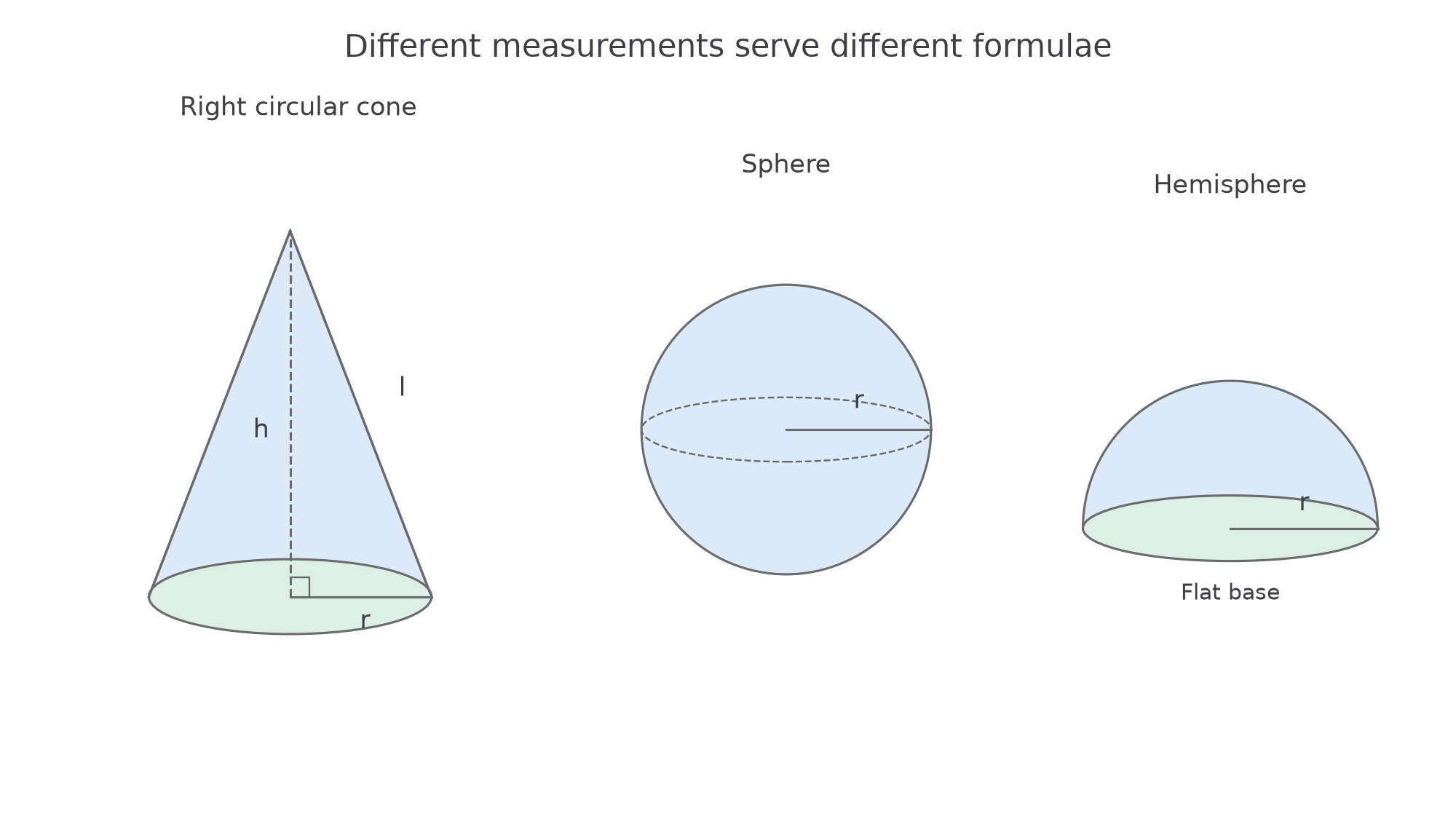
A cone's perpendicular height runs at right angles from its apex to its base plane. Its slant height runs along its curved surface from the apex to the circular rim. For a right circular cone, the apex is directly above the base centre. The slant height is longer than the perpendicular height.
[DIAGRAM: asset_name: Cone and sphere measurements; asset_slug: cone-sphere-measures; caption: Cone volume uses perpendicular height h. Curved area uses slant height l.; description: A right circular cone has radius r, vertical perpendicular height h and slant height l marked separately. Beside it a sphere of radius r and a hemisphere are shown, with the hemisphere's flat circular base distinguished.]
Supplied cone and sphere formulae
For a right circular cone of radius , perpendicular height and slant height :
For a sphere of radius :
These formulae are supplied when required in J560 questions. They are not listed on either 2027 formula sheet. A closed cone also needs its base area .
A cone tapers, so would overcount its space. The one-third factor gives one-third of the volume of a cylinder with the same base and perpendicular height. This is a volume relationship, not a rule to divide its surface area by three. To understand the curved-area formula, imagine cutting the cone along a sloping line and flattening it: it becomes a circular sector of radius , whose arc length equals the base circumference . Its area is half radius times arc length, giving .
Worked example 1: a closed cone
Question. A cone has radius , perpendicular height and slant height . Find its exact volume and total surface area, using the supplied formulae.
Plan. Use for volume and for curved area, then include the base.
Answer. Volume , total area .
Check. The matching cylinder has volume , exactly three times the cone's. The total area exceeds the curved area by one base.
Change only whether the base is present. This changes the area of material, not the space enclosed up to the rim.
Worked example 2: an open cone
Question. A thin conical container has the same dimensions but no circular base. Find its material area and its capacity up to the rim, ignoring thickness.
Plan. Use only the curved surface for material and the full cone volume for capacity.
Answer. Material area , capacity .
Check. Removing the base reduces area by , but leaves all the space inside the cone available.
A sphere has no flat base. A hemisphere is half a sphere, cut through its centre. Its volume and curved surface area are halved. If its flat circular base is exposed, add that disk separately.
Worked example 3: a sphere
Question. Find the exact volume and surface area of a sphere of radius , using the supplied formulae.
Plan. Cube the radius for volume and square it for area.
Answer. and .
Check. . Also the area is four times the area of a radius-six disk, as the supplied formula states.
Change only the portion of the sphere: take one half, including its newly exposed flat base.
Worked example 4: a closed hemisphere
Question. Find the exact volume and total surface area of a hemisphere of radius .
Plan. Halve the sphere's volume and curved area, then add one circular base.
Answer. and .
Check. Doubling the hemisphere's total area gives , not the sphere's . The extra consists of the two cut disks, which disappear when the halves are rejoined.
That last check explains why area cannot always be halved just because volume is halved.
Watch out
Use the radius, not the diameter. For a hemisphere, distinguish the curved surface from the total surface when the base is exposed.
Apply the same split with a fresh radius.
Pyramid volume and surface area
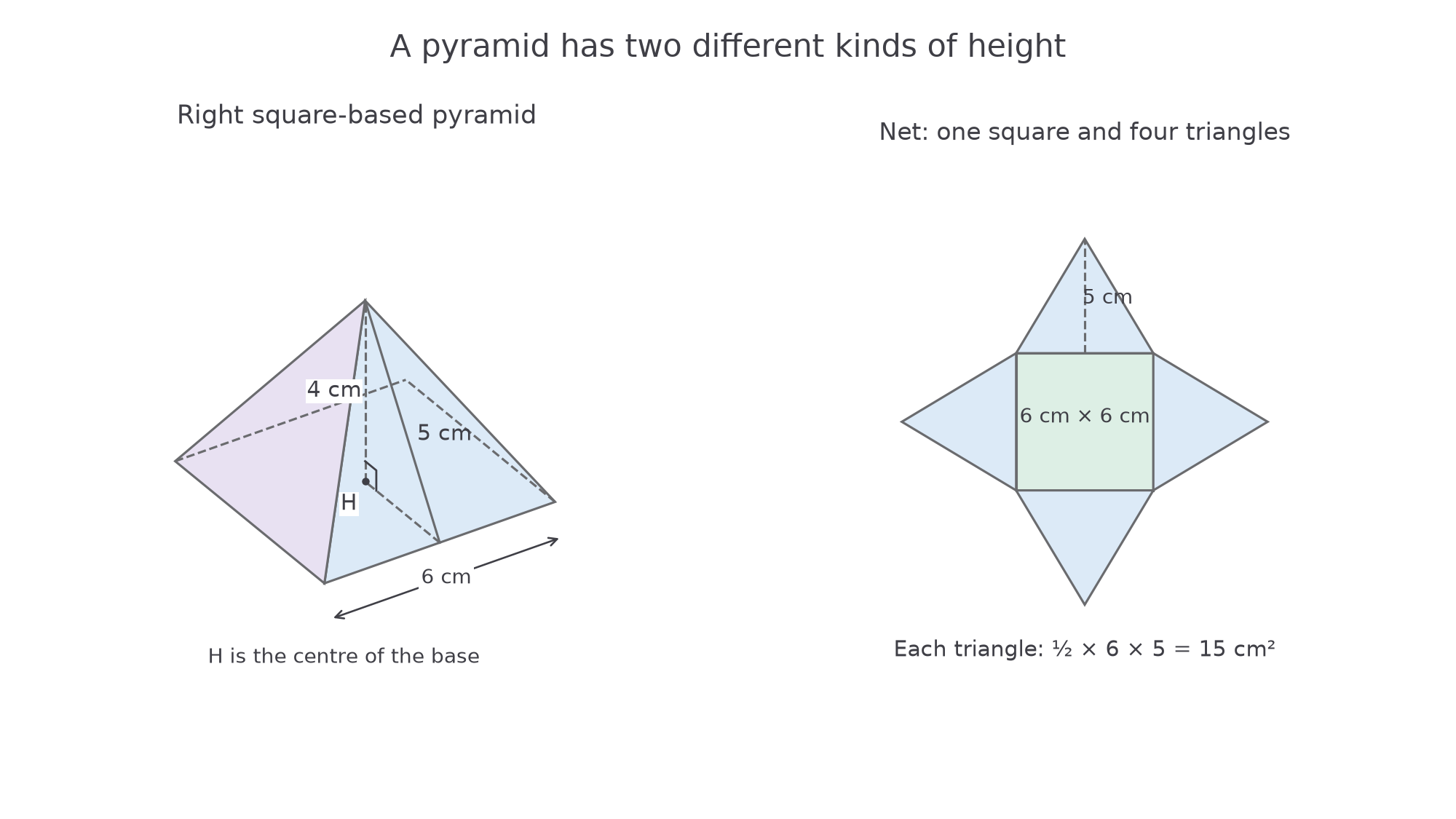
A pyramid has a polygonal base and triangular side faces meeting at an apex. Its base need not be a square. Its perpendicular height measures the distance from the apex to the base plane, whereas each triangular face has its own perpendicular height measured within that face.
[DIAGRAM: asset_name: A pyramid and its net; asset_slug: pyramid-net-heights; caption: The vertical height measures the solid. Each face height measures a triangle in the net.; description: A right square-based pyramid has base side six centimetres, perpendicular height four centimetres and triangular face height five centimetres. Its net has a six-by-six square and four triangles each with base six and perpendicular face height five.]
Pyramid volume
Here is the base area and is the perpendicular height above the base plane. The formula is supplied when required in J560 questions. It is not listed on either 2027 formula sheet.
Like a cone, a pyramid narrows. Its volume is one-third that of a prism with the same base and perpendicular height. To find surface area, use its net: add the base and every exposed triangular face. The volume formula does not calculate the area of those faces.
Continue this lesson.
You’re previewing NovaLearn without an account. Create a free account to read the rest.
Create free account