11.01a, 11.01d - Probability and expected outcomes
If a fair coin is tossed ten times, must five results be heads? In 11.01a, use the probability scale to describe chance. In 11.01d, calculate probabilities from equally likely outcomes, distinguish random from fair, and predict expected counts without treating a prediction as a guarantee.
The probability scale
A standard six-sided dice can show a six, but it cannot show a seven. Both are descriptions of an event, something we are interested in happening. An outcome is one possible result of an experiment, such as a particular face showing.
Probability
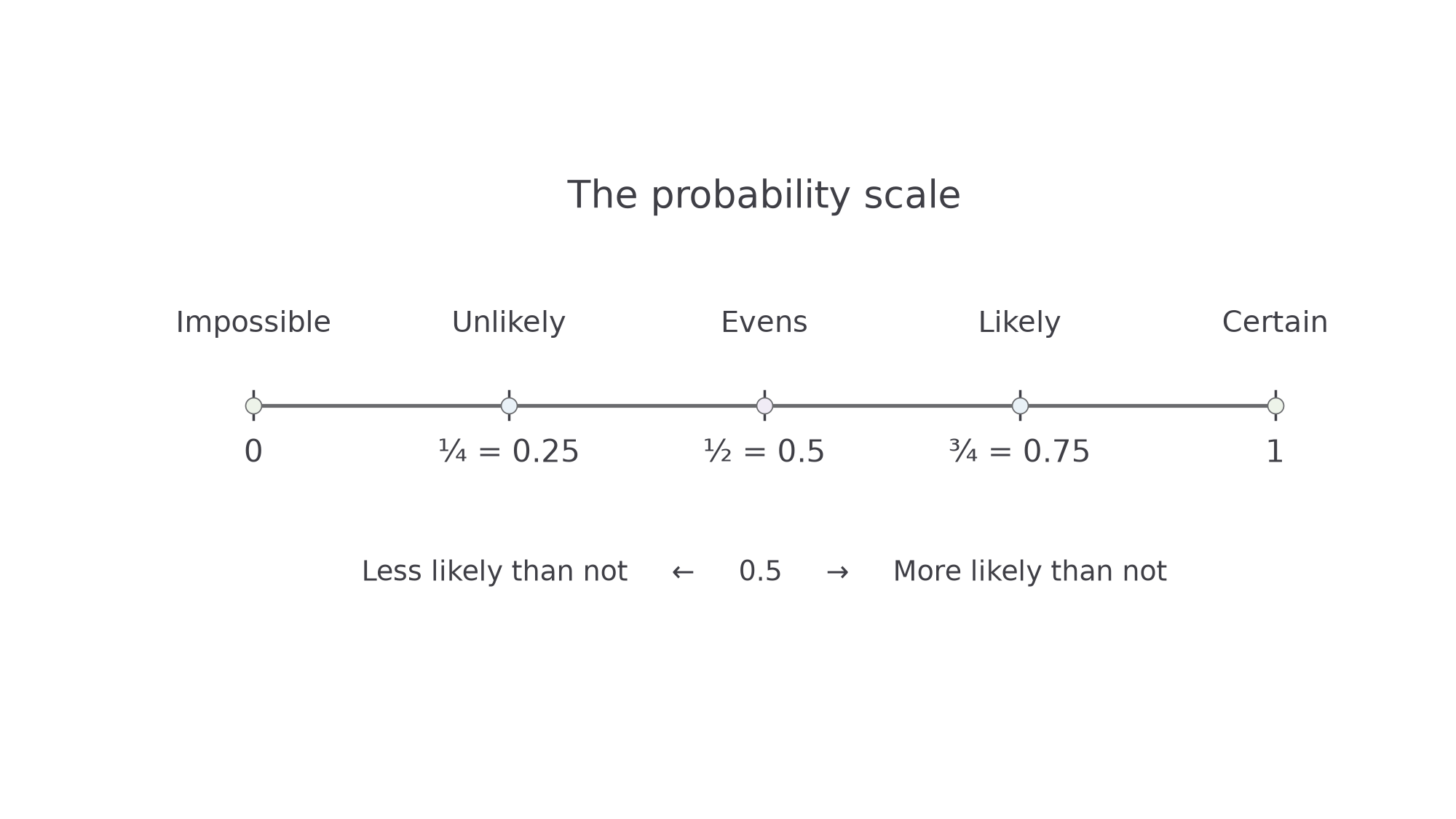
Probability measures how likely an event is. It lies between and , inclusive. In the finite experiments here, means impossible and means certain. A probability of , or , means an even chance: the event and its not happening are equally likely.
On a fair standard dice, showing seven is impossible, showing a number from one to six is certain, and showing an even number has an even chance. An event below is less likely than not; one above is more likely than not. Probability can be written as a fraction or decimal: , so these are the same position on the scale.
[DIAGRAM: asset_name: The probability scale; asset_slug: probability-scale; caption: Probability runs from zero for impossible to one for certain.; description: A horizontal probability scale marks zero impossible, one quarter unlikely, one half evens, three quarters likely and one certain. Fractions and decimals are paired at the internal marks.]
A small positive probability is still possible. An event with probability may happen on the very next trial, while an event with probability may fail to happen. “Likely” is not another word for “certain”.
Key idea
The scale describes likelihood, not the order in which outcomes will arrive. A probability of one half does not require results to alternate.
Choose the statement that keeps chance separate from certainty.
Counting equally likely outcomes
Imagine ten identical counters in a bag, four blue and six red. Mix them and choose one without looking. Each individual counter has the same chance of being selected, so count counters, not just colour names.
Probability from equally likely outcomes
When all individual outcomes are equally likely,
Here favourable means satisfying the event, not necessarily something desirable. The total must be positive.
Not in the formula booklet: learn it.
The formula requires equal likelihood. With four blue and six red counters, the two colours are not equally likely merely because there are two colour names. Choosing a counter at random and hiding its colour makes the individual counters a reasonable equally likely model.
Worked example 1: counting counters
Question. A bag contains four blue and six red identical counters. One is chosen at random. Find the probability of blue as a fraction and decimal.
Plan. Count all ten individual counters and the four favourable blue ones.
Answer. , or .
Check. Blue is the less common colour, so its probability should be below one half. Four of the ten counters are blue.
Change only one counter from red to blue. The total stays ten, while the favourable count increases by one.
Worked example 2: changing one favourable outcome
Question. The bag now contains five blue and five red counters. Find the probability of blue as a fraction and decimal.
Plan. Keep the denominator ten and use the new blue count.
Answer. , or : an even chance.
Check. The two colours now have equal counts and hence equal probabilities. Changing one of ten counters raised the blue probability by .
For a fair dice, the equally likely outcomes are its faces. For a fair spinner divided into equal sectors, they are its sectors. Repeated numbers on separate sectors still count separately. A spinner with two sectors labelled four has two ways to show four.
Watch out
“Two possible colours, so probability one half” is wrong when the colour counts differ. Count the equally likely individual possibilities.
Use the favourable count in a different bag.
Randomness and fairness
Random describes uncertainty in an individual result. Fair describes the chances in the model or the rules of a game. They are connected, but they are not interchangeable.
A fair coin has equal probabilities of heads and tails. A fair dice has equal probabilities for its faces. A selection is random when it uses chance rather than choosing a particular result; it can still give unequal probabilities to the categories we care about. A random counter from a bag containing nine red and one blue is much more likely to be red.
For two players with equal rewards and equal stakes, a fair game gives them equal chances of winning. A fair dice does not automatically make every game using it fair. Suppose one player wins on a six and the other wins on any other face. The chances are and , so the rules favour the second player despite the fair dice.
Outcomes can also be independent: knowing one result does not change the probabilities for the other. For independent tosses of a fair coin, heads on the previous toss leaves the next heads probability at . The coin has no need to “catch up” after a run of tails. This assumption is about the experiment; it is not automatic for every sequence of random events.
Continue this lesson.
You’re previewing NovaLearn without an account. Create a free account to read the rest.
Create free account