9.01a–9.01c - Reflection, rotation and translation
How can a designer move a tile without changing its shape or size? Reflection in 9.01a flips it, rotation in 9.01b turns it, and translation in 9.01c slides it. You will find image coordinates and describe each move precisely enough for someone else to repeat it.
Reflection and mirror lines
A tile with a pointed corner can be flipped to face the other way, while every edge keeps its length. The mirror line tells you exactly where the flipped tile belongs.
Reflection
A reflection maps each point to the opposite side of a mirror line, the same perpendicular distance from that line. A point on the mirror line stays fixed. The resulting shape is the image; corresponding vertices are often labelled and .
Join a point off the mirror to its image. The mirror line cuts that joining segment in half at a right angle: it is its perpendicular bisector. This gives both a construction method and a way to recover an unknown mirror line. Check two moving vertex pairs, because one pair alone might belong to a different move.
[DIAGRAM: asset_name: Reflections in vertical and diagonal lines; asset_slug: mirror-line-reflections; caption: Corresponding points are equally far from the mirror line along perpendicular joining segments.; description: Two coordinate panels show a triangle reflected in x equals one and a triangle reflected in y equals negative x. Mirror lines and selected perpendicular joining segments are marked, with corresponding vertex labels.]
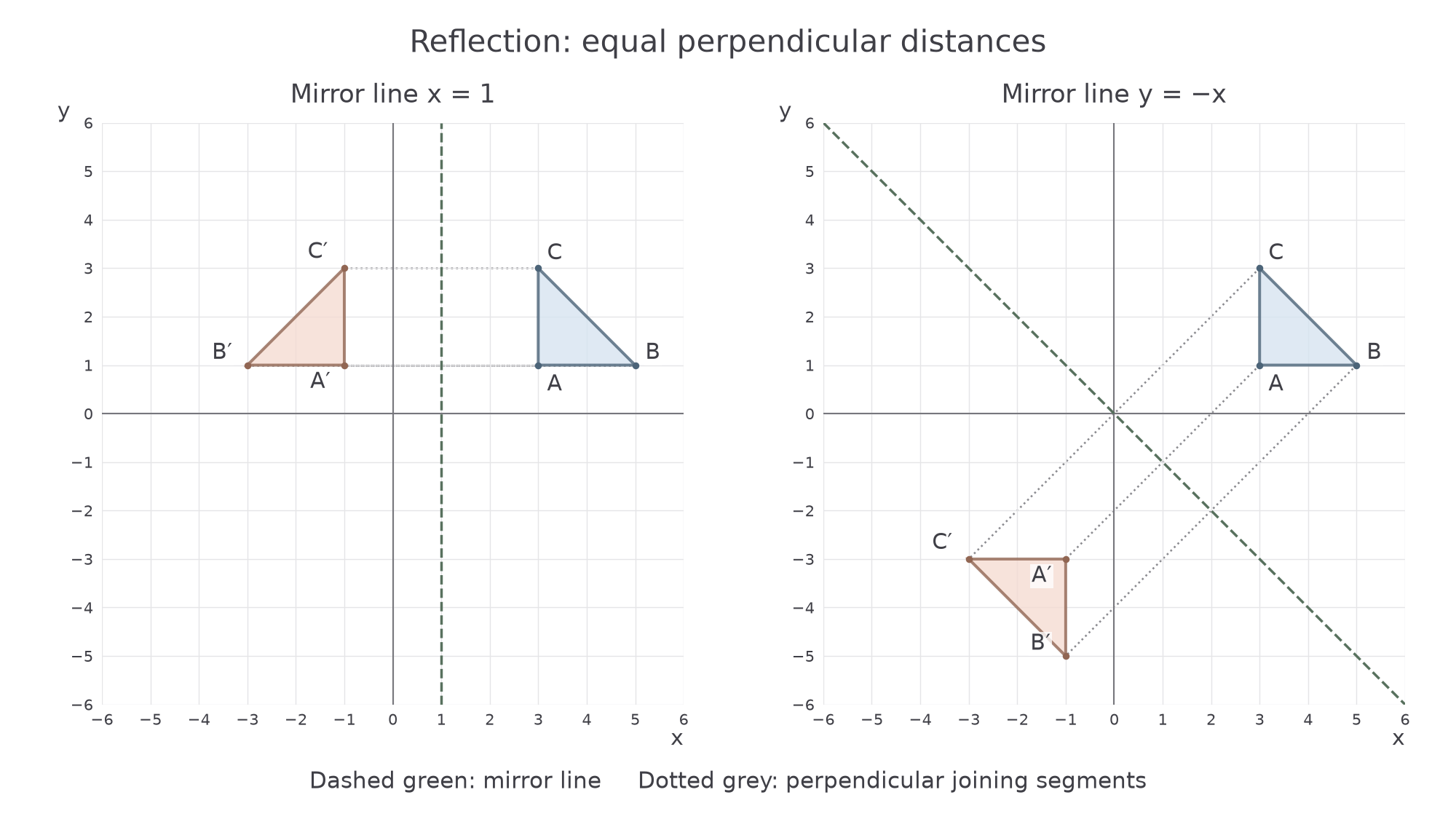
For a vertical line , only the horizontal coordinate changes: the midpoint condition gives . For , only the vertical coordinate changes: . Across , horizontal and vertical distances exchange roles, so becomes . Across , they exchange and both signs change, giving . These rules describe the mirror geometry; you can always check with perpendicular distances.
Worked example 1: vertical and horizontal mirrors
Question. Find the images of in (a) , and (b) .
Plan. Keep the coordinate parallel to each mirror unchanged and put the other coordinate equally far across it.
Answer. (a) , (b) .
Check. The horizontal midpoint in (a) is . The vertical midpoint in (b) is . Both joining segments are perpendicular to their mirrors.
Keep the same point, but change the mirror to a diagonal. Now both coordinates can change.
Worked example 2: diagonal mirrors
Question. Find the images of in (a) , and (b) .
Plan. Exchange the coordinates, changing both signs for the downward diagonal.
Answer. (a) , (b) .
Check. The joining segment in (a) has midpoint on . In (b), its midpoint is on . Each joining segment follows the other diagonal direction on the square grid, perpendicular to its mirror.
Reflect every vertex and join the images in the same order. The shape reverses its handedness: the clockwise order of labelled vertices becomes anti-clockwise. Lengths and angles stay the same.
Watch out
Reflection in is not just a sign change. For example, becomes , not . The latter is a half-turn about the origin.
Use a new point with the downward diagonal.
Rotation about a centre
A rotation turns every point through the same angle about one fixed centre, rather than flipping the shape over.
Rotation
A rotation is specified by its centre, angle and clockwise or anti-clockwise sense. Each point and its image are the same distance from the centre. The centre itself stays fixed.
Imagine the line from the centre to a vertex as a rigid clock hand. Turn that hand, keeping its length. Repeat for every vertex. Tracing paper is useful on a grid: pin it at the centre and turn the traced shape through the requested angle.
[DIAGRAM: asset_name: Quarter turns about a non-origin centre; asset_slug: quarter-turns; caption: The same triangle turns through ninety degrees in opposite senses about C at one comma one.; description: Two equal-scale coordinate panels show the triangle with vertices four comma two, five comma two, four comma four rotated ninety degrees anti-clockwise and clockwise about C at one comma one. Centre rays, right-angle turns and directional arrows are shown.]
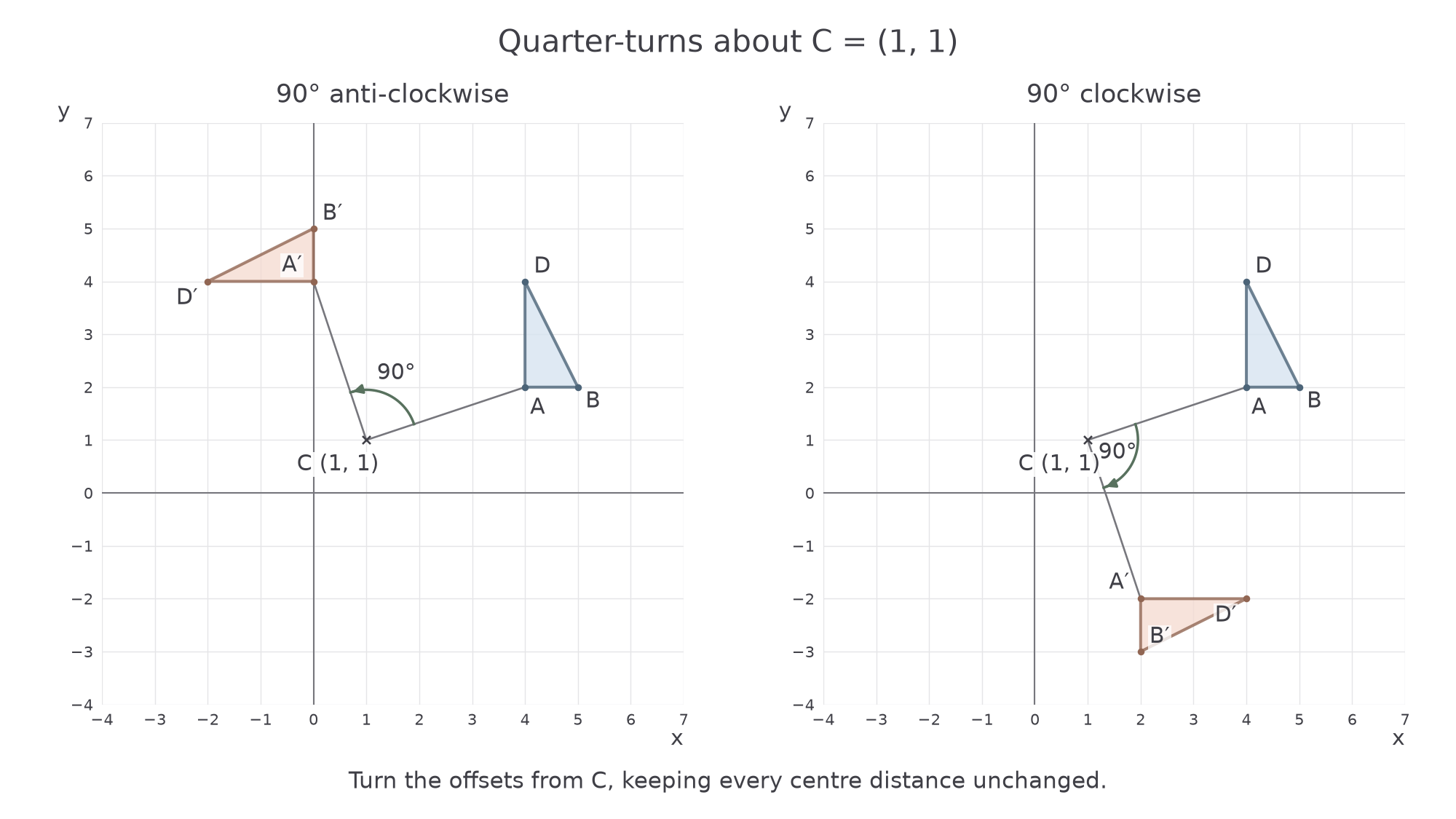
For a centre at the origin, a quarter-turn anti-clockwise maps to , and a quarter-turn clockwise maps it to . A half-turn maps it to . For another centre, first measure the horizontal and vertical offsets from that centre, turn those offsets, then add them back to the centre's coordinates. A anti-clockwise turn reaches the same position as clockwise. A turn needs no sense, because both senses give the same image.
Worked example 3: an anti-clockwise quarter-turn
Question. Rotate through anti-clockwise about .
Plan. Turn the displacement from , then return to the coordinate grid.
Answer. .
Check. Both centre distances have squared length . Turning the image offset clockwise gives , recovering .
Change only the sense of the turn. The same centre and angle now put the image on a different side.
Worked example 4: a clockwise quarter-turn
Question. Rotate through clockwise about .
Plan. Turn the same offset clockwise.
Answer. .
Check. The image lies one right and three down from , still at squared distance . A clockwise clock hand moves a rightward direction towards a downward one, consistent with this turn.
Using origin rules on the absolute coordinates would rotate about the wrong point.
Watch out
Always measure from the stated centre. The image of in a clockwise quarter-turn about is , whereas the same turn about the origin gives .
Turn a fresh offset about the same centre.
Translation vectors
A translation slides every vertex the same distance in the same direction, so no turning or flipping is involved.
Translation vector
The column vector means move horizontally and vertically. Positive entries mean right and up; negative entries mean left and down. It describes a movement, not a destination.
Continue this lesson.
You’re previewing NovaLearn without an account. Create a free account to read the rest.
Create free account