3.03a, 6.02d, 10.02b - Circumference and arc length
How much edging goes round a circular flower bed, and how much goes round just part of it? Use the circumference formula from 6.02d and 10.02b, preserve exact multiples of pi from 3.03a, and calculate arc lengths as fractions of a full circle.
The circumference formula
A circular flower bed has radius . Would of edging go all the way round? That is its diameter, a straight distance across, so we need a different length.
For every circle, the circumference divided by the diameter is the same number, pi, written . Its value begins . Thus the distance round is just over three diameters, regardless of the circle's size.
[DIAGRAM: asset_name: Circumference compared with diameter; asset_slug: circle-circumference-ratio; caption: Straightening the curved boundary gives a length just over three diameters.; description: An exact circle has diameter d marked across it. A straight reference line of length pi times d is shown at the same scale beside the circle. Tick marks at one, two and three diameters show that the full circumference extends a little beyond three diameters.]
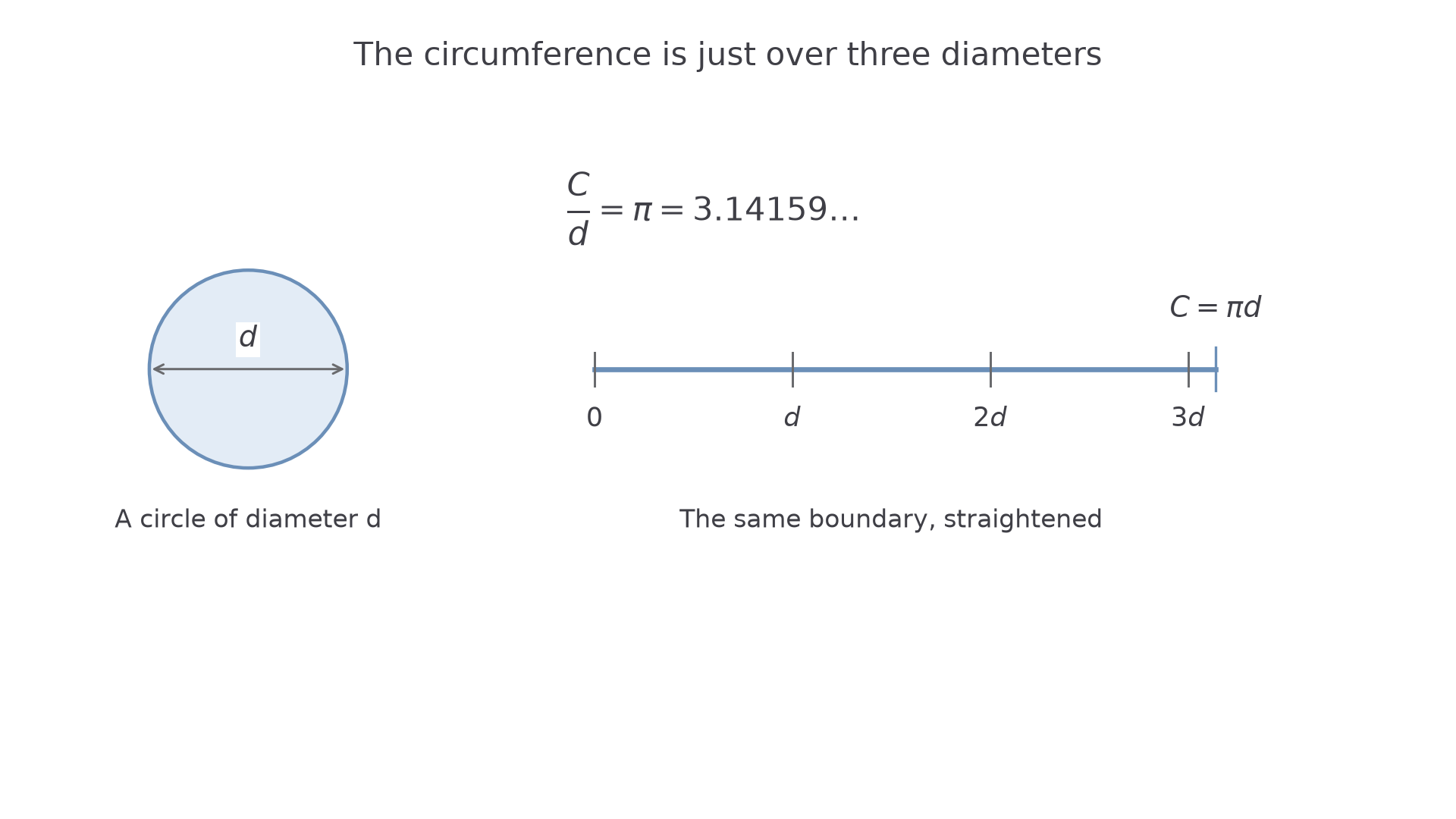
Circumference of a circle
For a circle of radius , diameter , and circumference ,
Use one consistent length unit. The circumference has that length unit too.
Supplied on both tiers' June/November 2027 formula sheets. Learn what the letters mean and how to use the formula in either direction.
The two forms are the same rule: replacing by gives . For the opening bed, , about . Six metres would cover less than a third of the boundary.
Worked example 1: finding the length round
Question. A circle has radius . Calculate its circumference, correct to decimal place.
Plan. Use because the given length is a radius.
Answer. .
Check. The diameter is . Three diameters give , so a circumference just above makes sense.
Now reverse the calculation for the same circle: its circumference is given, and the radius is unknown.
Worked example 2: finding a radius from circumference
Question. A circle has circumference . Find its radius.
Plan. Undo multiplication by .
Answer. .
Check. The diameter is , giving , as required.
If the circumference is a decimal instead, the same division works. To find a diameter, divide by , rather than .
Watch out
Using doubles the circumference. The correct choices are or . Identify the given length before substituting it.
Try the inverse calculation with a circumference that is not written using pi.
Exact answers with pi
Writing keeps the exact length, while writing replaces it by a nearby value. Which form to use depends on the question.
Pi is irrational: its decimal expansion does not terminate or repeat. A finite decimal such as is an approximation to . A calculator's pi key gives a much more accurate approximation, but an instruction to give an answer “in terms of ” asks you to keep the symbol in your final answer.
An exact multiple of pi
An expression such as , or gives an exact value when its coefficient is exact. Do the arithmetic with the coefficient and leave unchanged.
For instance, , just as three lengths plus five equal lengths make eight of them. Dividing by gives . Pi is a number, so ordinary multiplication, addition and cancellation rules apply.
Worked example 3: one exact lap
Question. A circular track has diameter . Find the distance for one complete lap, in terms of .
Plan. Multiply the exact diameter by pi.
Answer. , or .
Check. Using , the distance lies between and . The exact answer has this size.
Change only the number of laps. The track stays the same, so each lap contributes the same exact length.
Continue this lesson.
You’re previewing NovaLearn without an account. Create a free account to read the rest.
Create free account