6.02d, 10.03d - Circle and sector area
A sprinkler covers a circular garden, but sometimes turns through only part of a full revolution. Use the circle-area formula from 6.02d and 10.03d to find how much ground it waters, calculate sector areas, and work backwards to an unknown radius or angle.
The area of a circle
A sprinkler reaches from its centre and turns through . Does it water or square metres? First find the area it would water in a full turn.
Area measures how much surface a region covers. It uses square units. This is different from circumference, which measures the length of the boundary.
One way to understand the circle-area rule is to cut a circle into many equal narrow sectors and arrange them alternately pointing up and down. Their curved edges form the long edges of a shape which approaches a rectangle as the sectors become narrower.
[DIAGRAM: asset_name: Rearranging a circle into narrow sectors; asset_slug: circle-area-rearrangement; caption: Rearranging preserves area. With more narrow sectors, the strip approaches a rectangle of width pi times r and height r.; description: A circle of radius r is divided into sixteen equal sectors in alternating pale blue and sage. The same sixteen exact sectors are rearranged alternately up and down without overlap. The long edge tends to half the circumference, pi times r, and the height tends to r. The finite strip retains visibly curved edges so it is not labelled an exact rectangle.]
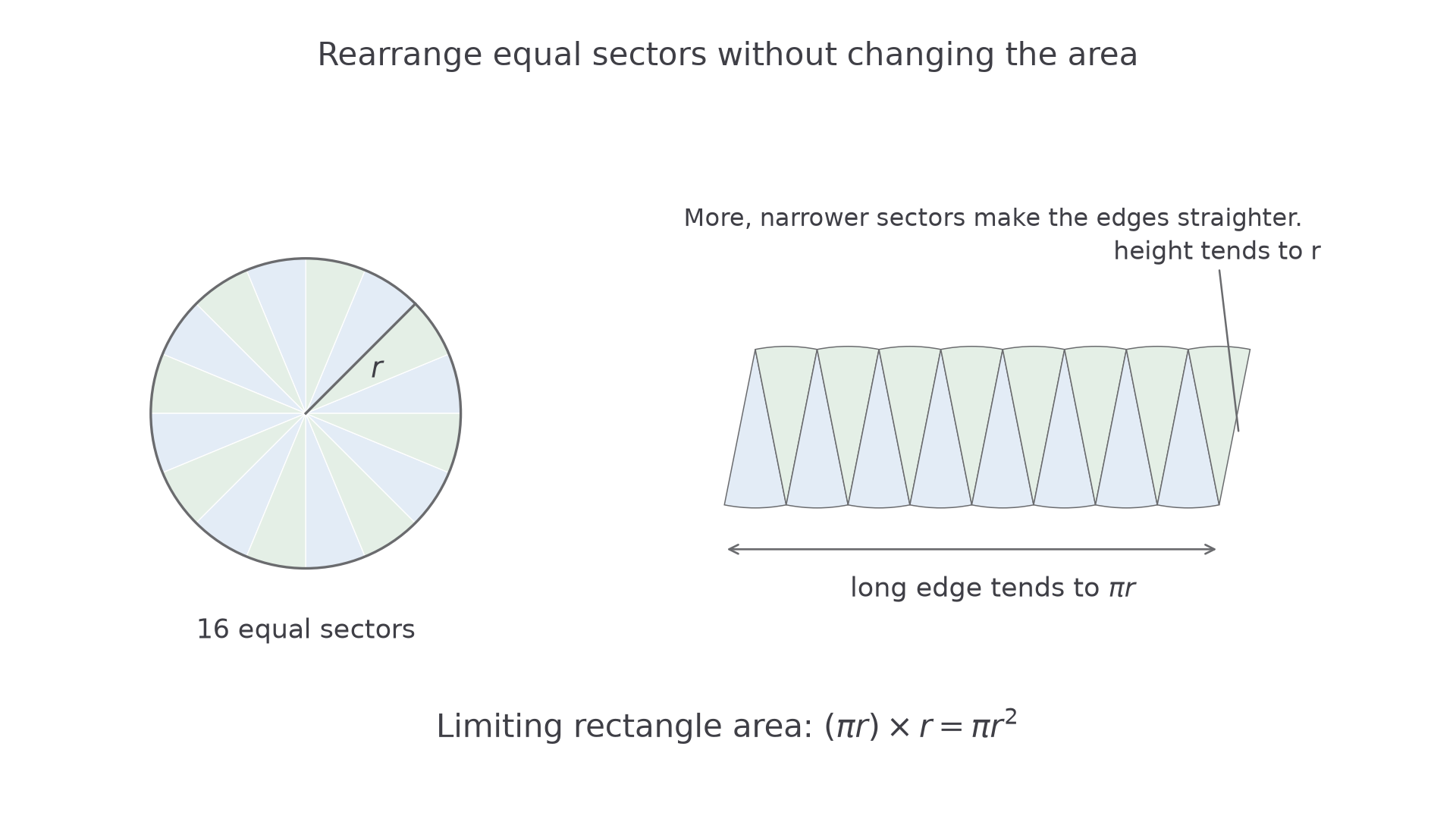
Each long edge uses half the circumference, so its limiting length is . The height approaches . Rearranging has not changed the area, giving .
Area of a circle
For a circle of radius ,
Square the radius, not the diameter. If is in centimetres, is in square centimetres.
Supplied on both tiers' June/November 2027 formula sheets. Learn the relationship as well as how to use the supplied formula.
The square acts on : means , not .
Worked example 1: a given radius
Question. A circle has radius . Find its area in terms of .
Plan. Square the centre-to-edge distance, then multiply by pi.
Answer. .
Check. A square of side just encloses the circle and has area . Since , the circle occupies less than the square, as expected.
Change only what the given measures: it is now a diameter. The radius must be halved before squaring.
Worked example 2: a given diameter
Question. A circle has diameter . Find its area in terms of .
Plan. Find the radius first, then use the area formula.
Answer. .
Check. Halving the radius quarters the area: . Both length directions have halved, so the area factor is .
That square relationship explains why doubling a sprinkler's reach would water four times as much ground in a full turn.
Watch out
For diameter , the line is wrong: it uses the diameter as a radius. Write first. Also, gives a length, not an area.
Find the radius before calculating the next area.
Sector area as a fraction
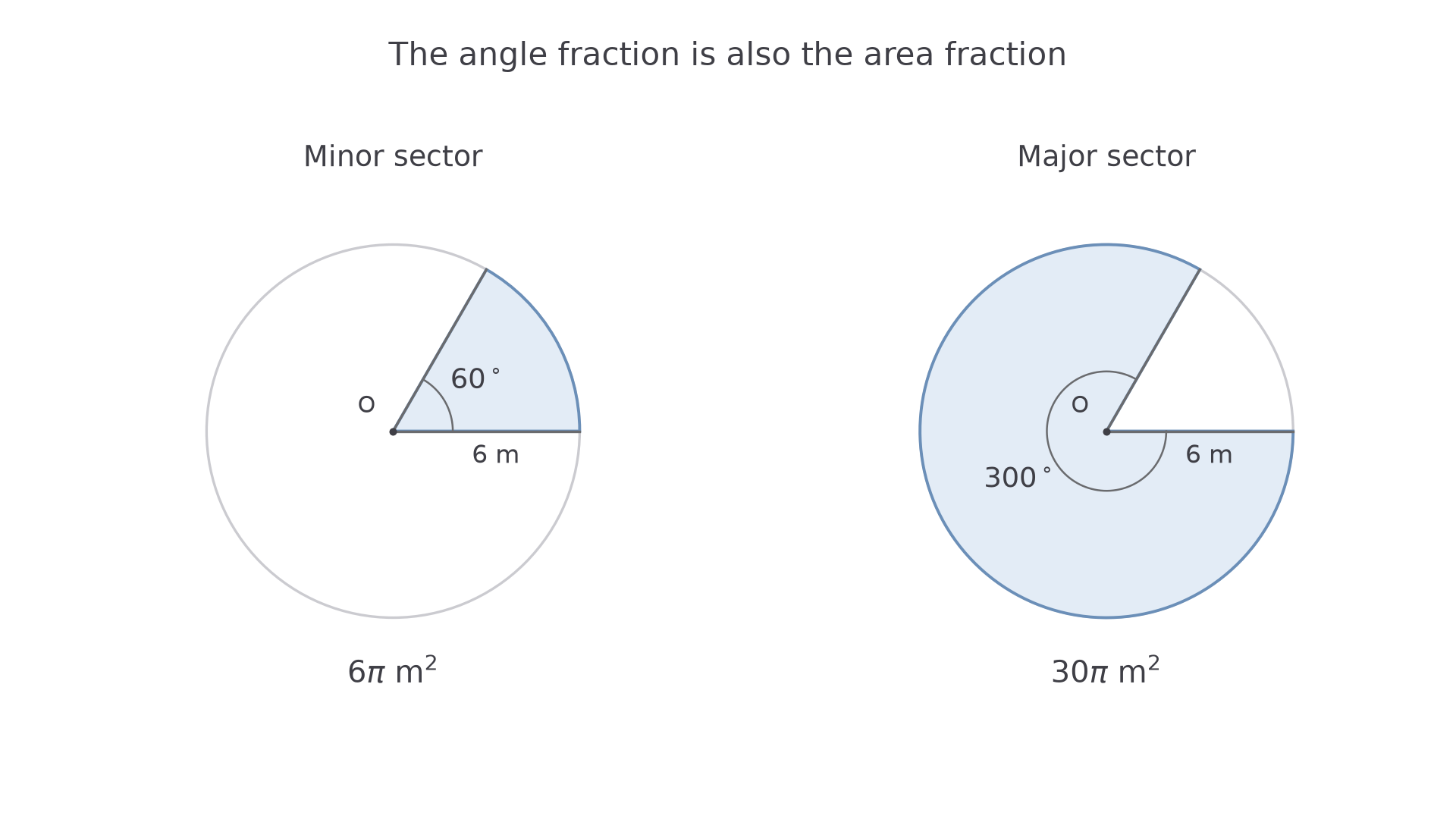
A half-circle has half the full circle's area, and a quarter-circle has a quarter. Equal central angles cut equal areas from a fixed circle.
Just as for arc length, an angle of selects of the whole. This time multiply that fraction by the circle's area, not its circumference.
[DIAGRAM: asset_name: Minor and major sectors of one circle; asset_slug: circle-sector-areas; caption: The angle fraction selects the same fraction of the full area. The 60 and 300 degree sectors together make the circle.; description: Two congruent circles of radius six metres. A sixty-degree minor sector is shaded in one, and the complementary three-hundred-degree major sector is shaded in the other. Their areas are respectively six pi and thirty pi square metres. The two bounding radii and each selected central angle are clearly marked.]
Sector area in degrees
For radius and sector angle at the centre,
Use the angle of the required region: a major sector has . A semicircle uses .
Not separately supplied on the 2027 formula sheets: derive it as a fraction of the supplied circle-area formula.
Both tiers receive the full-circle formula for the target 2027 exams. The fraction connecting a full circle to a sector is still yours to choose and apply.
Worked example 3: a minor sector
Question. A sprinkler reaches and turns through . Find the area watered, in terms of .
Plan. Find one sixth of the full-circle area.
Answer. .
Check. Six such sectors fit around the centre: , exactly the full-circle area.
Change only the turn to the reflex angle between the same two directions. The major sector covers the rest of the circle.
Continue this lesson.
You’re previewing NovaLearn without an account. Create a free account to read the rest.
Create free account