6.02a - Building expressions from situations
How can one rule describe many different purchases or shapes? Choose variables with clear meanings, translate operations in the right order, and build expressions and formulae from fixed amounts, changing amounts and geometric measurements.
Choosing variables
Three envelopes initially contain tickets each. You add two tickets to every envelope. Is the new total or ? Compare this with adding just two tickets altogether.
Keep as the initial number of tickets in one envelope. Adding two tickets altogether gives . Adding two to every envelope gives : three copies of the new count in one envelope. A clear definition prevents the letter from changing meaning halfway through the calculation.
A variable with a meaning
A variable represents a numerical quantity. State what it measures or counts, and its units where needed. For example, “ is the number of bags” means is a non-negative whole number; “ is the mass in kilograms” may allow fractional values.
Build the expression in the order described. “Three times a number, then add two” is . “Add two to a number, then multiply the result by three” is . Brackets keep a whole quantity together.
Worked example 1: multiplying before adding
Question. A bag contains counters. Write an expression for the number of counters in three such bags with two extra counters added altogether.
Plan. Count three complete bags, then add the two loose counters.
Answer. counters.
Check. If each bag has five counters, the count is . Substitution gives .
Change only where the two extra counters are added: now each bag receives two. The bracket records this change in grouping.
Worked example 2: adding before multiplying
Question. A bag initially contains counters. Two counters are added to each of three such bags. Write an expression for the total number of counters.
Plan. Work out the new count in one bag, then take three copies.
Answer. counters.
Check. At , there are three bags of seven: twenty-one counters. The expression gives .
Changing a few words changed the total by four counters, for every possible original bag size: the second situation adds six loose counters rather than two. Algebra records the structure of the situation, not just its numbers.
Watch out
“Five less than ” means , not . Try : five less is seven. Checking a sensible value can reveal a reversed operation.
Keep the whole new bag count inside your bracket.
Fixed and changing amounts
A delivery fee is paid once; a price per item is paid repeatedly. Separating those contributions is the key to many cost formulae.
If the fixed charge is £6 and each item costs £4, the total for items is pounds. The number six does not grow with . A formula names the output too: , where is the total cost in pounds.
Problem-solving
List each contribution before combining them. “Per item” means multiply by the number of items; “once” means add once. Convert money into a single unit before adding.
Some situations have more than one changing quantity. Give each its own variable and avoid adding pounds directly to pence.
Worked example 3: two changing contributions
Question. A van costs £24 per day to hire plus 20p per mile. Write a formula for the total cost in pounds for days and miles. There are no other charges.
Plan. Convert the mileage rate to pounds, then add the two costs.
Answer. , with measured in pounds.
Check. One day and ten miles cost . The formula gives .
Change only one feature: add a fixed booking fee. It appears once, even for a hire lasting several days.
Worked example 4: adding a fixed contribution
Question. The same van hire has an additional £7 booking fee per hire. Write a formula for in pounds for days and miles.
Plan. Keep both changing contributions and add the booking fee once.
Answer. .
Check. For two days and ten miles, the cost is . The formula gives ; the fee is seven pounds, not fourteen.
Use the values allowed by the situation. The number of whole days charged may be an integer, while mileage can be fractional. A formula does not by itself promise that a hire of zero days is available.
Watch out
For a single £7 booking fee, is wrong: it charges the fee every day. A fixed contribution is not multiplied by a changing quantity.
Write a complete formula with every cost in pounds.
Building geometric formulae
A rectangle's perimeter is the total distance around its four sides. Opposite sides have equal lengths. If one side is described using a variable, you can express every side before adding.
[DIAGRAM: asset_name: Rectangles with related side lengths; asset_slug: related-rectangles; caption: Add all four sides, keeping each length expression together.; description: Two rectangles drawn without a numerical scale. Both have width w centimetres. The first has length w plus three centimetres and the second has length w minus three centimetres. Opposite sides carry matching labels. The second rectangle requires w greater than three.]
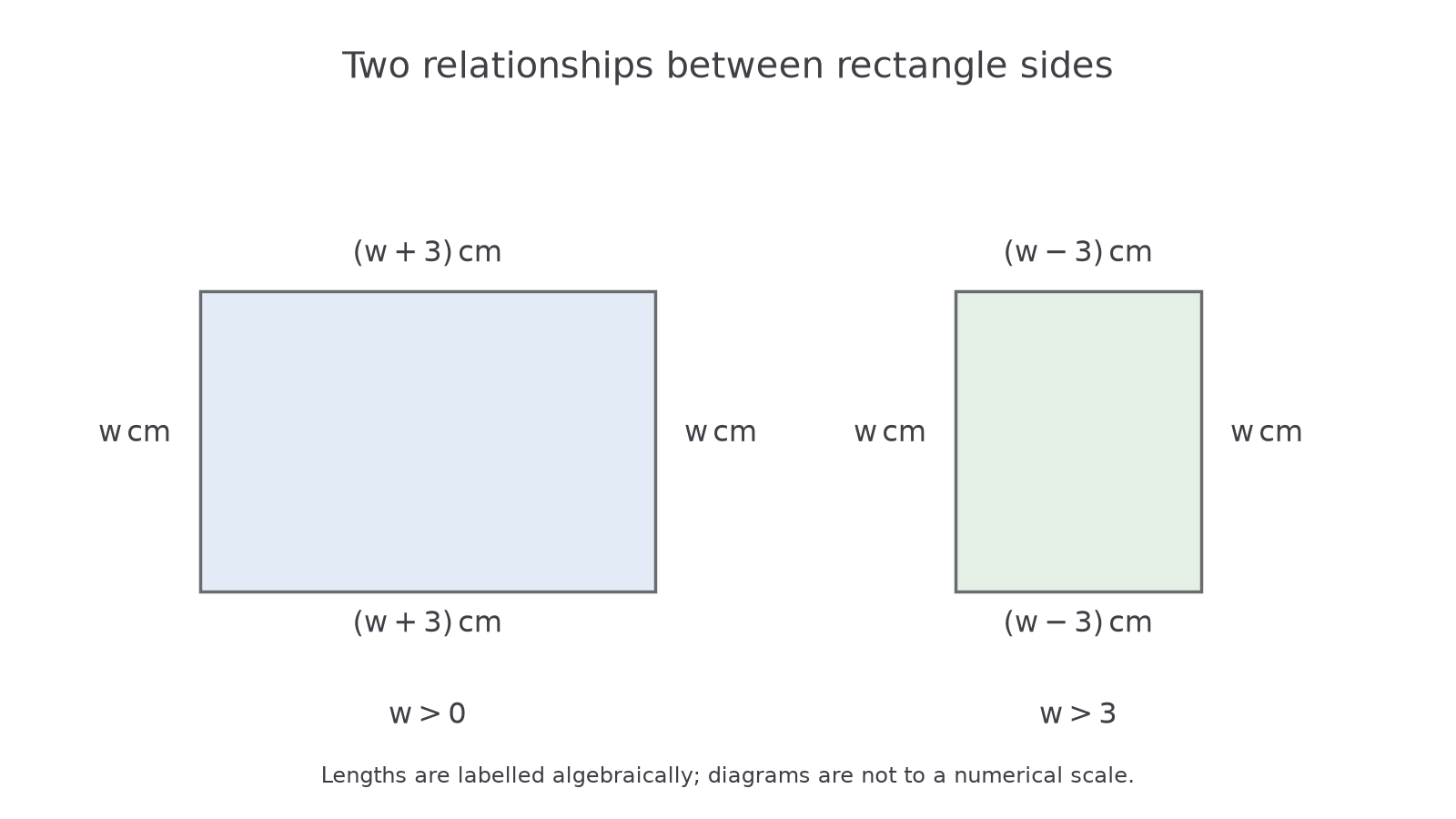
Keep length units consistent. A length must be positive for a genuine rectangle, so requires . A value that makes a side zero describes a collapsed shape, not a rectangle with positive area.
Worked example 5: a length greater than the width
Question. A rectangle has width and length . Write a simplified formula for its perimeter in centimetres.
Plan. Add the four sides and collect like terms.
Answer. , for .
Check. If , the sides are five and eight centimetres. Their perimeter is , matching .
Change only the plus sign in the length to a minus sign. The labelled length can now be the shorter side; the algebra still adds all four boundary lengths.
Worked example 6: a length less than the width
Question. A rectangle has width and length . Write a simplified formula for its perimeter in centimetres, and state the restriction on .
Plan. Add the four sides, then require both dimensions to be positive.
Answer. , with .
Check. At , the sides are five and two centimetres. Their perimeter is , matching .
For an area formula, multiply perpendicular side lengths rather than adding them. The first rectangle has , where is in square centimetres. This product is already a valid formula; a formula does not need every bracket removed. Later you will learn to expand such products.
Watch out
counts only two sides. A rectangle has two of each side length, so its perimeter is . Area uses multiplication and has square units.
Build the perimeter from the actual side lengths before simplifying.
Quick Recap
- Define what every variable measures or counts, including its units.
- Translate the order of operations; brackets keep a whole quantity together.
- Add fixed charges once and multiply rates by the quantities they apply to.
- Build perimeter by adding boundary lengths, and area by multiplying the appropriate lengths.
- Keep the values allowed by the context, such as positive side lengths.
The opening envelopes contain tickets after two are added to every envelope. Adding two tickets altogether would give . The brackets record which quantity is repeated.