9.04b - Enlargement
A drawing can be made twice as wide or half as wide without distorting it. Both moves are called enlargements in mathematics. You will use a centre and a positive scale factor to place the image, then work backwards to find those two details from corresponding shapes.
Rays from a centre
If a tile doubles in size, must each vertex move two squares? A vertex one square from the centre and one five squares away cannot follow that same instruction.
Enlargement
An enlargement with centre and positive scale factor places the image of each point on the ray from through , with . The centre itself stays fixed. A ray starts at a point and continues in one direction. Corresponding lengths are multiplied by , while angles are unchanged.
Draw a ray through each vertex. Measure its distance from the centre, multiply that distance by the scale factor, and mark the image on the ray. Join image vertices in matching order. The centre stays fixed. Unless , it is the only fixed point.
[DIAGRAM: asset_name: Enlargement rays and the centre; asset_slug: centre-and-rays; caption: Every image vertex is twice as far from the centre along its own ray.; description: A coordinate grid shows centre O at one comma one, original triangle with vertices two comma one, three comma one, two comma three and its scale-two image at three comma one, five comma one, three comma five. All three centre rays are shown with labelled vertices, including the coincident original B and image A prime at three comma one.]
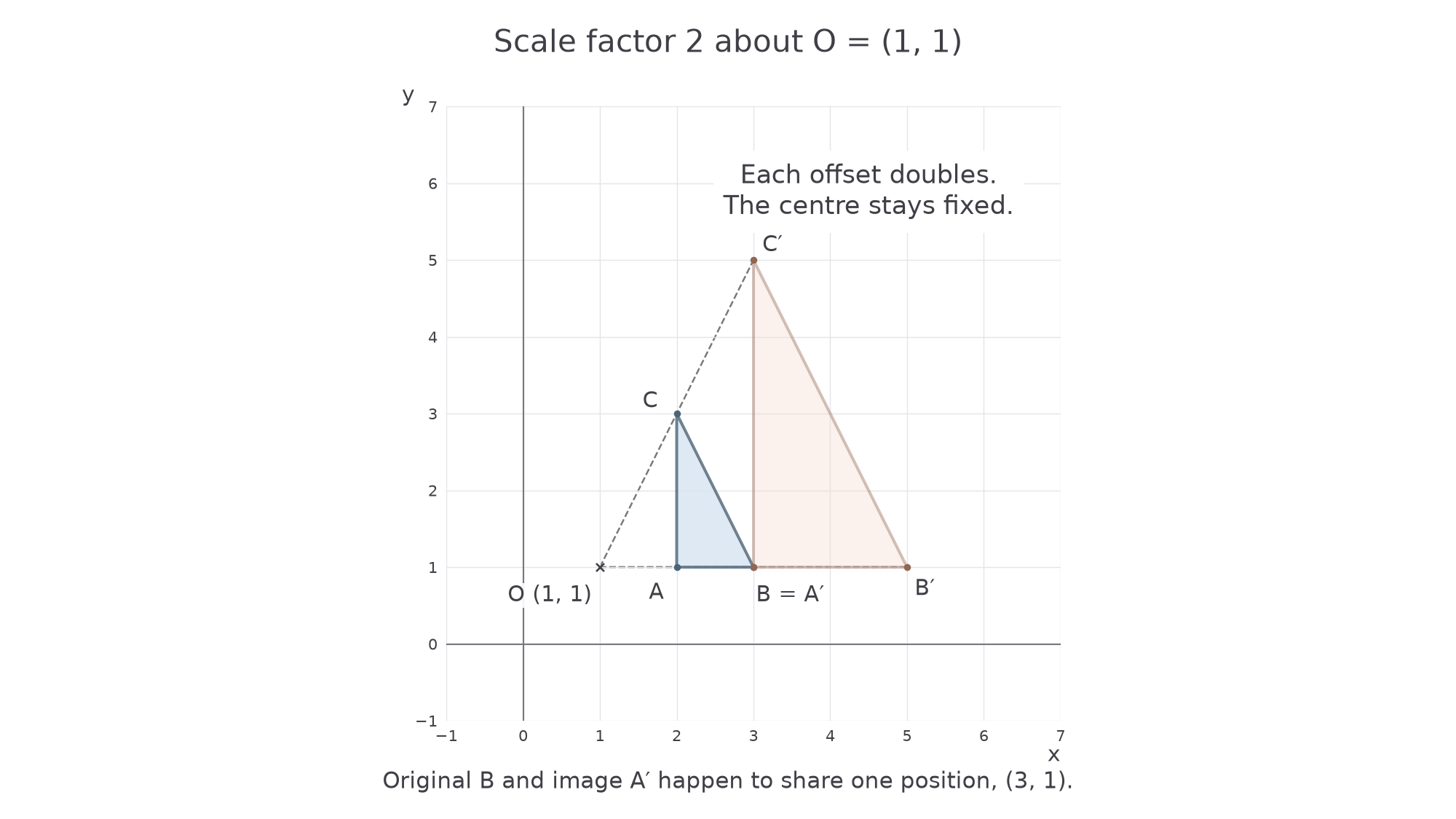
On a grid you can count horizontal and vertical offsets rather than measure slant distances. Multiplying both offsets by keeps the point on the same ray and multiplies its distance from the centre by .
Worked example 1: centre at the origin
Question. Enlarge , , by scale factor , centre . Give the image coordinates.
Plan. Double each vertex's horizontal and vertical distances from the origin.
Both offsets double in every line.
Answer. , , .
Check. and ; the corresponding image lengths are and . Both have doubled, while the right angle remains a right angle.
Change only the centre, keeping the original triangle and scale factor. Now doubling the coordinates would use the wrong centre.
Worked example 2: centre away from the origin
Question. Enlarge the same triangle by scale factor , centre .
Plan. Subtract the centre, double the offsets, then add the centre back.
Answer. , , .
Check. The image legs are still and , but their position differs from example 1. Also and , giving the required centre-distance ratio.
The centre controls position; the scale factor controls size.
Watch out
“Scale factor two” means twice the distance from the centre, not two extra squares from each vertex. Use centre rays rather than adding the same amount to every coordinate.
Apply the offset method to one new vertex.
Whole and fractional scale factors
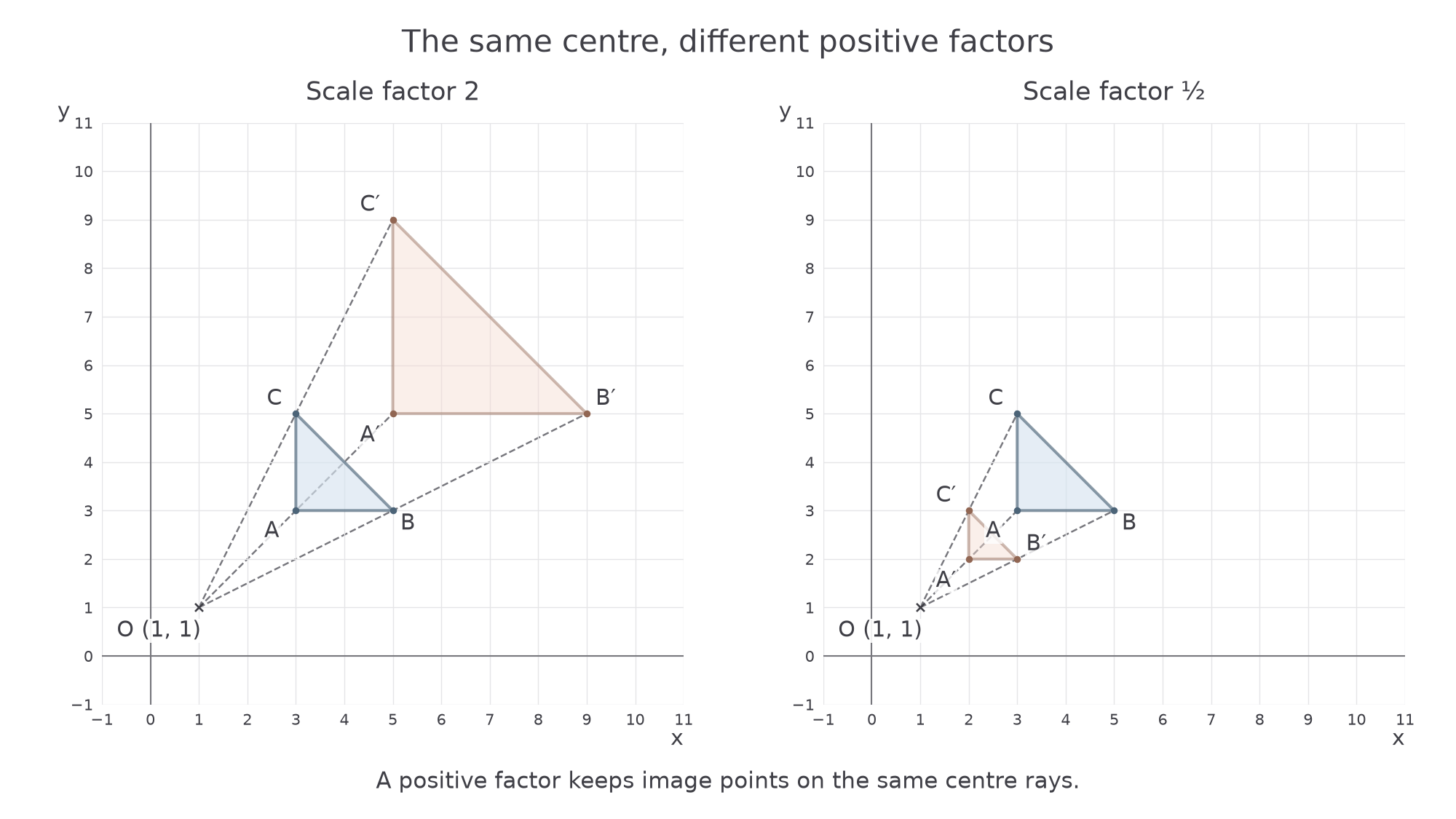
An enlargement can make a shape smaller: a positive fraction places each image vertex nearer the centre along the same ray.
For , the image is larger and lies further along each centre ray. For , it is smaller and lies between the centre and the original point. For , every point stays where it was. A factor of zero would collapse the whole shape to one point, so it does not give an ordinary similar image of a non-degenerate shape.
[DIAGRAM: asset_name: Positive whole and fractional factors; asset_slug: positive-scale-factors; caption: Scale factor two moves image vertices outward, while scale factor one half puts them halfway from the same centre.; description: Two coordinate panels show the same triangle at three comma three, five comma three, three comma five with centre one comma one. The left panel shows scale factor two and the right shows scale factor one half. Centre rays and original and image vertices are labelled.]
Worked example 3: a larger positive image
Question. Enlarge , , , centre , scale factor .
Plan. Double the offsets from the given centre.
Each coordinate is the centre coordinate plus its scaled offset.
Answer. , , , respectively.
Check. The original horizontal leg is units and its image is units, as required. The centre-to- offset doubles to .
Change only the scale factor to . Keep the centre and original triangle.
Worked example 4: a smaller positive image
Question. Enlarge the same triangle, centre , scale factor .
Plan. Halve each offset, so each image lies halfway from the centre to its original vertex.
Answer. , , , respectively.
Check. The image horizontal leg is , half the original . Enlarging this smaller image by about the same centre returns the original triangle.
Continue this lesson.
You’re previewing NovaLearn without an account. Create a free account to read the rest.
Create free account