6.01f - Completing the square
The same quadratic can be written as an expanded expression or as a shifted square plus a constant. You will complete the square for monic and non-monic quadratics, keep fractional values exact and check each result by expansion. This form will later make important features of quadratic graphs easier to see.
Completing a monic square
Can you rewrite so that the letter appears inside just one squared bracket?
Higher only. Start with the nearby square: . Its first two terms are exactly right, but its constant is four too large. Subtracting four repairs that difference without changing the expression.
Completing the square
Completing the square means rewriting a quadratic in the form , where . A monic quadratic has coefficient before , so .
The middle term in is . Therefore halve the coefficient of to find the number inside the bracket. Add and subtract its square so the overall value stays unchanged:
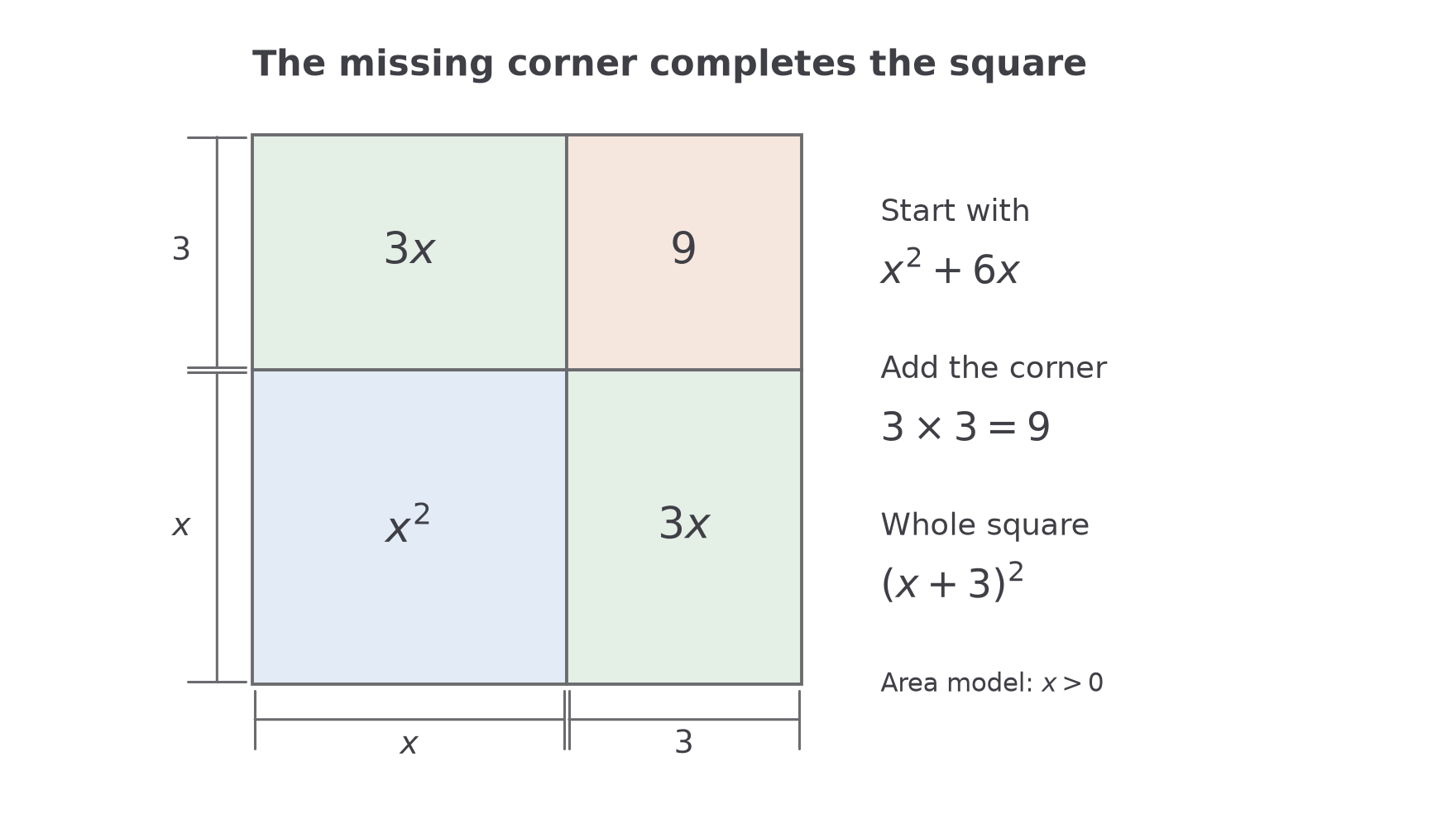
For positive , the area picture shows why adding completes the square. The algebraic identity also holds for zero and negative , even though those are not positive side lengths.
[DIAGRAM: asset_name: Completing a square by adding the missing corner; asset_slug: completing-square-area; caption: Two strips of area 3x need a corner of area 9 to make a square of side x + 3.; description: A square is split into a blue x by x square, two sage rectangles each x by 3, and a clay 3 by 3 corner. Side segments are labelled x and 3. The total area is x squared plus 6x plus 9, equal to the square of x plus 3. This is an area model for positive x.]
Worked example 1: repairing the constant
Question. Write in completed-square form.
Plan. Use inside the bracket, then compensate for the added .
Answer. .
Check. Expanding gives .
Change only the sign of the linear term. The bracket number becomes negative, but its square is still positive.
Worked example 2: a negative linear coefficient
Question. Write in completed-square form.
Plan. Halve to get , then compensate for .
Answer. .
Check. .
The opening expression is therefore a square minus four. Unlike factorising into linear brackets, this method does not depend on finding integer factors of the quadratic.
Watch out
: that right side has constant . The square has already introduced , so subtract it before restoring the original constant.
Use expansion to check your own bracket and constant.
Completing squares with fractions
An odd linear coefficient produces a fraction inside the square, but the method is unchanged.
For example, half of is , and . Keeping these as fractions avoids rounding. Convert the original constant to quarters before combining it with .
Worked example 3: an odd linear coefficient
Question. Complete the square in .
Plan. Use in the bracket and express both constants in quarters.
Answer. .
Check. Expansion gives .
Continue this lesson.
You’re previewing NovaLearn without an account. Create a free account to read the rest.
Create free account