8.05b–8.05d - Angles at the centre and circumference
Why can a camera move along a circular track while keeping the same viewing angle between two fixed posts? In 8.05b you will connect angles at the centre and circumference, in 8.05c explain the right angle made by a diameter, and in 8.05d prove why angles in the same segment stay equal.
Angles at the centre and circumference
Suppose two posts are at and on a circle and a camera is at on its circumference. If its viewing angle is , the angle at the centre standing on the same arc is . The word same matters: the two endpoints alone leave a choice of two arcs.
Subtended angle
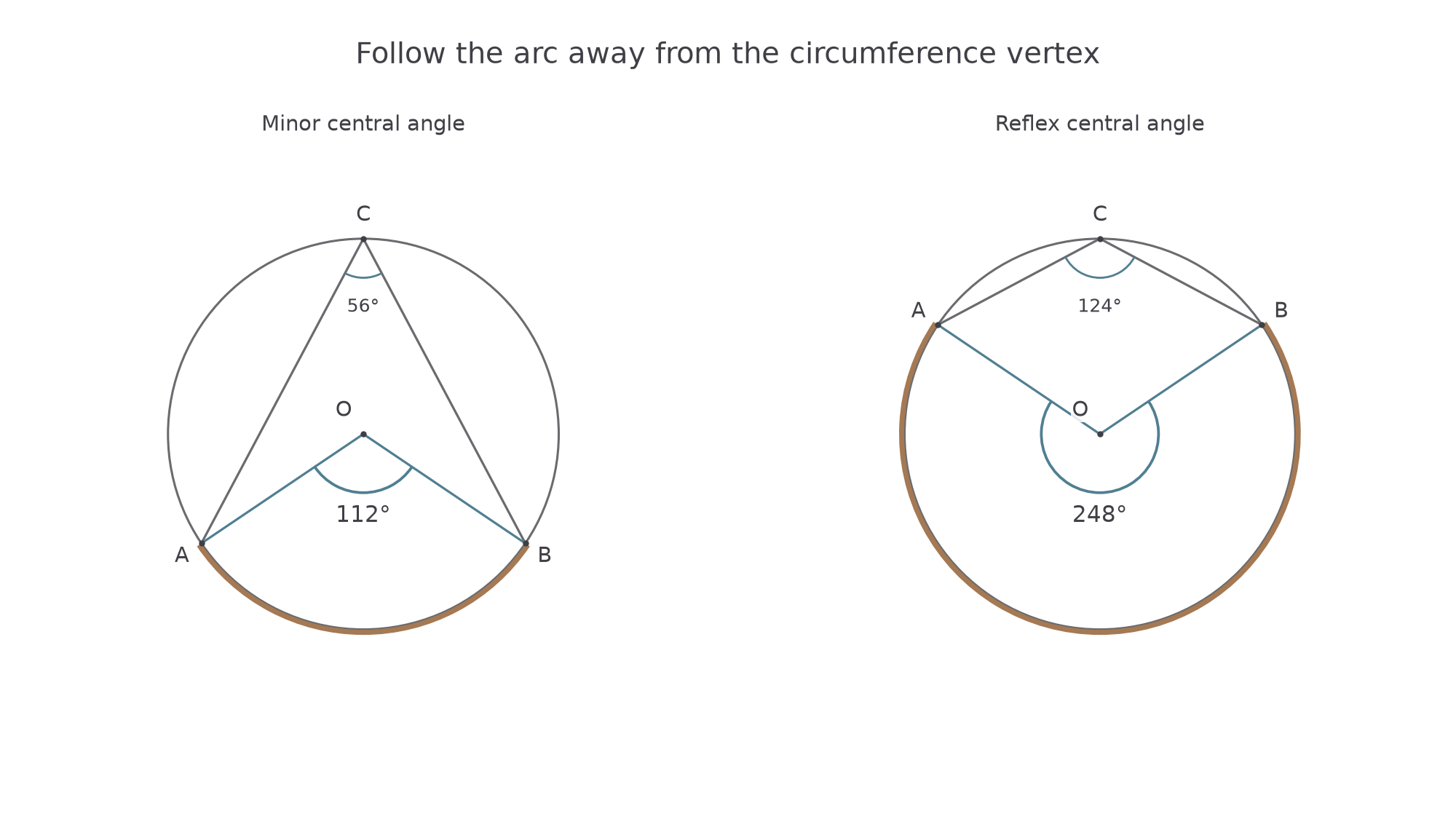
An angle subtended by an arc joins the arc's two endpoints to a vertex. For , use the arc that does not contain . The corresponding angle at the centre follows that same arc, so it can be reflex.
Trace from to along the arc away from . At the centre , sweep in that direction between and .
[DIAGRAM: asset_name: The same arc gives a double central angle; asset_slug: centre-arc-examples; caption: The central angle follows the arc away from C and can be reflex.; description: Two exact circles with chords AC and BC and radii OA and OB. The left circumference angle is 56 degrees and its corresponding central angle is 112 degrees. The right circumference angle is 124 degrees and its corresponding reflex central angle is 248 degrees. The intercepted arc away from C is highlighted in each.]
Centre and circumference
For distinct points , , on a circle with centre ,
where and is the central angle following the arc not containing .
Not on the 2027 formula sheet: learn the theorem and its conditions.
Here is a proof, including the configurations in which the centre lies outside the angle. Draw the diameter , with between and . For either endpoint or , triangle is isosceles because . If , then . The exterior angle at is therefore
This central angle follows the arc away from .
[DIAGRAM: asset_name: Adding or subtracting the two isosceles results; asset_slug: centre-angle-proof; caption: The diameter through C allows the same proof by addition or subtraction.; description: Two labelled circles with C at the top and its opposite diameter endpoint D at the bottom. In the left circle D lies on the intercepted arc AB and angle ACB splits into u and v around CO. In the right circle A and B lie on the same side of CD so angle ACB is the difference of angles ACD and BCD. Radii to A and B show the matching central angle sums or differences.]
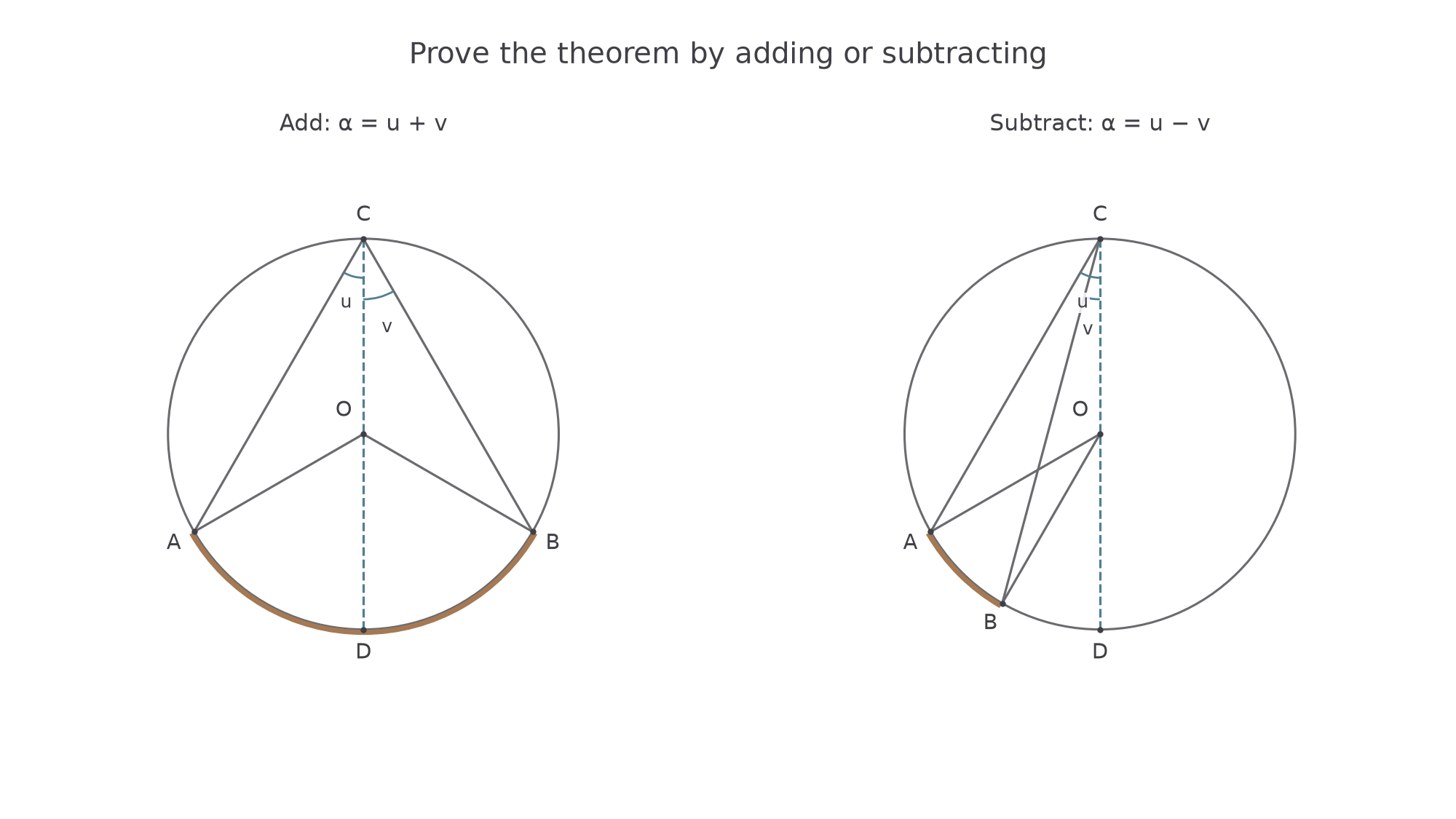
If is on the arc away from , add the two results: . If and are on the same side of , subtract the smaller result from the larger: , naming as the larger angle. If an endpoint is , just one isosceles triangle is needed. This covers the boundary case in which the centre lies on an arm of as well as the interior and exterior cases.
Worked example 1: a minor central angle
Question. , and lie on a circle with centre . . Find the central angle following the arc away from .
Plan. Double the circumference angle, keeping the same arc.
Answer. .
Check. Halving gives the stated . Since the circumference angle is acute, its double is below .
Change only the size of the circumference angle. When it becomes obtuse, the required central angle crosses .
Worked example 2: the central angle is reflex
Question. In another circle, . Find the central angle following the arc away from , and the other angle between and .
Plan. Double first, then use a full turn to find the remaining angle.
Answer. The corresponding angle is reflex ; the other angle is .
Check. , and only , when halved, gives .
The shape may look different after a rotation. Trace the arc rather than choosing whichever central angle looks smaller.
Watch out
The statement “the angle at the centre is twice any angle on the circumference” is too broad. Both angles must stand on the same arc, with the correct choice of reflex or non-reflex central angle.
Use that distinction in your own calculation.
The angle in a semicircle
A diameter creates a right angle at every other point on the circumference, even when the triangle looks far from symmetrical.
Let be a diameter and a point on the circle other than and . The arc away from is a semicircle, so its central angle is a straight angle. The theorem just proved gives
This proves the angle in a semicircle theorem; it does not assume the right angle from the drawing.
Continue this lesson.
You’re previewing NovaLearn without an account. Create a free account to read the rest.
Create free account