10.05c - Exact trigonometric values
Can you find a triangle's height without rounding a calculator value? Two familiar shapes, a square and an equilateral triangle, give exact trigonometric ratios. Use them to build the standard values, understand the boundary angles and calculate exact lengths.
Exact ratios from standard triangles
A square's diagonal and an equilateral triangle's height create right-angled triangles whose side lengths can be found exactly.
An exact value keeps all the information in a number. For example, is exact, whereas 1.414 is a rounded approximation. Leaving a square root in an answer is often more accurate and simpler than writing a long decimal.
[DIAGRAM: asset_name: Two standard triangles give exact ratios; asset_slug: standard-trig-triangles; caption: A half-square gives 45 degrees and a half-equilateral triangle gives 30 and 60 degrees.; description: The left panel shows a square with side 1 split by a diagonal of length square root of 2, with a highlighted right triangle having acute angles 45 degrees. The right panel shows an equilateral triangle of side 2 divided by its perpendicular height into two congruent right triangles. Each has base 1, height square root of 3, hypotenuse 2, angle 30 degrees at the top and 60 degrees at the base.]
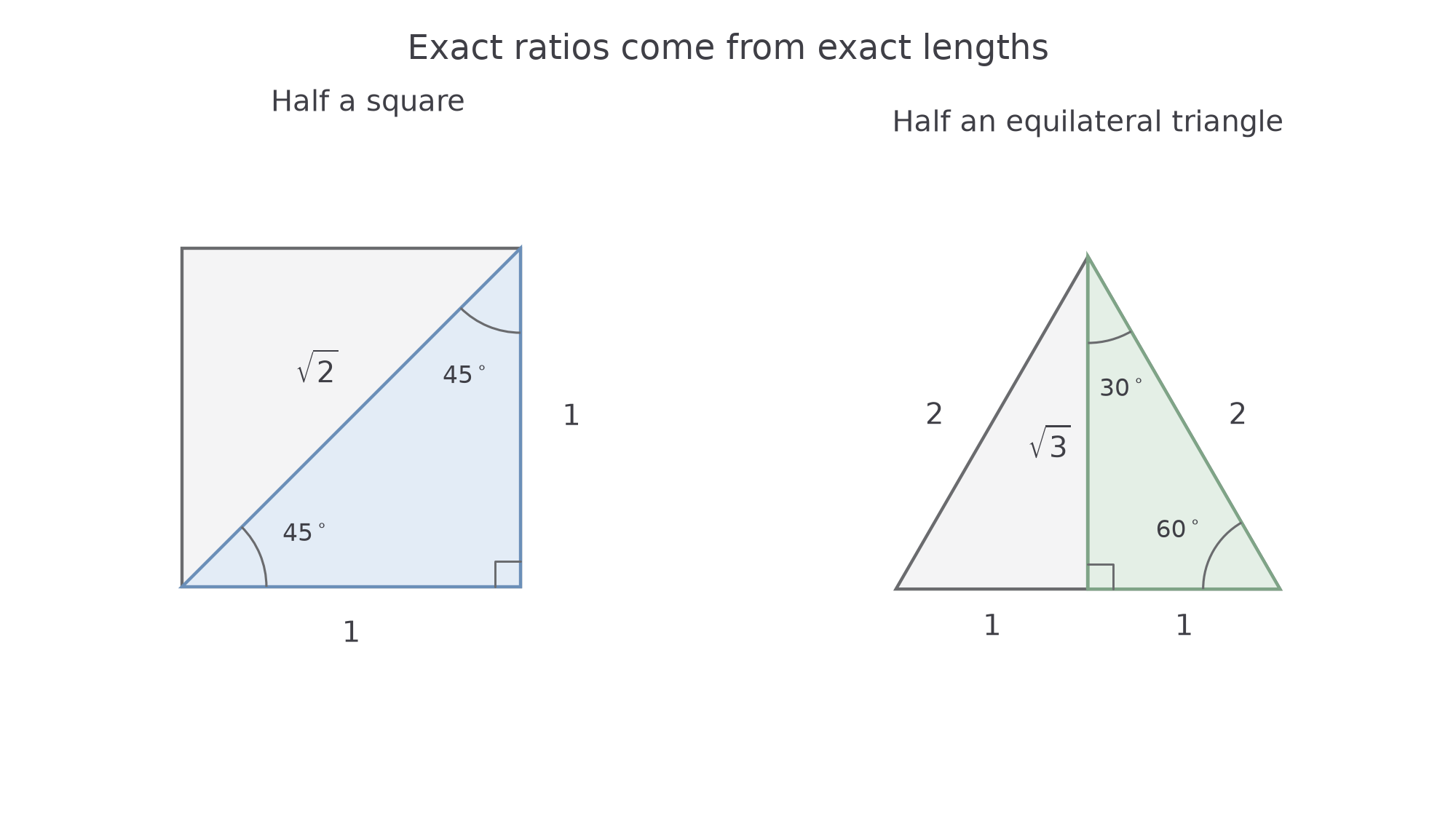
A diagonal bisects a square into two congruent triangles. Each has equal perpendicular sides of length 1, so its acute angles are both . Pythagoras gives the hypotenuse:
An equilateral triangle of side 2 has all angles . Its line of symmetry splits the base into lengths 1 and 1 and the top angle into two angles. The height is perpendicular to the base. Pythagoras gives
These exact lengths now go into the ordinary sine, cosine and tangent ratios.
Worked example 1: ratios in half a square
Question. A right-angled triangle has perpendicular sides 1 and 1, and hypotenuse . Find the sine, cosine and tangent of either acute angle.
Plan. The acute angle is . Use opposite, adjacent and hypotenuse in their usual order.
Answer. Sine and cosine are ; tangent is 1.
Check. Equal shorter sides mean opposite and adjacent can exchange roles without changing either fraction. Tangent is 1 because those sides are equal.
Change the starting shape to half an equilateral triangle. The sides are now unequal, so the two acute angles give different ratios.
Worked example 2: ratios in half an equilateral triangle
Question. A right-angled triangle has hypotenuse 2, a side of length 1 opposite , and its other shorter side . Find all three ratios for and for .
Plan. Label the sides for , then exchange opposite and adjacent for .
Answer. The six exact values are shown above.
Check. Sine at equals cosine at , and vice versa. The same two shorter sides have swapped names. Their tangent ratios multiply to 1.
For these complementary angles, sine of one is cosine of the other. This explains the repeated entries rather than leaving six unrelated facts to remember.
You may also see instead of , and instead of . They are equal: for example, . Either exact form is suitable here; converting the denominator is not needed to use the ratios.
Exact values for the acute standard angles
| Angle | Sine | Cosine | Tangent |
|---|---|---|---|
Try recovering two entries from the triangle rather than a decimal approximation.
Ratios at zero and ninety degrees
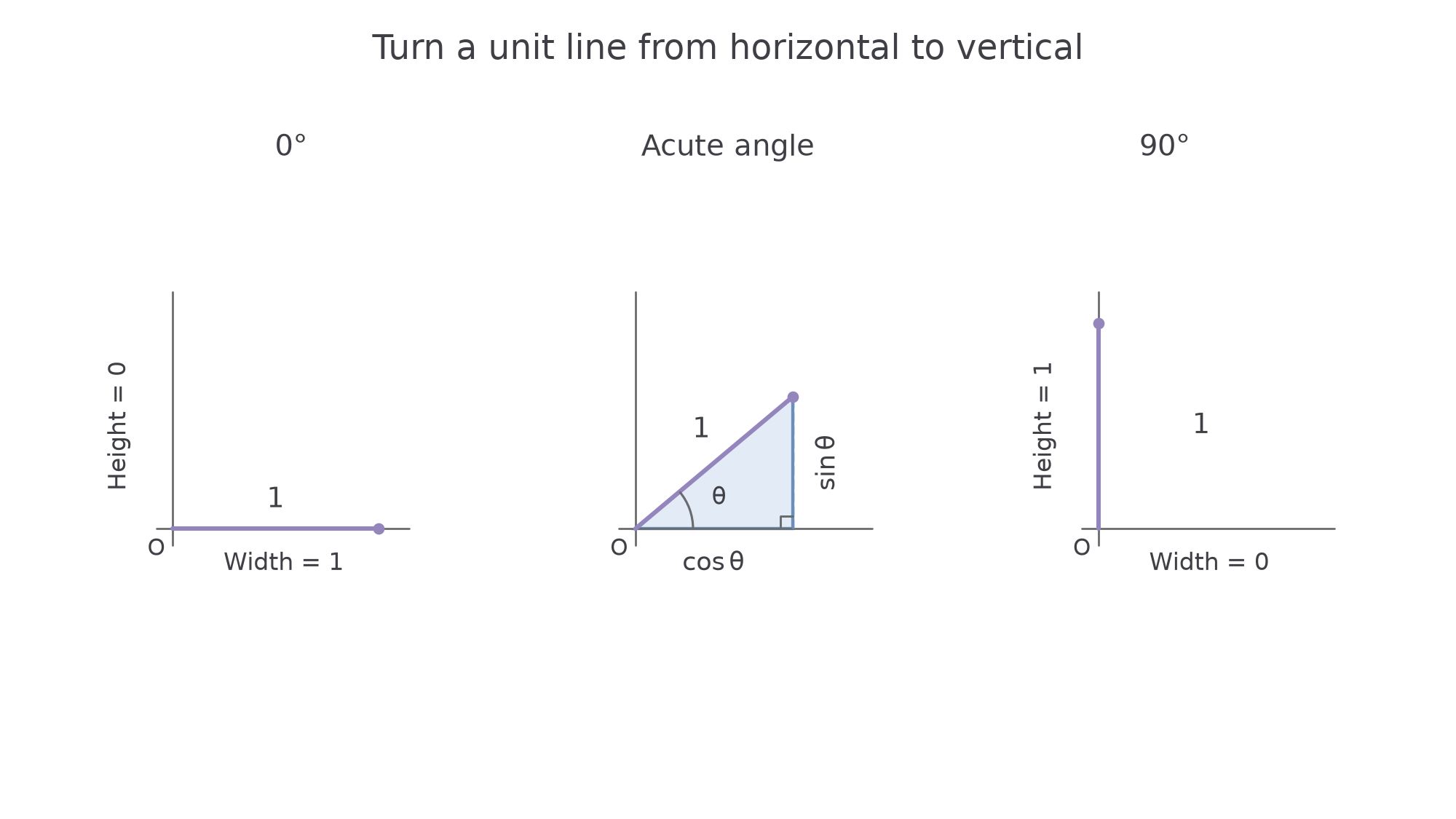
Zero and ninety degrees are boundary angles: they cannot be acute angles of a genuine right-angled triangle, but the ratios extend naturally to them.
Picture a line of length 1 turning from horizontal to vertical. For an angle between and , drop a perpendicular from its upper endpoint to the horizontal baseline. The resulting right triangle has hypotenuse 1, horizontal width , and vertical height .
[DIAGRAM: asset_name: Horizontal and vertical boundary positions; asset_slug: trig-boundary-angles; caption: A unit line has full width at zero degrees and full height at ninety degrees.; description: Three panels show a line of length 1 from O. At 0 degrees its endpoint is at horizontal coordinate 1 and height 0. At an intermediate acute angle it has a horizontal projection labelled cosine theta and a vertical projection labelled sine theta, with a right angle at the foot. At 90 degrees its endpoint has width 0 and height 1.]
Continue this lesson.
You’re previewing NovaLearn without an account. Create a free account to read the rest.
Create free account