6.02d, 10.05e - The cosine rule
Find the third side when two sides and their included angle are known, or find an angle from three sides. Derive the 6.02d formula from Pythagoras, then use 10.05e to choose and combine triangle rules without losing accuracy.
Why the cosine rule works
Two paths leave a hut at an angle of . One reaches a gate away; the other reaches a tower away. How far apart are the gate and tower? There is no known opposite side–angle pair for the sine rule, and the angle is not a right angle. We need a different starting point.
Think first about two sides of lengths and . If they meet at , Pythagoras gives a third side of . If we close the angle to , their endpoints move closer together. The third side should be less than . The cosine rule adjusts Pythagoras to account for that angle.
Included angle
The included angle is the angle between two specified sides. In triangle , sides and meet at , so their included angle is . The side opposite that angle is .
Place at , at , and above the horizontal axis. The horizontal and vertical components of are and .
[DIAGRAM: asset_name: The cosine rule from horizontal and vertical distances; asset_slug: cosine-projection; caption: Pythagoras uses the horizontal difference c minus b cos A and the vertical height b sin A.; description: Two panels show triangle ABC with A at the origin and B at horizontal coordinate c. In the acute panel C has positive horizontal coordinate b cos A. In the obtuse panel it has negative horizontal coordinate b cos A, with the perpendicular foot left of A. Both show AC equal to b, BC equal to a and the perpendicular height b sin A.]
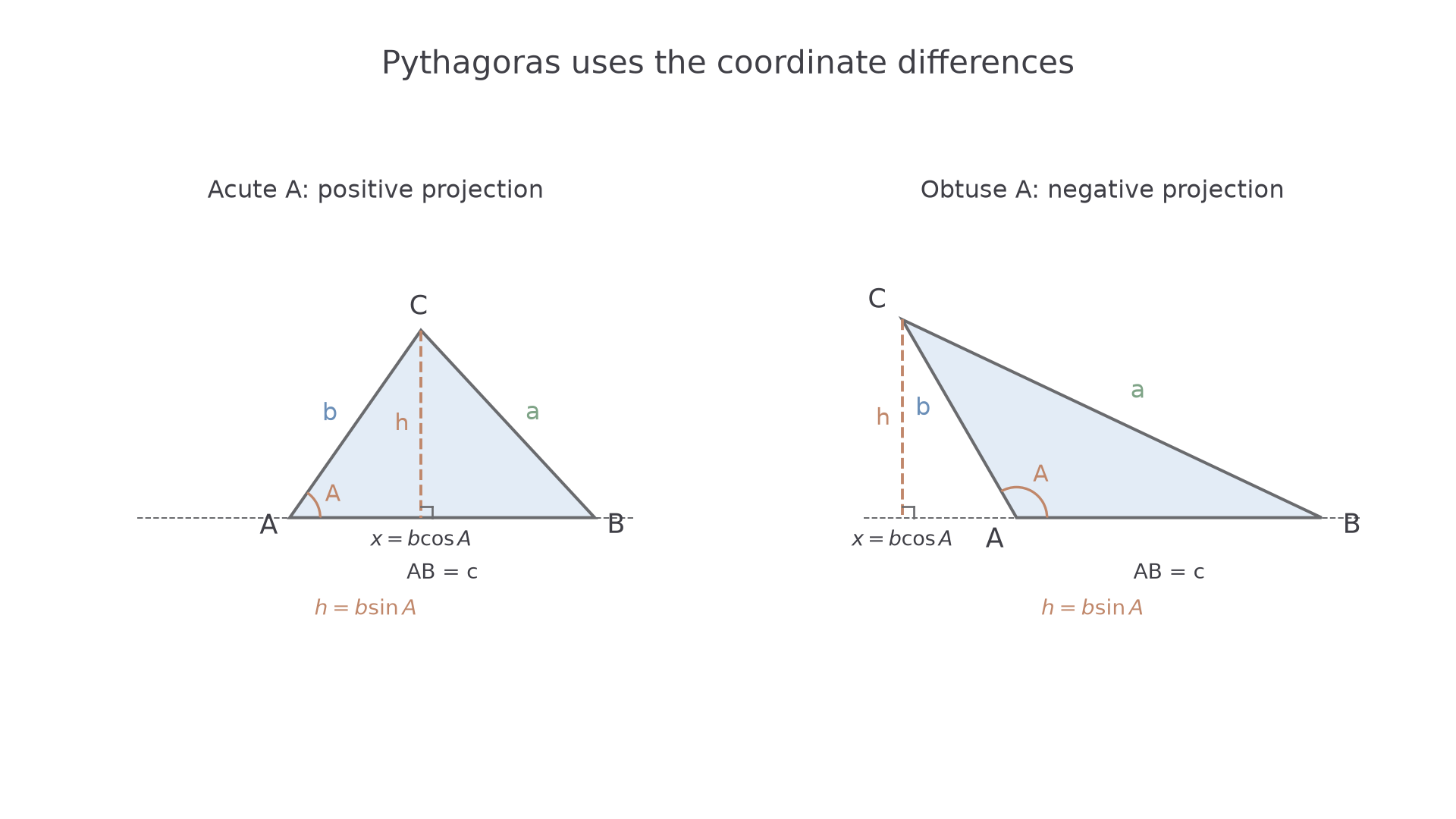
The squared horizontal separation of and , plus their squared vertical separation, is . This is the coordinate form of Pythagoras.
The last step uses , which comes from dividing Pythagoras by the hypotenuse squared in a right-angled triangle. For an obtuse angle, reflecting across the vertical axis makes the horizontal component negative and leaves the height positive: , while the sine stays the same. The coordinate calculation therefore works for obtuse triangles too.
Cosine rule
In any non-degenerate triangle, with opposite ,
The angle is between sides and . At , , so the rule becomes Pythagoras.
In the June and November 2027 Higher Tier Formulae Sheet.
Use a right angle first to see the familiar special case.
Worked example 1: recovering Pythagoras
Question. Two sides are and , with included angle . Find the opposite side .
Plan. Substitute into the cosine rule and use .
Answer. .
Check. Direct Pythagoras gives the familiar –– right-angled triangle.
Change only the included angle to . The correction term now subtracts a positive amount.
Worked example 2: closing the angle
Question. The same two sides, and , meet at . Find exactly.
Plan. Use , then take the positive square root.
Answer. .
Check. The endpoint of the side has coordinates . Its distance from is , and is smaller than , as expected.
The rule covers both cases. It does not require you to call any side the hypotenuse unless there is a right angle.
Watch out
The correction is , with the two sides that touch . Do not use an angle opposite one of those sides in that position.
Look for the vanishing correction term in this case.
Finding the third side
Use the cosine rule directly when you know two sides and their included angle.
Label the unknown opposite that angle, substitute carefully, and calculate the squared length first. Then take the positive square root because a side length is positive. Use degree mode, and retain the full expression or stored calculator value until the final rounding.
Worked example 3: an acute included angle
Question. Two sides are and , with included angle . Find the third side to significant figures.
Plan. The known angle lies between the known sides, so use the cosine rule.
Answer. .
Check. With the -unit side on the horizontal axis, the other endpoint is . Its squared distance from is .
Keep both sides the same and change only the angle to its supplement, . The cosine changes sign.
Worked example 4: an obtuse included angle
Question. Two sides are and , with included angle . Find the third side to significant figures.
Plan. Keep the subtraction sign in the formula, then substitute the negative cosine.
Answer. .
Check. The horizontal separation is now , giving . The side opposite is the longest, but , as a triangle requires.
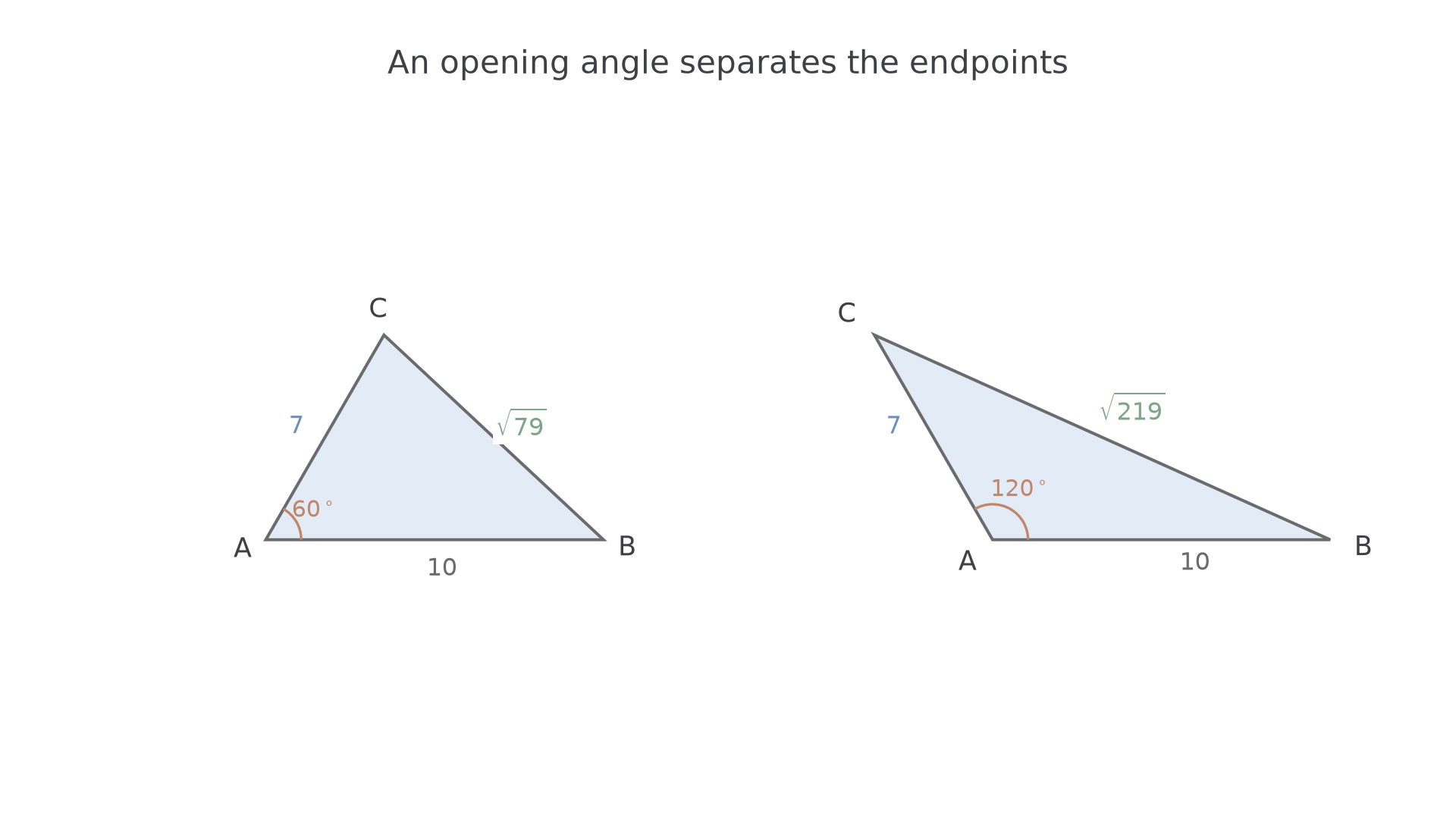
The drawing makes the sign change visible: the endpoints separate as the included angle opens.
[DIAGRAM: asset_name: Opening the included angle; asset_slug: cosine-angle-change; caption: Keeping the two sides fixed, changing 60 degrees to 120 degrees increases the opposite side.; description: Two accurately drawn triangles have sides 7 and 10 meeting at a common labelled vertex in each panel. Their included angles are 60 degrees and 120 degrees, and the respective opposite sides are labelled square root 79 and square root 219.]
Watch out
An obtuse angle does not make a squared length negative. Since its cosine is negative, subtracting adds a positive amount.
Apply the same sequence to a new triangle.
Continue this lesson.
You’re previewing NovaLearn without an account. Create a free account to read the rest.
Create free account