11.02d, 11.02f - Probability trees
Why does taking one counter change the chance of the next colour, while tossing a coin usually does not? Under 11.02d you will build and complete probability trees. Under 11.02f you will multiply along paths and add alternative paths for both independent and dependent events.
Representing successive events
A tree records what can happen next, starting from each possible history. At a branching point, the outgoing branches must describe every next outcome without overlap. Their probabilities therefore add to one.
A probability tree
A probability tree has a branch for each possible next event. A complete path describes a sequence of events, in order. A probability written on a branch is the chance of that next event from the particular point where the branch starts.
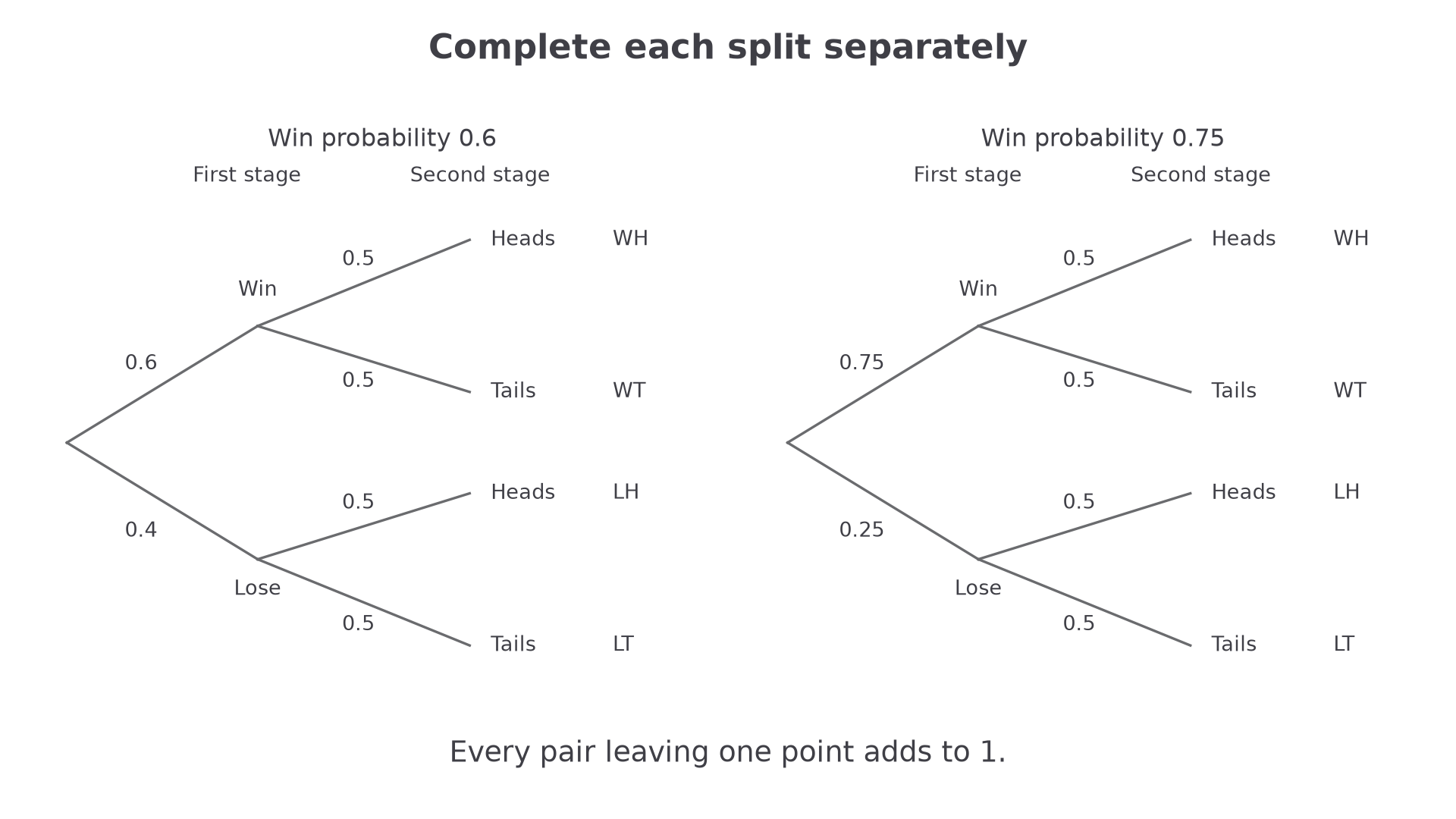
Draw one stage at a time. Label events first, then fill their probabilities. A two-stage tree with two possibilities at each stage has four complete paths. A completed frame still needs branch probabilities in the right places.
[DIAGRAM: asset_name: Completing successive-event trees; asset_slug: tree-stage-completion; caption: Each pair of branches leaving a point adds to one.; description: Two side-by-side trees show a game followed by an independent fair coin toss. The first has win 0.6, lose 0.4 and heads 0.5, tails 0.5 after either result. The second changes only the game probabilities to win 0.75 and lose 0.25. Complete paths WH, WT, LH and LT are labelled.]
Worked example 1: completing missing branches
Question. A game is won with probability . After the game, an independent fair coin is tossed. State every branch probability and list the complete outcome paths.
Plan. Use complements at each split, keeping the coin stage after either game result.
Answer. First-stage probabilities are win , lose . Each second-stage split has heads , tails . The paths are WH, WT, LH and LT.
Check. , and each coin split has . Every game/coin sequence occurs in the list once.
Change only the win probability. The coin does not respond to the game result, so its branches remain unchanged.
Worked example 2: changing one stage
Question. The game now has win probability ; the independent coin is still fair. Complete the probabilities and list the paths.
Plan. Recalculate only the complementary game probability.
Answer. The first branches are ; both later pairs are . The four paths remain WH, WT, LH and LT.
Check. The new first split totals one. Changing probabilities has changed how likely the paths are, not which paths are possible.
If a stage has a certain result, a branch may have probability one and its alternative zero. The branch-sum rule still works. Do not add every probability printed anywhere on a tree: only the branches leaving the same point form one complete split.
Watch out
“Win then heads” and “lose then heads” are different paths, even though both finish with heads. Keep both second-stage copies; merging them loses the history the tree is meant to record.
Describe the completed branches in text.
Independent event paths
To find the chance of a complete path, take the stated fraction of the group reaching each stage. If half the trials reach one point and a third of those continue along a branch, one sixth of all trials follow that combined route. This is why path probabilities multiply.
Independent events
Two events are independent if knowing whether one occurred does not change the probability of the other. Independent repetitions therefore use the same next-stage probabilities after either first result.
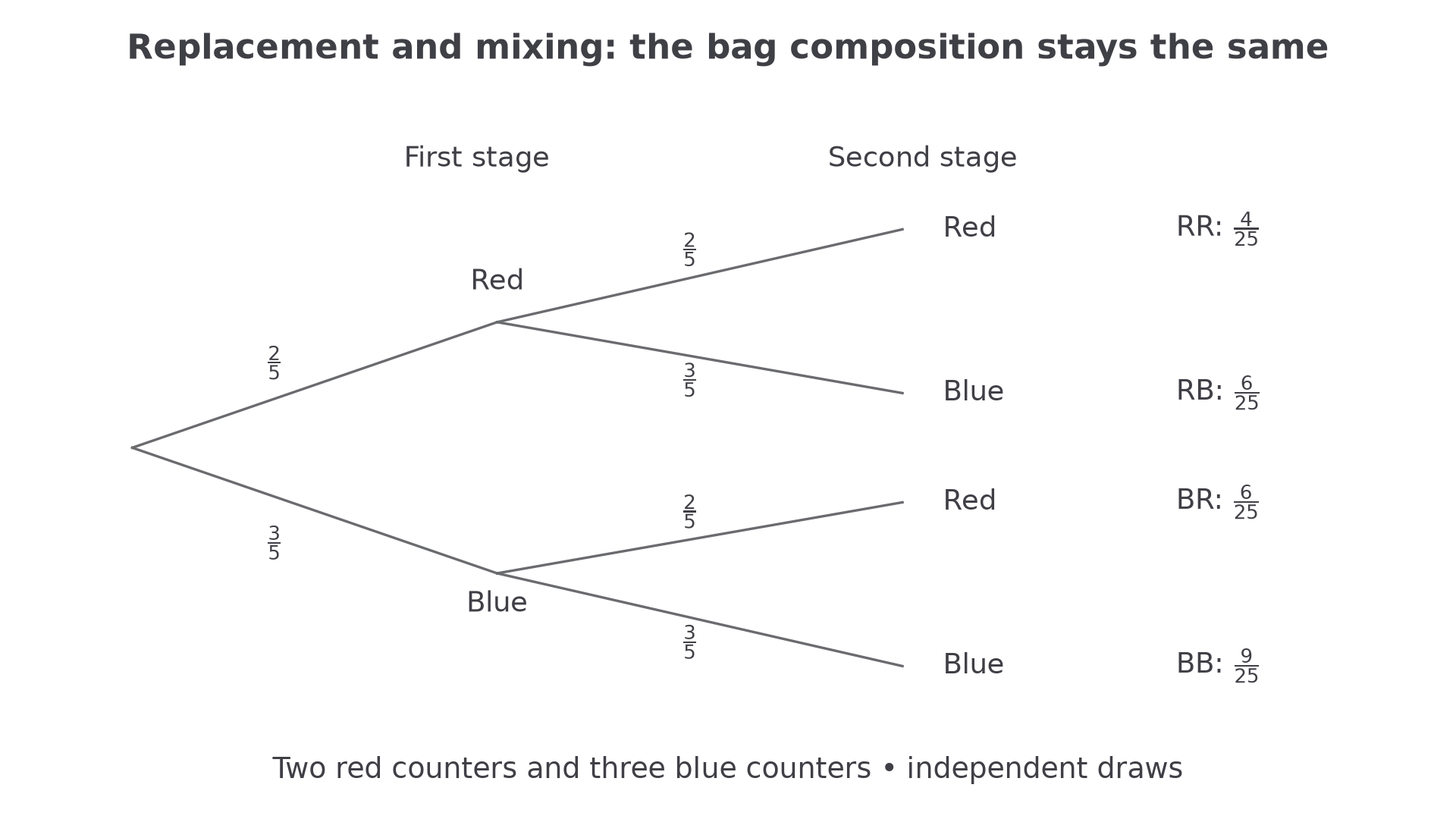
Replacing a counter and mixing the bag thoroughly can keep its composition unchanged. The model below also states that each random selection is independent; the phrase “with replacement” alone does not describe a fair mixing procedure.
[DIAGRAM: asset_name: Independent counter selections; asset_slug: tree-with-replacement; caption: Replacing the counter keeps both second-stage splits the same.; description: A two-draw tree for a bag of two red and three blue counters with replacement. First red 2/5 and blue 3/5. After either result, red 2/5 and blue 3/5. Endpoints RR, RB, BR and BB carry probabilities 4/25, 6/25, 6/25 and 9/25.]
Multiplying an independent path
For independent events and ,
The independent form is not separately printed on the 2027 sheets: learn how to multiply the relevant tree branches. The general conditional version is supplied at Higher.
We start with a specific path and then change only its second result.
Worked example 3: two reds with replacement
Question. A bag has two red and three blue counters. A counter is chosen at random, replaced, and the bag mixed. A second independent random choice is made. Find the probability of red then red.
Plan. Follow the RR path and multiply its two branch probabilities.
Answer. .
Check. Temporarily label the five counters. The equally likely ordered pairs include red-red pairs.
The bag and replacement process stay the same, but the desired second colour becomes blue.
Worked example 4: red then blue
Question. For the same experiment, find the probability of red then blue.
Plan. Follow RB, using the blue probability at the second stage.
Answer. .
Check. The labelled-counter count gives suitable ordered pairs out of . Also, , the first-red probability.
Independence does not mean equal probabilities: here red and blue have different chances. It also differs from mutual exclusivity. A red first draw and a blue second draw can happen together.
Watch out
Do not add for red then blue. Addition would combine alternative outcomes; this path requires both stages, so multiply.
Use the same reasoning for a different bag.
Continue this lesson.
You’re previewing NovaLearn without an account. Create a free account to read the rest.
Create free account