11.02a, 11.02b - Systematic lists and sample spaces
Two fair dice can total seven in several ways, but total two in only one. In 11.02a, use outcome grids to calculate probabilities without treating different totals as equally likely. In 11.02b, list possibilities systematically, deciding first whether order matters and whether repetition is allowed.
Listing outcomes systematically
Suppose you choose two different activities from art , baking and cycling . Does mean something different from ? It does if you are choosing a morning activity followed by an afternoon activity. It does not if you are simply choosing an unordered pair.
A systematic list follows a fixed rule so possibilities are neither missed nor counted twice. First read the restrictions: how many choices, whether a choice can repeat, and whether the order distinguishes outcomes. Then fix one choice at a time and work through the remaining choices in a consistent order.
Worked example 1: an ordered choice
Question. Choose a morning activity and a different afternoon activity from , and . List every possible order.
Plan. Fix the morning activity, then list each available afternoon activity.
Answer. : six possible orders.
Check. Each of the three possible first activities has its two different partners listed once. There are no repeated-activity choices such as .
Change only whether order matters. We still choose two different activities from the same three, but now choose just the pair to attend at some point.
Worked example 2: an unordered choice
Question. List every unordered pair of different activities from , and .
Plan. Keep each pair once, writing its letters in alphabetical order.
Answer. : three pairs.
Check. Each ordered pair from the previous list belongs to exactly one reversal pair: , , . Keeping one from each leaves three.
Systematic ordering also works when arranging all three letters. Fix first and swap the other two, then do the same with and :
There are six arrangements, each using every letter once. Do not silently allow repeats or merge orders that the question treats as different. A complete list is often the simplest way to justify a count without needing a general counting formula.
Watch out
and are different for first-and-second choices, but the same for an unordered pair. Decide this before counting, not after calculating a probability.
Use the unordered-pair method with four new activities.
Grids for combined outcomes
A sample space is the complete set of possible outcomes. A grid is useful when one result is combined with another: use one set of results for column headings and the other for row headings. Each cell then represents one ordered pair.
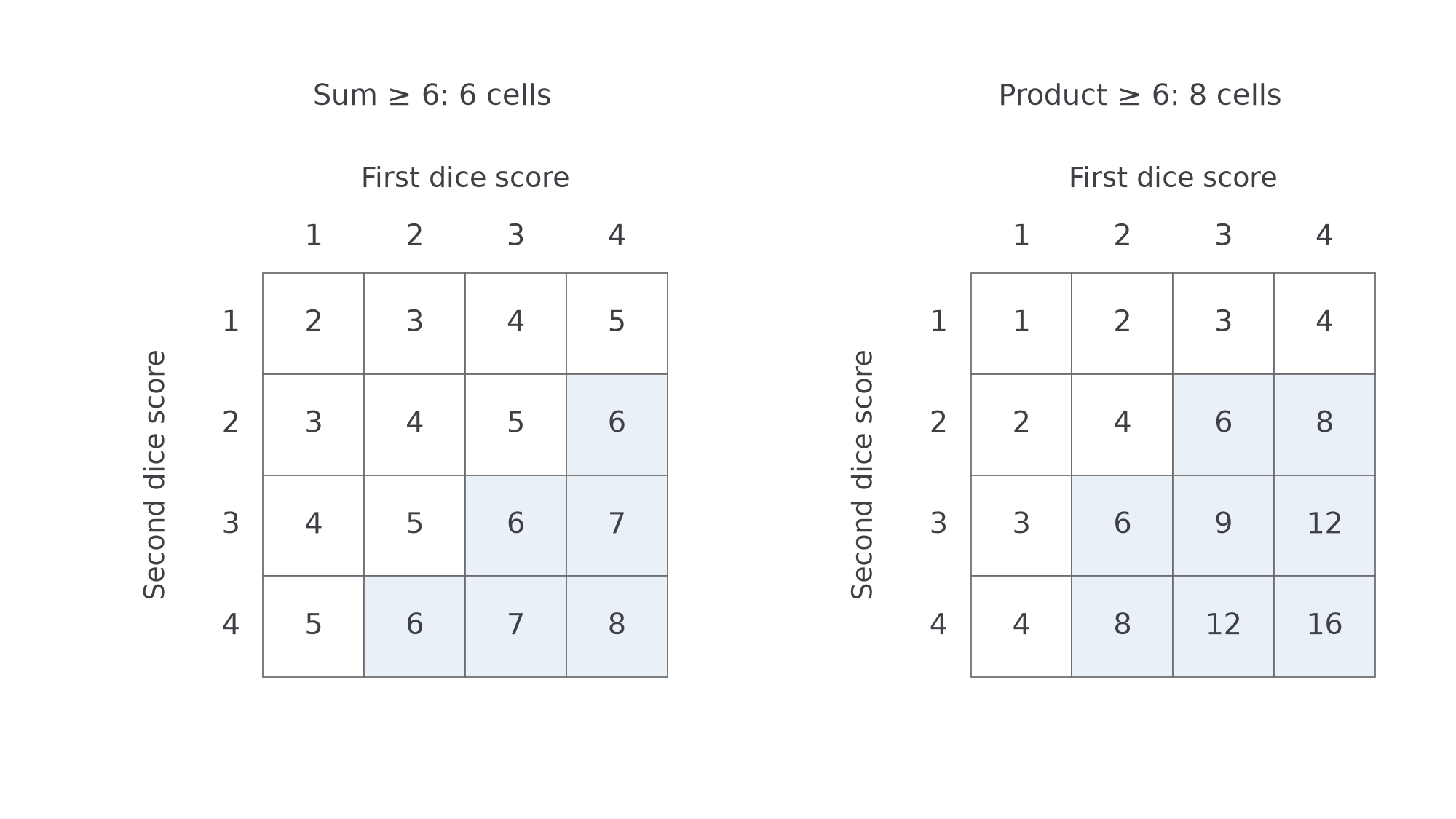
For two independent fair four-sided dice labelled , , , , all sixteen cells are equally likely. To make a sum grid, add the row and column labels. To make a product grid, multiply them. A repeated value in different cells represents several different ways to obtain that value, so keep every occurrence.
[DIAGRAM: asset_name: Sum and product sample spaces; asset_slug: sum-product-grids; caption: The same sixteen ordered dice pairs give different favourable cells when the combining operation changes.; description: Two four-by-four grids have row and column headings one two three four. The left cells contain sums and the right products. Cells with results at least six are shaded, six in the sum grid and eight in the product grid.]
Worked example 3: a sum grid
Question. Two independent fair four-sided dice, each numbered to , are rolled. Find the probability that their sum is at least six.
Plan. Add row and column scores, then count all cells containing six, seven or eight.
Answer. .
Check. The favourable counts by first score are , totalling six. The other ten cells have sums below six, giving all sixteen cells.
Keep the dice and threshold unchanged; change only addition to multiplication. The ordered pairs are unchanged, but their recorded results differ.
Continue this lesson.
You’re previewing NovaLearn without an account. Create a free account to read the rest.
Create free account