2.01a - Equivalent fractions and mixed numbers
Can two differently written fractions represent exactly the same amount? Learn to change the size of the parts without changing the value, simplify fractions and move between mixed numbers and improper fractions.
Equal fractions
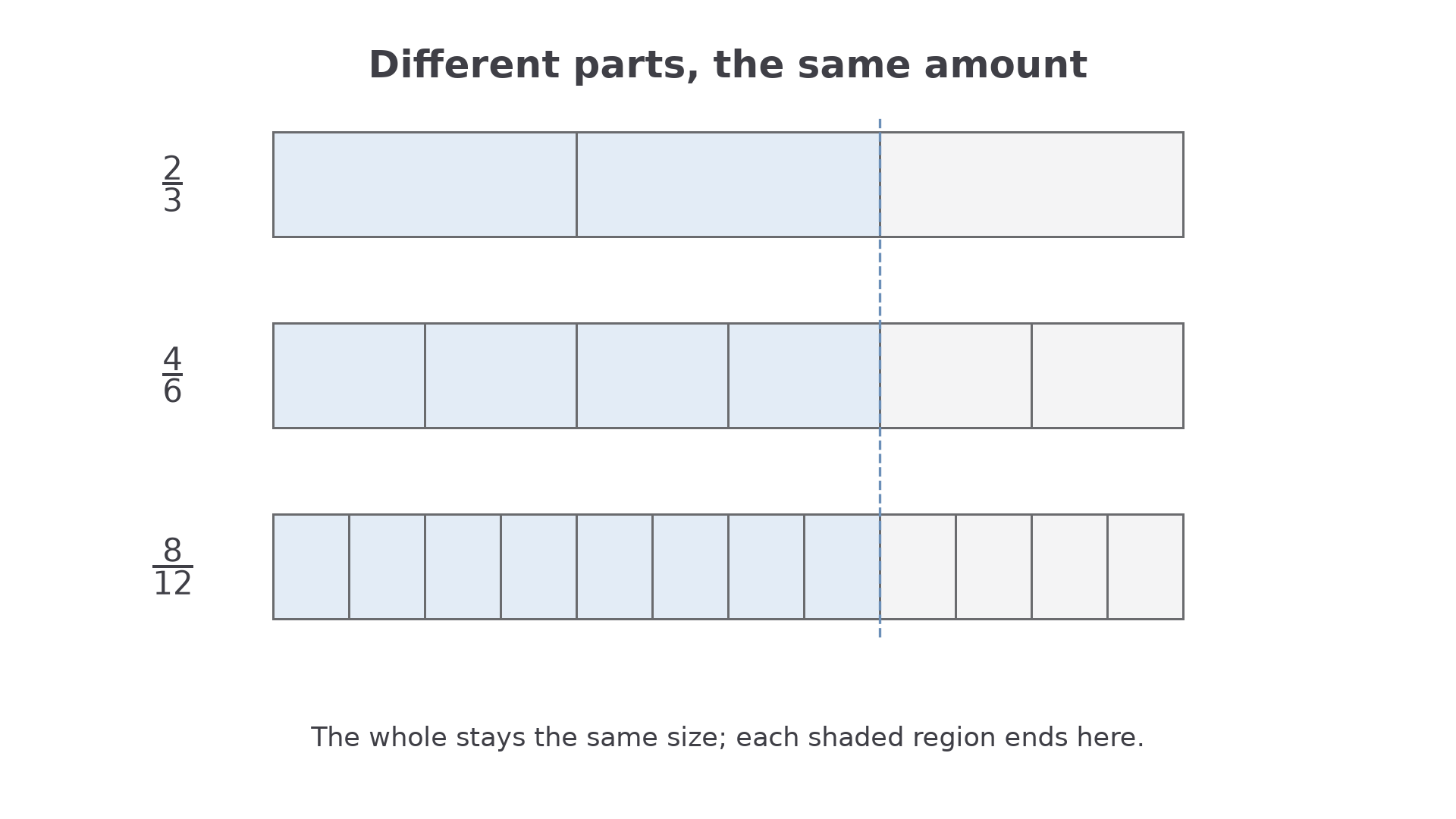
If you cut every third of a chocolate bar in half, do you get more chocolate? No: two shaded thirds become four shaded sixths, but the shaded amount stays the same. Fractions count equal parts of a chosen whole, so the size of that whole matters.
[DIAGRAM: asset_name: Equivalent thirds sixths and twelfths; asset_slug: equivalent-fraction-bars; caption: Two thirds, four sixths and eight twelfths cover the same amount of the same whole.; description: Three equal-length horizontal bars. The top bar has three equal parts with two shaded blue, the middle six equal parts with four shaded blue, and the bottom twelve equal parts with eight shaded blue. Their shaded right edges align.]
Numerator and denominator
In , the denominator, , tells you that a whole is divided into three equal parts. The numerator, , counts two of those parts. The denominator cannot be zero. We normally write numerical fractions with a positive denominator, placing a negative sign in front when needed.
Equivalent fractions have the same value. Multiplying numerator and denominator by the same nonzero number preserves their ratio. With whole-number parts, multiplying both by a positive whole number splits every old part into the same number of smaller parts.
Worked example 1: splitting every part
Question. Write as a fraction with denominator .
Plan. Find the factor taking to , then apply it to the numerator too.
Answer. .
Check. Put the twelve small parts into three groups of four: eight shaded small parts make two of those three groups, recovering .
Change only the numerator, so that the starting fraction is greater than one. Equivalence still works; fractions do not have to lie below one.
Worked example 2: equivalence above one
Question. Write as a fraction with denominator .
Plan. Use the same denominator scale factor of four.
Answer. .
Check. and , which restores the original fraction. Both fractions are greater than one.
This is the useful surprise: changing both counts together can leave an amount unchanged, even when both written numbers become much larger.
Watch out
Adding the same number to top and bottom does not preserve value: . Split each part equally by multiplying, rather than adding one extra part.
Find the denominator's scale factor first.
Simplest form
You can reverse splitting by grouping equal small pieces together. In , grouping every six small pieces makes three groups out of five. Dividing numerator and denominator by the same common factor is called cancelling.
Simplest form
A fraction is in simplest form when its integer numerator and positive denominator have no common factor greater than . Their highest common factor is . For instance, is simplest, but is not.
Divide by the highest common factor to finish in one step. Using smaller common factors in several steps also works. A fraction need not be proper to be in simplest form: is simplest even though it is greater than one. Also, , and .
Worked example 3: cancelling a common factor
Question. Write in its simplest form.
Plan. Divide both numbers by their HCF, .
Answer. .
Check. Multiplying both and by restores . Neither nor divides the other, and both are prime, so no further cancellation is possible.
Change only the numerator so that the fraction exceeds one. The HCF is still six.
Worked example 4: simplifying an improper fraction
Question. Write in its simplest form.
Plan. Cancel the HCF of and .
Answer. .
Check. Scaling by gives . Both values exceed one because their numerators exceed their denominators.
If a question asks for simplest form, stop only when there is no common factor left.
Watch out
is correct, but unfinished. Both and are still divisible by , giving . Cancelling digits, rather than factors of the whole numbers, is not a valid method.
Use the HCF or a sequence of valid cancellations.
Mixed numbers and improper fractions
Fifths continue after the first whole: five fifths make one, ten fifths make two and thirteen fifths make two wholes with three fifths left.
Proper, improper and mixed
For non-negative fractions with a positive denominator, a proper fraction has numerator smaller than denominator. An improper fraction has numerator greater than or equal to denominator. A mixed number combines a whole number and a proper fraction, such as . The space in a mixed number means addition, not multiplication.
To convert a mixed number, count all the fractional units: multiply the whole number by the denominator, then add the numerator. Keep the denominator because the size of each part has not changed.
Worked example 5: counting all the fifths
Question. Write as an improper fraction.
Plan. Count the fifths in two wholes, then include the extra three fifths.
Answer. .
Check. Taking away leaves , the stated extra part.
Now reverse the direction of conversion. Division finds how many complete wholes can be made from the same thirteen fifths.
Worked example 6: finding wholes and a remainder
Question. Write as a mixed number.
Plan. Divide by ; use the quotient for the whole number and the remainder for the numerator.
Answer. .
Check. rebuilds the original numerator.
If the remainder is zero, the answer is a whole number: . For a negative mixed number, the minus applies to the whole amount: , rather than . Keeping this sign clear will help with fraction arithmetic.
Watch out
. Multiplying by the numerator loses the two whole units. Each whole contains five fifths, so the correct count is .
Use the remainder as a fraction of one whole.
Quick Recap
- Equivalent fractions name the same value; scale numerator and denominator together.
- Cancel common factors to reach simplest form.
- A mixed number counts wholes plus a proper fraction.
- Improper fractions can represent amounts equal to or greater than one.
Cutting each third in half changes into , but it creates no extra chocolate: the whole and the shaded amount stay the same.