7.01f, 7.02b - Circles and perpendicular tangents
A circle equation describes every point the same distance from its centre. In 7.01f you will use an origin-centred circle, and in 7.02b you will find perpendicular lines and the tangent at a given point. These are Higher-tier coordinate-geometry skills.
The equation of a circle
Can you find the tangent to a circle at without drawing a careful tangent? The radius gives the direction you need, but first we must check that the point really lies on the circle.
The point is units from the origin: a right triangle gives . Every point on the circle of radius has that same distance. Negative coordinates do not change the squared distance.
[DIAGRAM: asset_name: A circle from Pythagoras; asset_slug: origin-circle; caption: Squared horizontal and vertical distances add to the squared radius.; description: An equal-scale coordinate diagram shows the circle x squared plus y squared equals twenty-five, the radius from the origin to three comma four, and a right triangle with horizontal length three and vertical length four. The four axis intercepts are marked.]
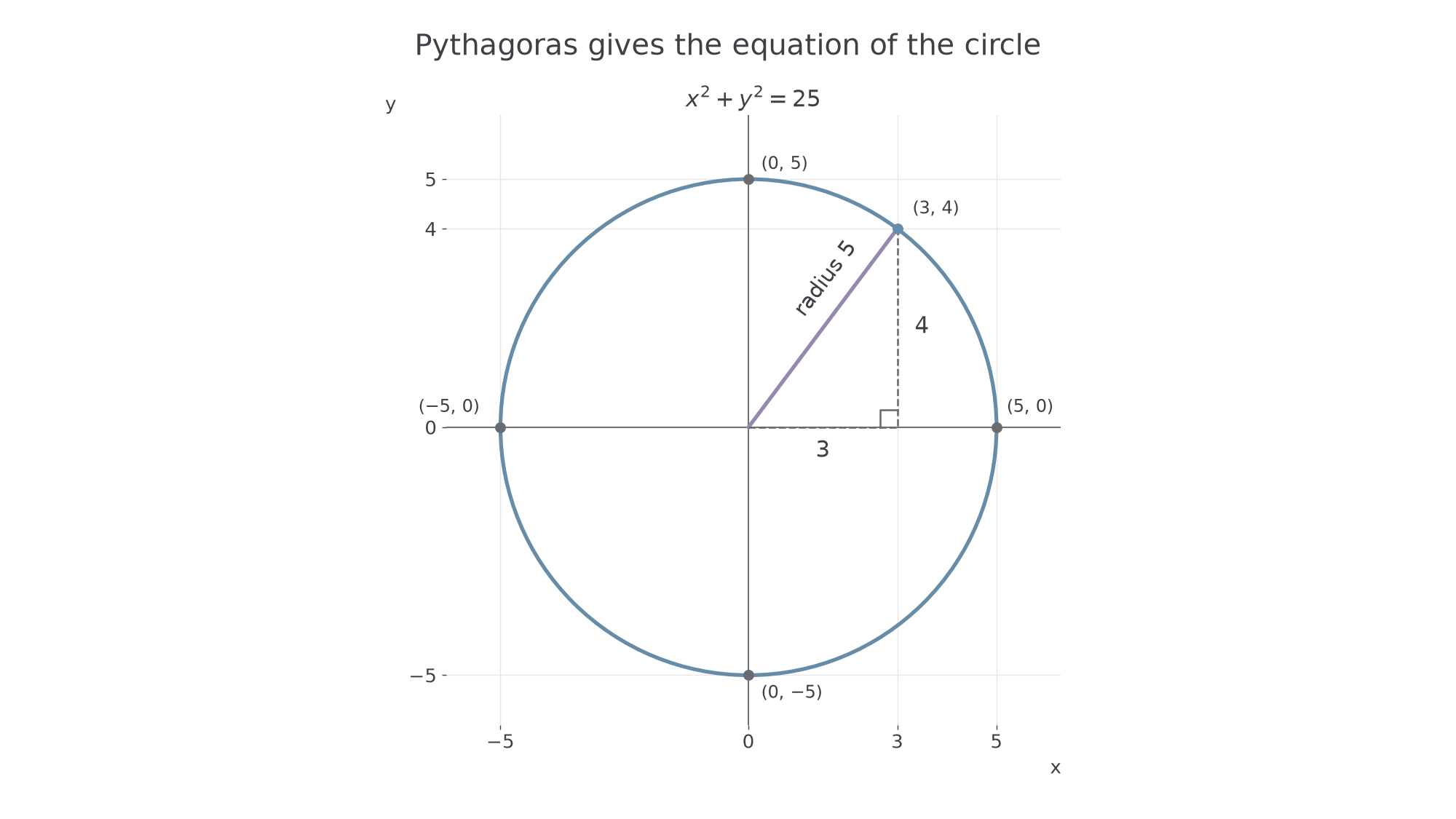
Origin-centred circle
The centre is and the radius is . This follows from Pythagoras. Not on the 2027 formula sheet: learn it.
To test a point, substitute both coordinates. Equality means on the circle. A smaller sum means inside and a larger sum means outside, because the sum is the square of the distance from the centre. The equation with right side zero gives only the origin; a negative right side gives no real points.
Worked example 1: identifying a circle
Question. State the centre, radius and axis intercepts of . Check whether lies on it.
Plan. Read the squared radius, then set one coordinate to zero for each pair of intercepts.
Answer. Centre , radius , intercepts , , , . The point is on the circle.
Check. All four intercepts are distance from the origin, matching the radius.
Change only the right-hand constant. The centre stays fixed, while the radius changes by its square root.
Worked example 2: a larger squared radius
Question. State the centre, radius and axis intercepts of . Decide whether the same point lies on it.
Plan. Repeat the radius and intercept calculations, then compare the point's squared distance.
Answer. Centre , radius , intercepts and . The point is inside, not on, this circle.
Check. Its distance is still , which is smaller than the new radius . You cannot find “the tangent at ” to this circle because the point is not on it.
The equation is a distance statement, not a recipe that makes every supplied point a circle point.
Watch out
In , the radius is , not . Take the positive square root of the constant.
Check both the radius and the proposed point.
Perpendicular gradients
Perpendicular lines meet at a right angle, and their directions are linked by a quarter turn.
A line of gradient can move units right and up. Turn that direction through : one perpendicular direction moves right and down, giving gradient . The rise and run exchange jobs, and one changes sign.
[DIAGRAM: asset_name: A quarter turn of direction; asset_slug: perpendicular-directions; caption: A right-three up-two direction turns into a right-two down-three direction.; description: Equal-scale axes show two perpendicular lines through the origin, with direction steps three comma two and two comma negative three. Dashed rise-and-run triangles label both gradients, and a right-angle marker lies between the directions.]
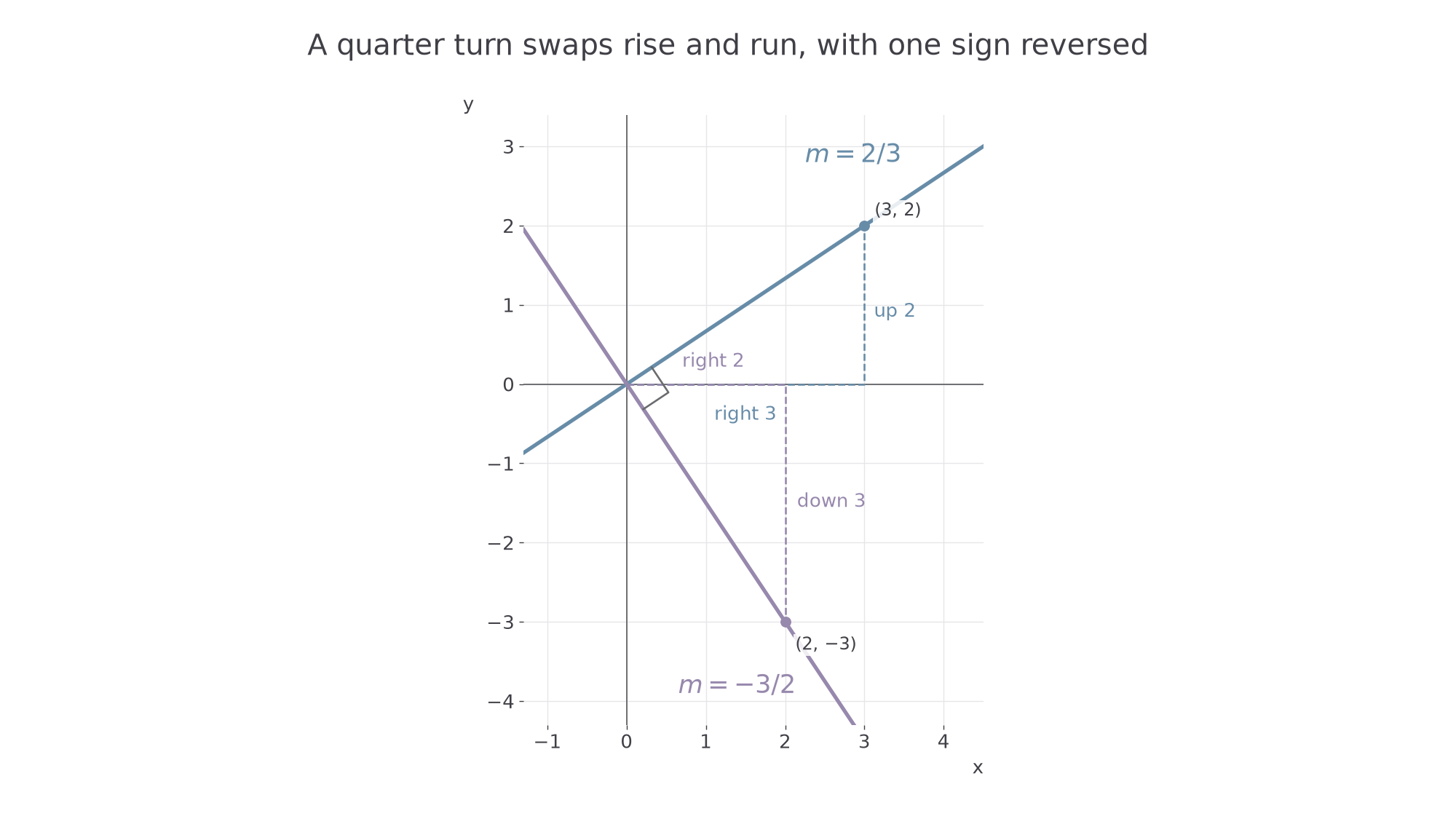
Perpendicular finite gradients
These forms apply when both gradients are finite and nonzero. A horizontal line has gradient zero and is perpendicular to a vertical line, whose gradient is undefined. Not on the 2027 formula sheet: learn these direction rules.
Once you know a finite gradient, substitute a point into to find . The perpendicular gradient alone does not choose one particular line.
Worked example 3: perpendicular to a rising line
Question. Find the line through perpendicular to .
Plan. Take the negative reciprocal of the gradient, then use the point.
Answer. .
Check. , and at the new equation gives .
Change only the sign of the original gradient. Its perpendicular now rises.
Worked example 4: perpendicular to a falling line
Question. Find the line through perpendicular to .
Plan. Use the new negative reciprocal and the same point.
Answer. .
Check. , and , so both conditions hold.
Horizontal and vertical lines need a direction argument rather than division by zero.
Continue this lesson.
You’re previewing NovaLearn without an account. Create a free account to read the rest.
Create free account