10.01a - Converting units
Does changing metres to centimetres multiply an area by 100 too? Convert length, mass, area, volume, capacity, time and money without changing the quantity. Use the same reasoning when measurements contain letters, and see why square and cubic units need different factors.
Length and mass conversions
A square tile is wide. Each edge is , but does that mean its area is ? Hold that question while we first make sense of changing the units of one length.
Unit conversion
A unit conversion changes how a quantity is expressed, not the quantity itself. A smaller unit needs a larger numerical count: the same ribbon contains more millimetres than centimetres.
The prefixes tell you useful relationships: “kilo” means a thousand, “centi” a hundredth, and “milli” a thousandth. For standard length and mass units, use these exact facts.
| Length | Mass |
|---|---|
Converting to smaller units means multiplying by the number of small units in one large unit. Reverse the conversion by dividing by the same factor. Do not choose multiplication merely because a question says “convert”.
Worked example 1: metres to centimetres
Question. Convert to centimetres.
Plan. Count one hundred centimetres for every metre.
Answer. .
Check. . Also, and contribute and .
Now reverse only the conversion direction. The number must decrease when the unit becomes larger.
Worked example 2: centimetres to metres
Question. Convert to metres.
Plan. Group the centimetres into hundreds.
Answer. .
Check. Four metres use , leaving .
Mass follows the same reasoning, with its own factor. For example, , and . Each check reverses the multiplication or division. Kilograms to grams uses 1000, not the 100 used for metres to centimetres.
Watch out
is impossible: the same length needs more centimetres than metres. Use the unit relationship and a size check together.
Apply the larger-unit direction to a mass.
Area and volume units
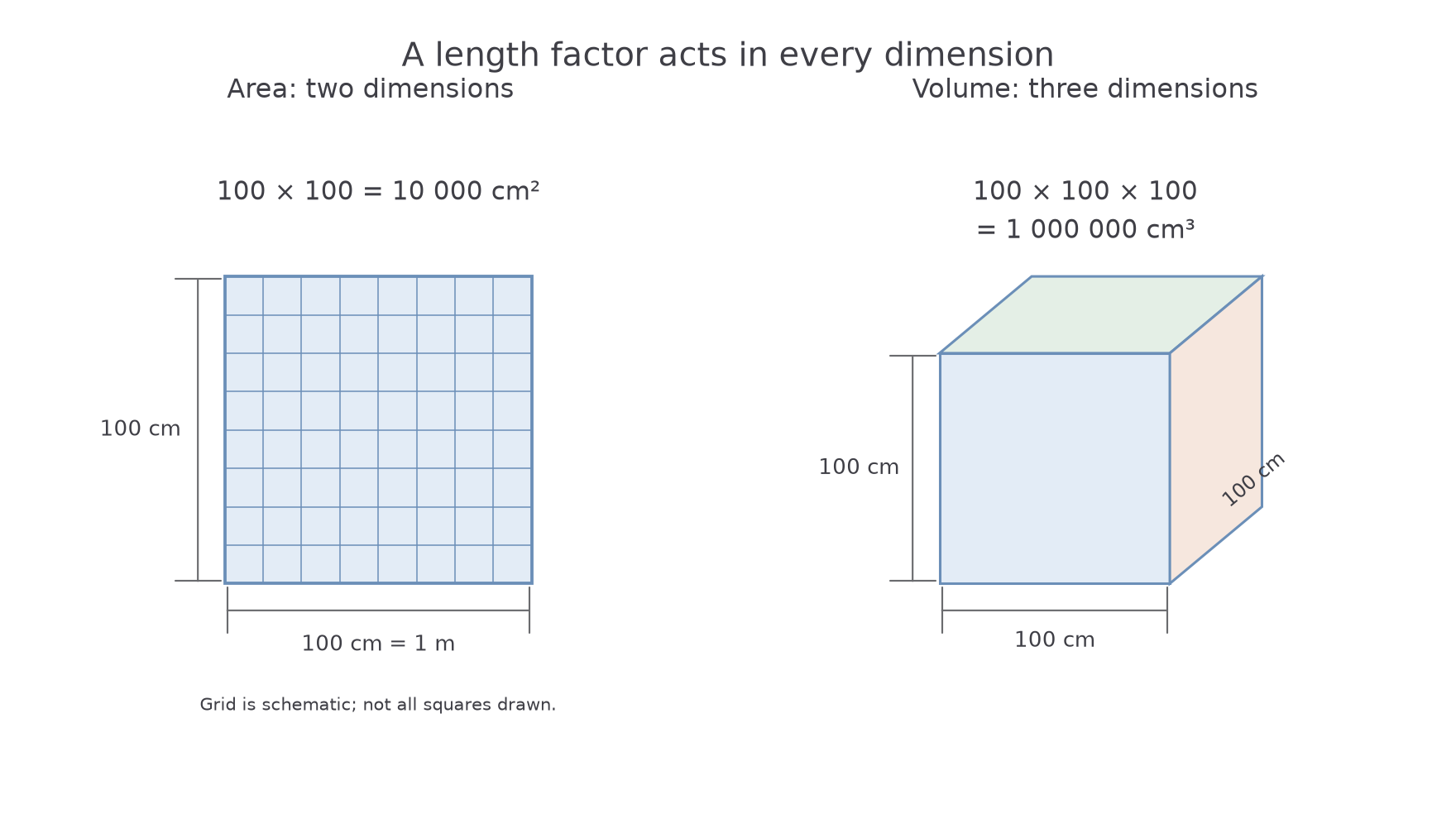
An area counts unit squares, while a volume counts unit cubes. Changing the unit changes two dimensions for area and three for volume.
The opening tile is one metre along each side. There are 100 one-centimetre squares along each row and 100 rows. That is squares, not 100.
[DIAGRAM: asset_name: Why area and volume factors are squared and cubed; asset_slug: squared-cubed-units; caption: A one-metre square contains 100 by 100 square centimetres. A one-metre cube contains 100 by 100 by 100 cubic centimetres.; description: Left panel shows a square with both sides labelled one metre equals one hundred centimetres. A schematic grid indicates 100 columns and 100 rows, giving 10000 square centimetres. Right panel shows a cube with three edges labelled one hundred centimetres, giving 1000000 cubic centimetres. The grid is schematic, with a note that not every unit square or cube is drawn.]
Square and cubic conversion factors
If one larger length unit equals smaller length units, then
Use the reciprocal factors in the reverse direction. These conversion rules are not on the 2027 formula sheet: understand them rather than relying on a sheet.
In particular, , , , and .
Worked example 3: square metres to square centimetres
Question. Convert to square centimetres.
Plan. Square the length factor of 100 before converting the area.
Answer. .
Check. A rectangle measuring by has the same dimensions as by . Counting its rows and columns gives square centimetres.
Change only the conversion direction. Divide by the squared factor.
Worked example 4: square centimetres to square metres
Question. Convert to square metres.
Plan. Group the square centimetres into groups of 10000.
Answer. .
Check. is three quarters of the square centimetres in one square metre.
Capacity is the volume a container can hold. Its common units link exactly to cubic units:
A cubic centimetre is not a square centimetre: one measures space, the other surface.
Worked example 5: cubic metres to litres
Question. Convert to cubic centimetres and then litres.
Plan. Cube the length factor, then use 1000 cubic centimetres per litre.
Answer. .
Check. litres directly, since a cubic metre holds 1000 litres.
Reverse only the cubic-unit direction in the next example.
Worked example 6: litres to cubic metres
Question. Convert to cubic centimetres and then cubic metres.
Plan. Turn litres into cubic centimetres, then divide by the cubic factor.
Answer. .
Check. litres, recovering the starting capacity.
The opening tile therefore has area . A length factor of 100 becomes an area factor of 10000 and a volume factor of 1000000.
Continue this lesson.
You’re previewing NovaLearn without an account. Create a free account to read the rest.
Create free account