6.01d, 6.01e - Quadratic expressions
What happens when both factors contain a letter? Multiply two binomials, reverse the expansion to factorise monic quadratics, and use the cancellation in a difference of two squares, including exact square roots.
Multiplying two binomials
A rectangle has side lengths and . Is its area ? Splitting each side shows two extra regions that this tempting answer misses.
[DIAGRAM: asset_name: Four products in a rectangle; asset_slug: two-bracket-area; caption: Each term in the first bracket multiplies each term in the second.; description: A rectangle of width x plus three and height x plus two, split into four regions. The widths are x and three; the heights are x and two. The four areas are labelled x squared, three x, two x and six. The picture uses positive x.]
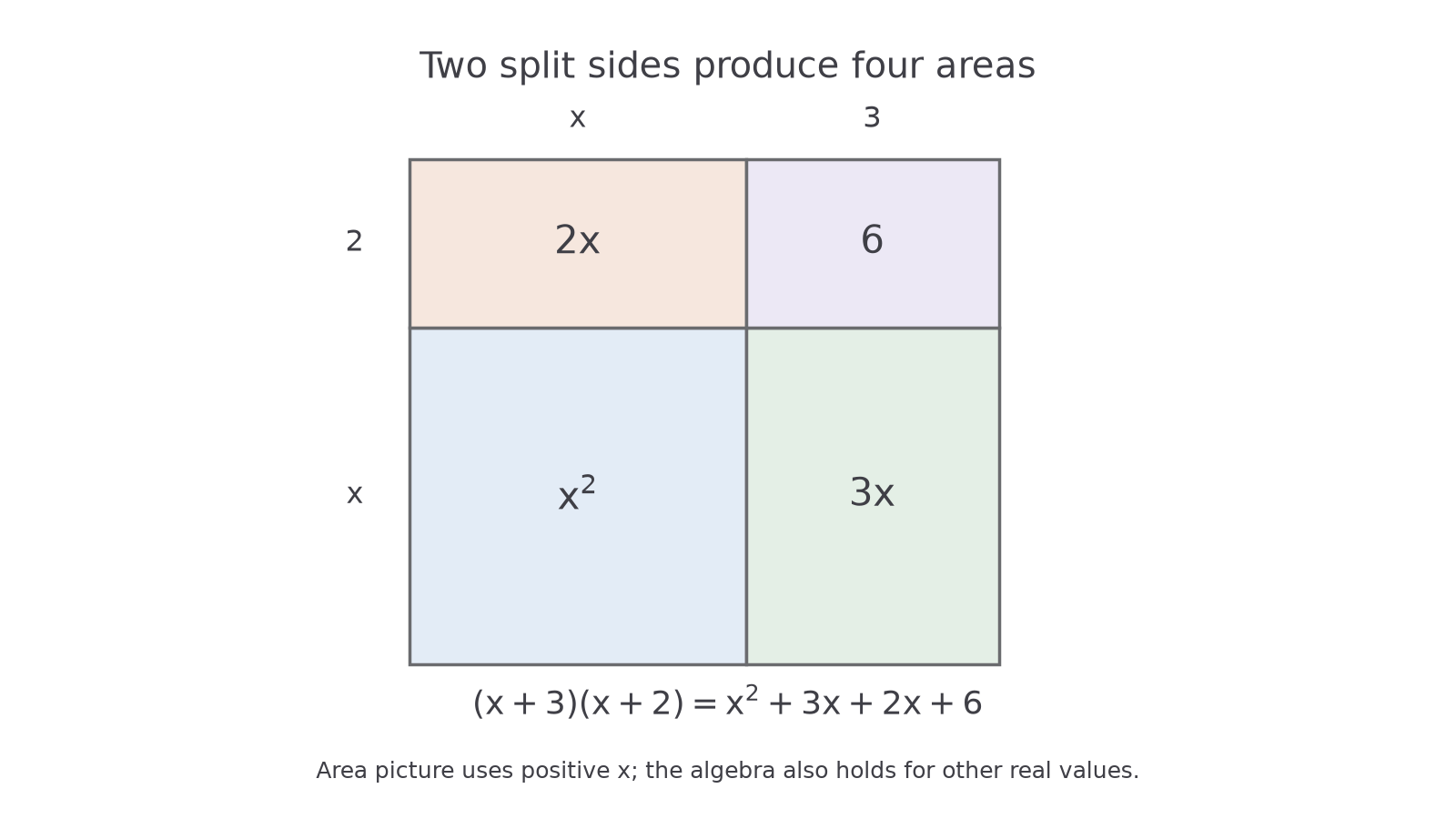
The four areas add to . The two middle regions explain why multiplying only the first terms and the last terms is incomplete. A binomial is an expression with two terms; multiplying two binomials gives four products before any like terms are collected.
Multiplying two binomials
Every term in one bracket multiplies every term in the other. The rule holds for all real values, including negative terms and zero. It is not supplied on the 2027 formula sheets: learn it.
Use distribution twice: first , then distribute within each part. A grid is another way to keep track of the same four products.
Worked example 1: two positive constants
Question. Expand and simplify .
Plan. Find all four products, then collect the two -terms.
Answer. .
Check. At , the bracket form is , and the expansion is .
Change only the sign of the two in the second bracket. Two of the four products now change sign.
Worked example 2: one negative constant
Question. Expand and simplify .
Plan. Multiply every pair, keeping negative two as a signed term.
Answer. .
Check. At , the brackets give , matching .
The same method works with other letters or coefficients. For example, . The negative sign belongs to in both of its products.
Watch out
misses the products and . Make four products before you simplify. When squaring a bracket, there are still four products: , not .
Use the same structure with a fresh positive and negative constant.
Finding quadratic factors
Expanding the general product gives . To reverse that process, find two numbers whose sum gives the middle coefficient and whose product gives the constant term.
Monic quadratic
A quadratic expression has highest variable power two after simplification, with a non-zero squared-term coefficient. It is monic when that coefficient is one, as in .
For , the numbers must satisfy both and .
When seeking integer factors, list factor pairs of and use the signs. A positive product requires two signs the same; their sum decides which sign. A negative product requires opposite signs; their sum decides which number has the greater magnitude. If no integer pair works, say so rather than forcing a false factorisation. For example, has no such integer pair: the only integer pairs with product one are and , whose sums are two and negative two, not one.
Worked example 3: two negative factors
Question. Factorise .
Plan. Find a pair with product six and sum negative five.
Answer. .
Check. Expansion gives . Both the middle term and constant agree.
Change only the sign of the constant term. The product must now be negative, so the two numbers have opposite signs.
Worked example 4: opposite signs
Question. Factorise .
Plan. Find an opposite-sign pair with product negative six and sum negative five.
Answer. .
Check. Expanding gives . The constant is negative and the middle coefficient is negative five, as required.
A repeated pair is allowed too: . If the constant is zero, use the common-factor method: .
Watch out
Finding a pair with the correct product is only half the job. For , has constant but middle term . Reverse the signs to obtain .
The next quadratic does have an integer pair; use both conditions to find it.
Differences of squares
Multiply and the middle products cancel: one is , the other is . This makes a two-term expression factorise into two binomials.
Difference of two squares
For all real and ,
The two brackets have the same terms and opposite signs between them. This rule is not on the 2027 formula sheets: learn it.
Recognise both squares before writing the factors. For example, , so its factors are . You need subtraction: does not follow this difference-of-squares pattern.
Worked example 5: a square-number constant
Question. Factorise .
Plan. Write nine as a square and use the opposite-sign brackets.
Answer. .
Check. Expanding gives , with no middle term.
Change only the constant from nine to five. Five is not the square of an integer, but it is the square of its exact square root. You do not need a decimal approximation.
Worked example 6: an exact square root
Question. Factorise using exact values.
Plan. Write and use the same pattern.
Answer. .
Check. The middle terms and cancel. The constant product is , exactly as required.
This is the connection: “not a square number” does not mean “cannot be written as a square”. Every positive real number is , so . At , this becomes . For , is not real, so that real-root construction does not apply.
Watch out
is wrong: squaring one bracket produces . The opposite signs in are what cancel the middle terms and make the constant negative.
Keep the square root exact in this new factorisation.
Quick Recap
- Multiply every term in one binomial by every term in the other, then collect like terms.
- For monic quadratic factors, the two constants must have both the correct sum and the correct product.
- Not every monic quadratic has integer factors.
- In a difference of squares, opposite-sign brackets cancel the middle terms.
- Exact square roots let you factorise for positive without rounding.
The rectangle's area is , because the two middle regions contribute . Multiplying only the corners misses part of the area.