6.03d - Solving equations with graphs
Where do two different rules give the same answer? Use intersections to solve linear equations and simultaneous equations, and choose an accuracy that the graph can support.
Reading an intersection
Two lines cross at a single point. Why does that point solve both equations at once?
Every point on the first line satisfies its equation; every point on the second satisfies the other. A point on both therefore satisfies both together. To read it, trace vertically to the -axis for its first coordinate, then horizontally to the -axis for its second. Read the scale on each axis separately.
Intersection
An intersection is a point shared by graphs. Its coordinates are values that satisfy all the corresponding equations simultaneously.
A graph usually gives an approximate reading. If a small interval represents , halfway across represents . Do not write several decimal places that the drawing cannot distinguish. Follow any stated accuracy, and use for an estimate.
Worked example 1: a crossing on grid lines
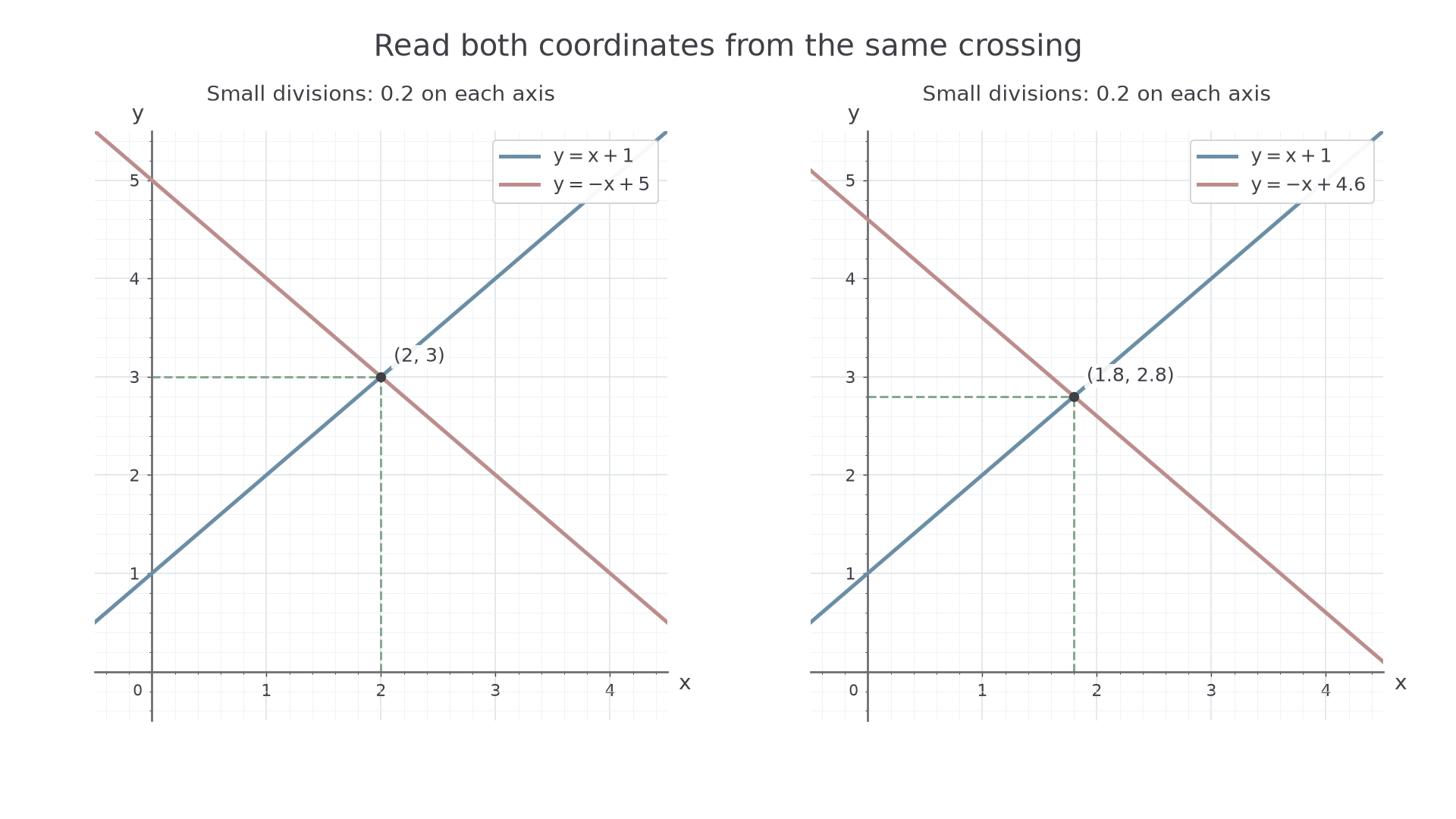
Question. Use the left-hand graph below to solve and .
Plan. Locate the crossing and project it to the two axes.
Answer. , .
Check. At , both equations give : and . Here the graphical readings happen to be exact.
Lower only the intercept of the falling line, from to . The crossing moves between the main grid lines.
Worked example 2: reading smaller divisions
Question. Use the right-hand graph to solve and .
Plan. Use the small divisions, each worth , for both coordinate readings.
Answer. , .
Check. and . Both heights agree with the read point.
[DIAGRAM: asset_name: Reading two line intersections; asset_slug: reading-intersections; caption: Project the same crossing to both axes and read each scale.; description: Two coordinate grids show a rising line y equals x plus one meeting a falling line. The left falling line is y equals negative x plus five and the right is y equals negative x plus four point six. Dashed coordinate guides show crossings at two three and one point eight two point eight. Small divisions represent zero point two.]
Watch out
Do not swap the coordinates. A crossing two units along and three units up is , meaning and .
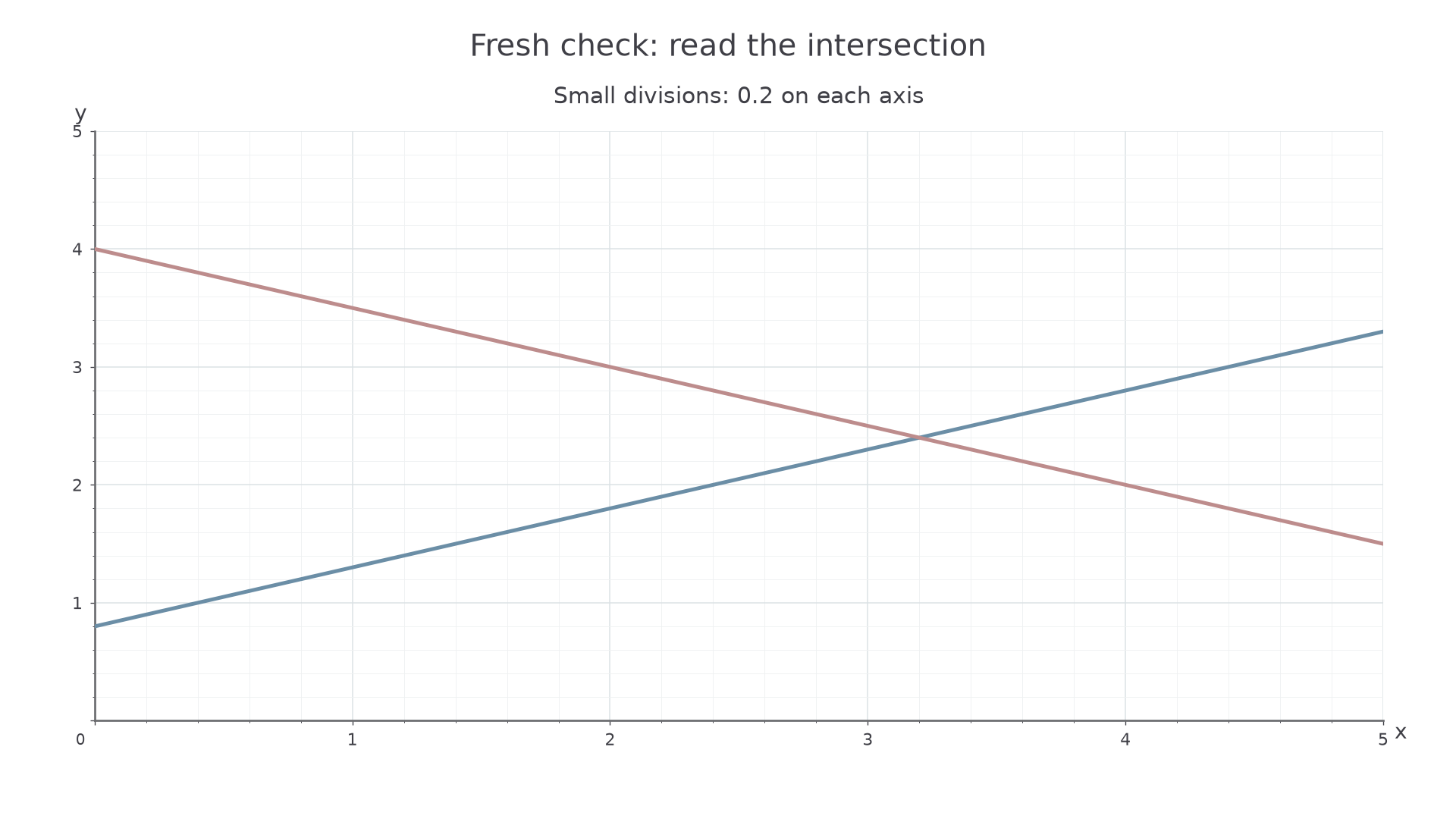
Read the new crossing from its own graph.
[DIAGRAM: asset_name: Fresh intersection reading check; asset_slug: intersection-check; caption: Use this graph for the check below with small divisions of zero point two.; description: A scaled coordinate grid shows two unlabelled straight lines meeting at three point two two point four. Each small division on both axes represents zero point two.]
One equation on a graph
To solve graphically, look for the input where the graph of reaches height .
Draw the horizontal line , find its intersection with the existing graph, and read the -coordinate. The common height helps locate the solution, but the equation asks for . The graph must extend far enough to include the crossing.
More generally, to solve an equation whose two sides both depend on , graph each side as a height: for , draw and . Their intersection has equal heights, so its -coordinate solves the original equation.
Worked example 3: reaching a given height
Question. Use the graph of to solve .
Plan. Draw , then read horizontally to the sloping line and down to .
Answer. .
Check. Substitution gives , exactly the required height.
Raise only the target height from to . The new input will be slightly larger.
Continue this lesson.
You’re previewing NovaLearn without an account. Create a free account to read the rest.
Create free account