6.02d, 10.05a - Pythagoras' theorem
A rectangular garden is 6 metres by 8 metres. How long is the straight path between opposite corners? Use squared areas to explain Pythagoras' theorem, then find missing lengths in right-angled triangles and simple two-dimensional shapes.
An area proof of Pythagoras
A diagonal takes a shortcut across the garden, but adding the two edge lengths measures a different route. The connection we need is between the squares of the lengths.
In a right-angled triangle, the two sides meeting at the right angle are perpendicular. The side opposite that angle is the hypotenuse, the longest side. Call the perpendicular side lengths and , and the hypotenuse . All three lengths are positive and measured in the same units.
[DIAGRAM: asset_name: Four triangles prove Pythagoras; asset_slug: pythagoras-area-proof; caption: Four identical right-angled triangles leave a square of side c.; description: An outer square has side a plus b. Four congruent right-angled triangles of perpendicular sides a and b are placed against its four corners, leaving a central tilted square with all four sides c. The two acute angles of a triangle are alpha and beta, adding to 90 degrees.]
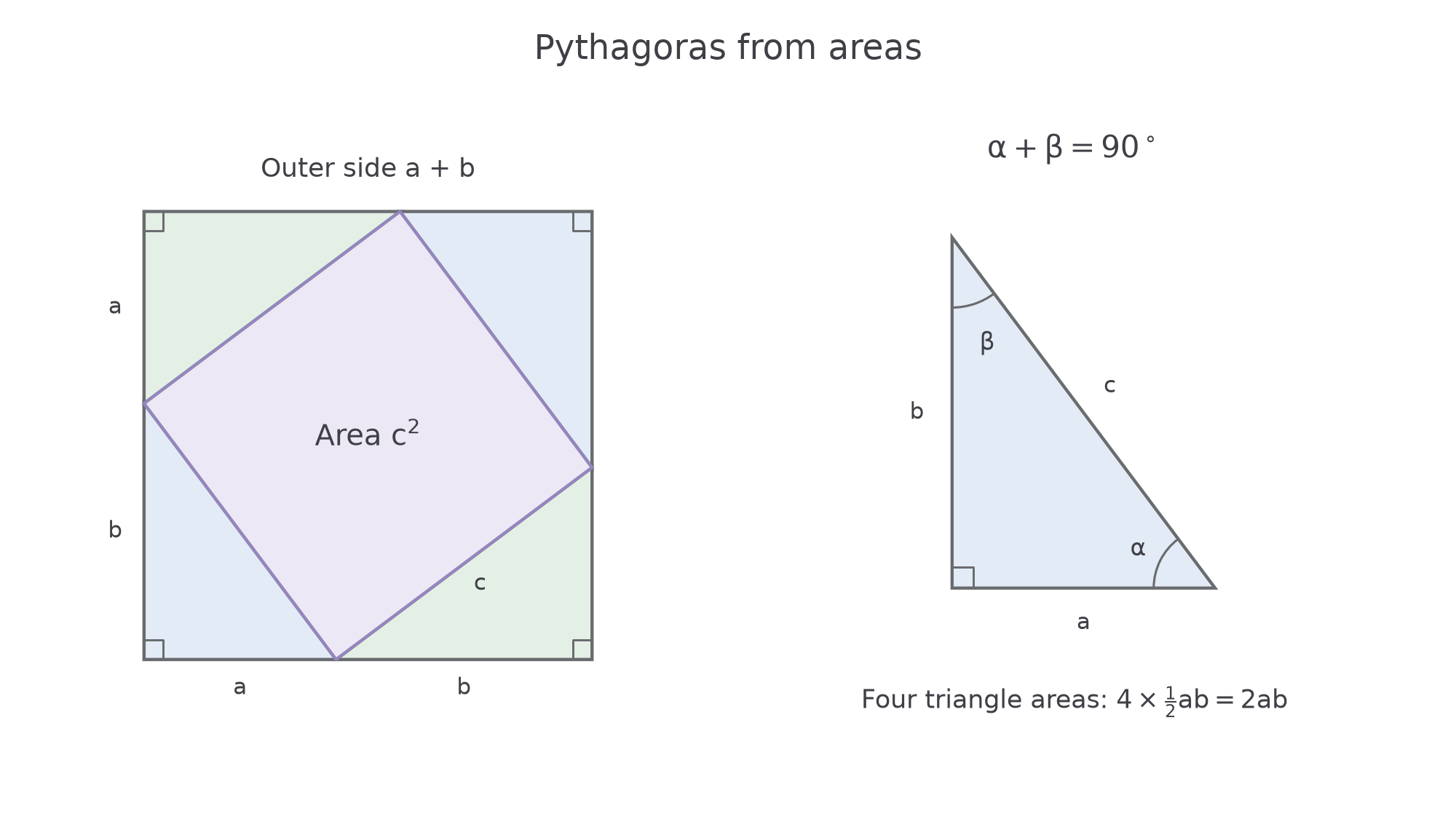
The outer square has area . The four triangles together have area . The remaining shape has four sides of length . Each of its angles is , since the two acute angles of a right-angled triangle add to . So the centre really is a square, with area .
Calculate the same remaining area in two ways:
Pythagoras' theorem
For a right-angled triangle with hypotenuse ,
The squares on the two perpendicular sides have the same total area as the square on the hypotenuse. The June and November 2027 OCR formula sheets supply this formula for both tiers; you still need to identify the right angle and the hypotenuse.
Try actual areas before using the rule to calculate lengths.
Worked example 1: the remaining square
Question. In the arrangement above, let and . Find the area of the central square.
Plan. Subtract the four triangle areas from the outer square area.
Answer. .
Check. The two smaller squares have total area , agreeing with the subtraction.
Change only one perpendicular side. The central area need not be a square number.
Worked example 2: a different triangle
Question. Repeat the area calculation when and .
Plan. Use the same arrangement with the new side length.
Answer. .
Check. . The theorem concerns areas even when is not a whole number.
The right angle is essential: the area arrangement used it to make the central square. Do not apply this equation to a triangle merely because its sketch looks nearly right-angled.
Finding the hypotenuse
When both perpendicular sides are known, add their squares and take the positive square root to find the hypotenuse.
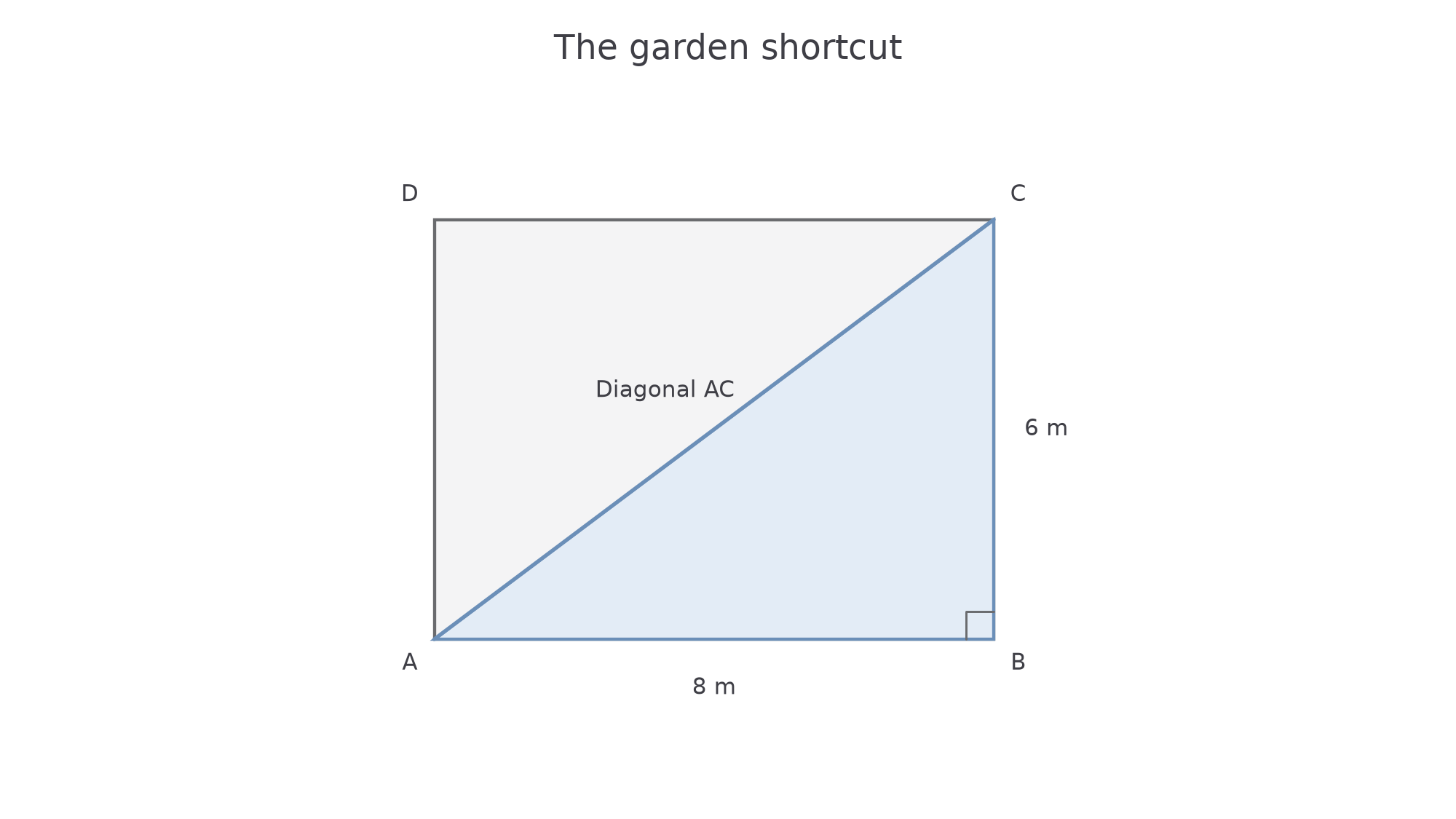
The garden's edges meet at a right angle. Its diagonal is opposite that angle, so it is the hypotenuse. The label is a convention, not a position on the page: a rotated triangle still has the same hypotenuse.
[DIAGRAM: asset_name: A garden diagonal is a hypotenuse; asset_slug: garden-diagonal; caption: The diagonal is opposite the right angle in triangle ABC.; description: A rectangle ABCD has AB equal to 8 metres and BC equal to 6 metres. Its diagonal AC splits it into two right-angled triangles. In triangle ABC the right angle is at B, so AC is the hypotenuse.]
Worked example 3: the garden shortcut
Question. A rectangular garden has sides 6 m and 8 m. Find its diagonal length.
Plan. Use the two perpendicular edges as the shorter sides.
Answer. .
Check. . Also, 10 m is longer than either edge and shorter than the 14 m route round two edges.
Change the 8 m edge to 7 m. The method stays the same, but a calculator is useful for the final root.
Worked example 4: a non-integer diagonal
Question. A rectangle has sides 6 m and 7 m. Find its diagonal to 3 significant figures.
Plan. Keep the exact squared length until the final calculation.
Answer. to 3 significant figures.
Check. , so the diagonal lies between 9 m and 10 m. Its rounded value is in that interval.
The mistake would make the diagonal equal the longer edge route. A square root does not distribute over addition.
Continue this lesson.
You’re previewing NovaLearn without an account. Create a free account to read the rest.
Create free account