8.03a–8.03d, 8.04a, 8.04b - Proof with angles and shapes
A measured diagram can suggest a result, but a proof must establish it for every figure satisfying the given conditions. Build formal chains from angle facts, triangle properties and quadrilateral properties, keeping each reason beside the statement it supports.
Proofs from angle relationships
A diagram of a rhombus makes its diagonals look perpendicular. Would measuring one drawing prove that every rhombus has perpendicular diagonals? Keep that question in mind: the goal is a conclusion forced by the given properties, without a measurement.
A proof starts from given facts, definitions and previously established results. Each step must follow from them. A numerical example can check a proof for a slip, but cannot replace the general argument. In this Higher lesson we will make the links explicit, including facts which a shorter calculation might leave implied.
[DIAGRAM: asset_name: Angle relationships for proof; asset_slug: angle-proof-map; caption: The parallel arrows and the straight lines supply the assumptions for the angle equalities.; description: In the left panel two parallel horizontal lines are crossed at U and V by a rising transversal. The four regions at U are a b c d anticlockwise from the rightward ray, and the four at V are e f g h in the same order. The right panel shows a convex pentagon with one interior angle i and its adjacent exterior angle e, to support the straight-angle relationship at a vertex.]
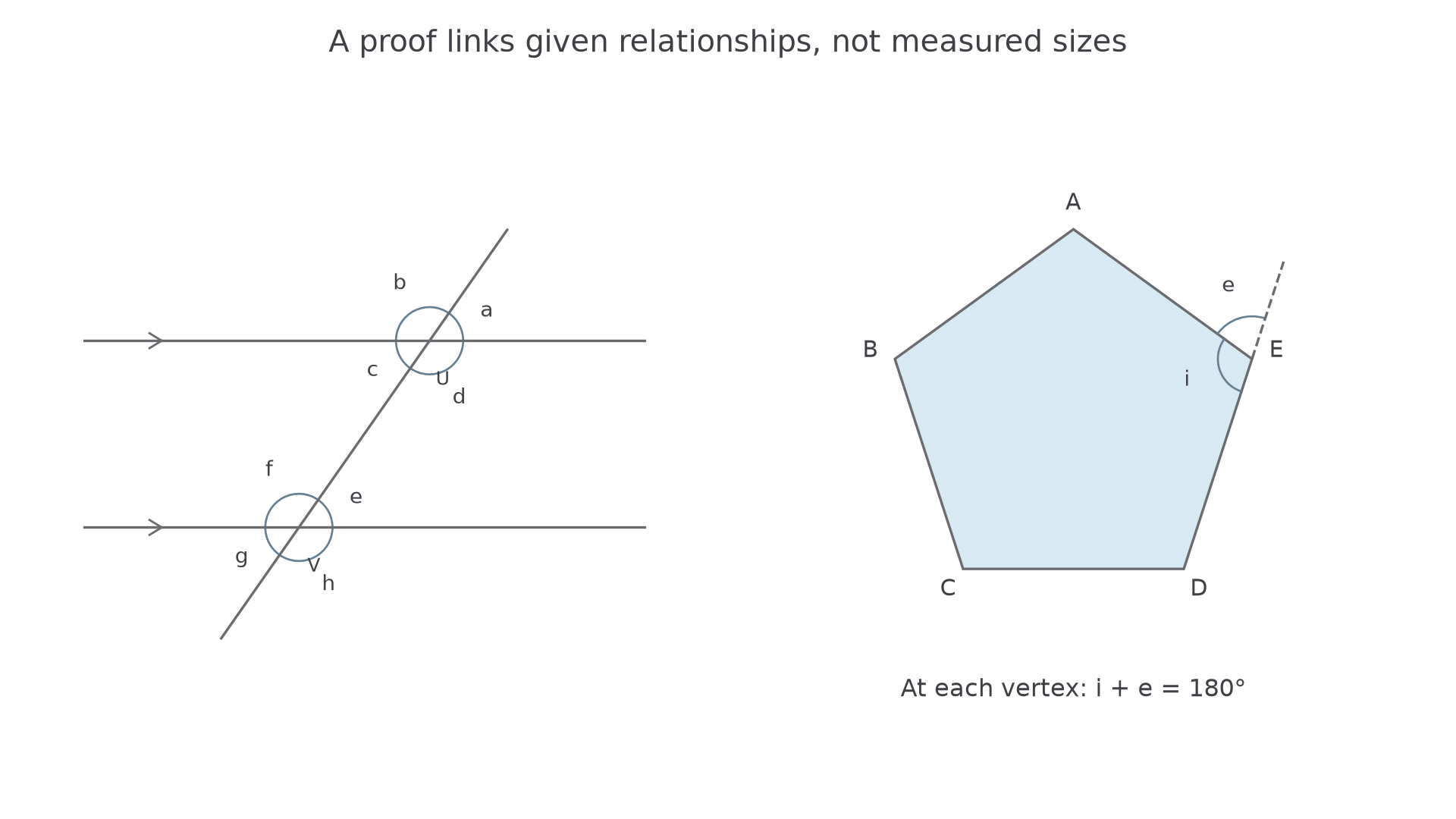
First, even vertically opposite equality can be derived rather than assumed. At U, and , because each pair fills a straight angle. Subtracting gives . The full turn then gives
The last equality uses . Thus both opposite pairs are equal, using straight-line and point-angle facts. The lines must genuinely be straight through U; four arbitrary rays do not guarantee opposite equal angles.
Worked example 1: deriving an alternate-angle result
Question. In the parallel-line diagram, prove , using corresponding and vertically opposite angles.
Plan. Link both target angles to the same angle .
Answer. The alternate interior angles and are equal.
Check. The proof uses the marked parallel relationship in its second line. Without it the two local intersections need not have the same angles, so the general conclusion would fail.
Change only the target pair, from the alternate pair to the co-interior pair . The conclusion becomes a sum rather than an equality.
Worked example 2: deriving a co-interior result
Question. In the same diagram, prove .
Plan. Use the established equality , then replace in the straight angle at V.
Answer. The co-interior angles and are supplementary.
Check. A numerical instance, such as and , satisfies the result. More importantly, no numerical value was needed in the proof, so it applies to every valid configuration.
Polygon angles provide a second kind of formal chain. For a convex -sided polygon, each interior angle and its adjacent exterior turn total . Adding all equalities gives
Triangulation gives interior sum , hence
This agrees with one full turn at a point after walking around the boundary. The proof needs integer and a non-crossing convex boundary for these positive exterior turns. A self-crossing path or unsigned turns around a concave polygon require different care.
Watch out
“The angles look equal” supplies no reason. Replace it with a named relationship and its condition, such as “corresponding angles on the given parallel lines”. Do not use the result you are trying to prove as an unproved starting fact.
Apply the polygon argument without assuming that the five angles are equal.
Proofs using triangle properties
An extra line can expose two triangles whose matching properties force the conclusion. State what is given about that line, then prove its other properties. “Midpoint”, “perpendicular” and “angle bisector” are different conditions; one must not silently stand in for another.
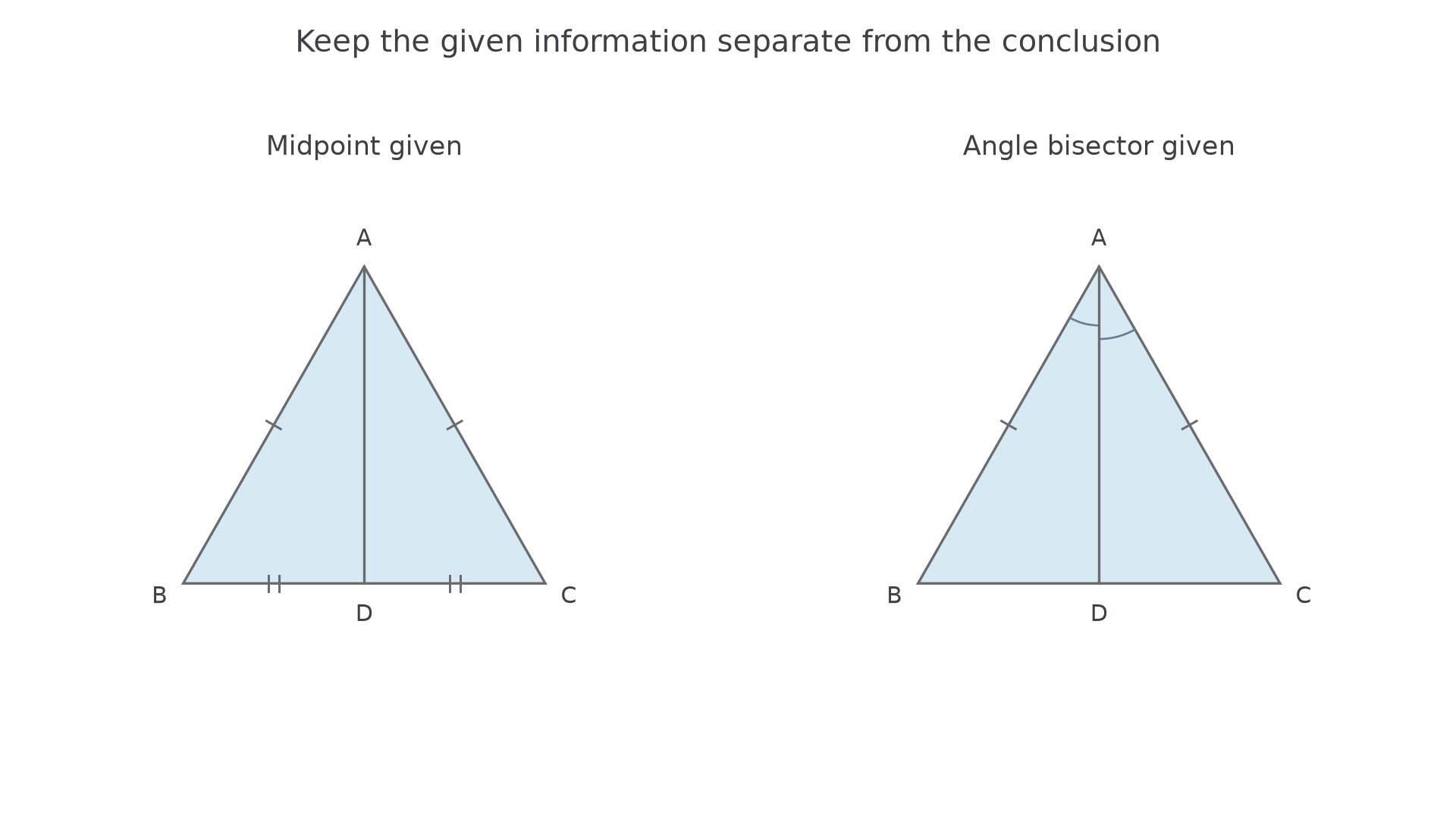
[DIAGRAM: asset_name: Two routes through an isosceles triangle; asset_slug: isosceles-proof-routes; caption: The first proof starts with a midpoint, while the second starts with an angle bisector.; description: Two panels show non-degenerate isosceles triangle ABC with AB equal to AC and D inside segment BC. The left marks BD equal to DC, with AD drawn but no assumed right angle. The right marks angle BAD equal to angle DAC, with AD drawn but no assumed midpoint or right angle. The triangles are labelled to support the stated proofs.]
An angle bisector divides an angle into two equal angles. A segment from a triangle's vertex to the opposite side's midpoint is a median. A perpendicular from a vertex to the line containing the opposite side is an altitude. In a general triangle these can be different lines. For the apex of an isosceles triangle, we can prove that they coincide.
Worked example 3: start with the midpoint
Question. In non-degenerate triangle ABC, . D is the midpoint of BC. Prove that AD bisects angle BAC and is perpendicular to BC.
Plan. Prove triangles ABD and ACD congruent by SSS, then use corresponding angles and the straight line at D.
Therefore triangles ABD and ACD are congruent by SSS. Corresponding angles give , so AD bisects angle BAC. Also . Since B, D and C lie on one straight line, these equal angles sum to ; each is .
Answer. AD is both the angle bisector at A and perpendicular to BC.
Check. The proof did not assume the right-angle square it was trying to establish. Non-degeneracy and the midpoint condition put D inside BC and make the two smaller triangles genuine triangles.
Change only the starting condition about AD: give the angle bisector instead of the midpoint. That changes which congruence test is available first.
Continue this lesson.
You’re previewing NovaLearn without an account. Create a free account to read the rest.
Create free account