2.04a, 2.04b - Comparing numbers
Which is larger: or ? Compare signed numbers on a number line, put fractions, decimals and percentages into a common form, and use equality and inequality symbols precisely.
Ordering signed numbers
Is larger than because three eighths sounds close to four tenths? We will settle that comparison by converting both values. First, make sure the direction of number order is secure.
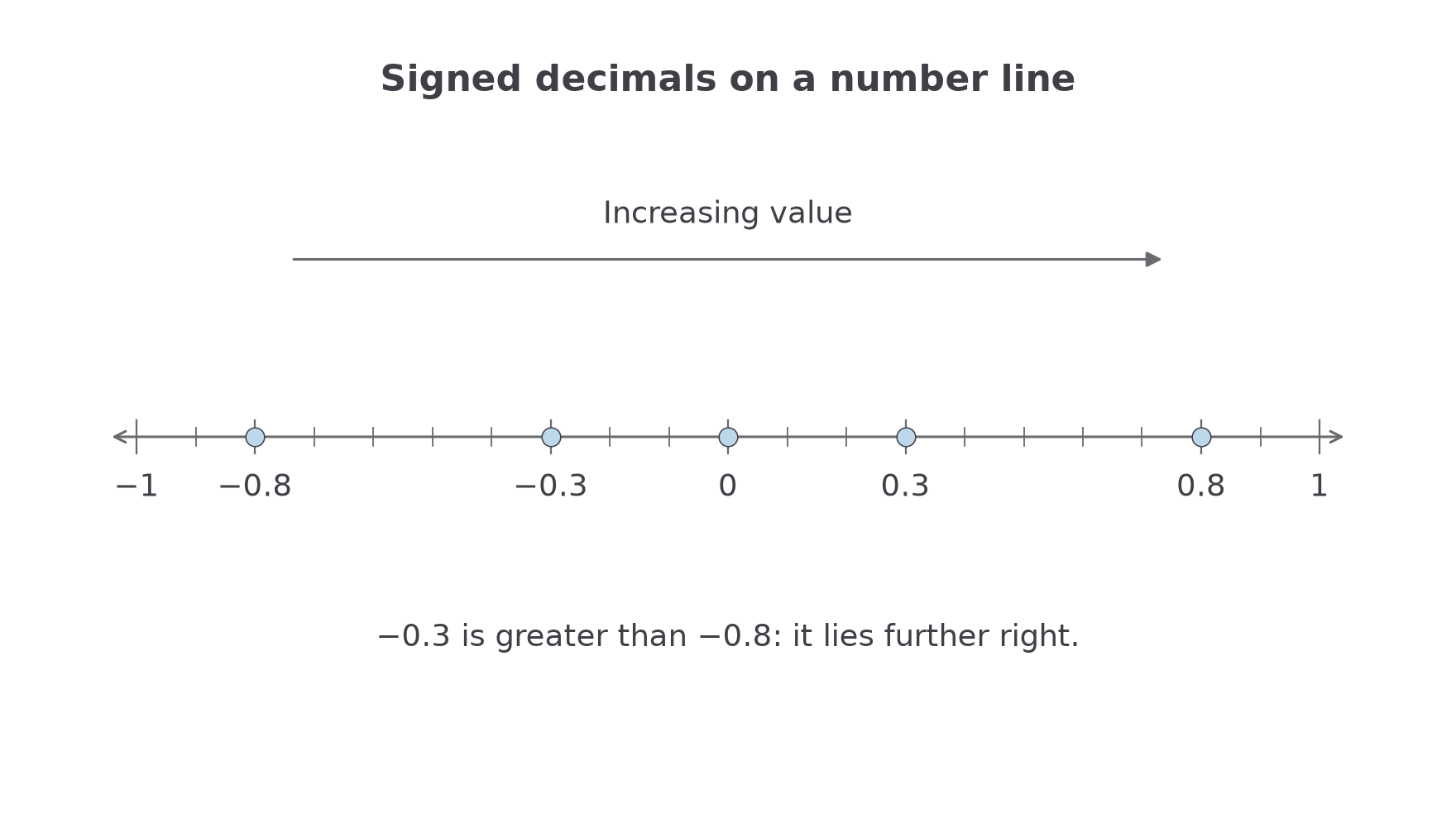
On a number line, numbers increase to the right. This remains true for decimal steps: is greater than , because it lies further right. Its distance from zero is smaller, but its value is larger.
[DIAGRAM: asset_name: Ordering signed decimals; asset_slug: signed-decimal-order; caption: Values increase to the right; negative values closer to zero are greater.; description: A horizontal number line from negative one to positive one, with marked points at negative 0.8, negative 0.3, zero, positive 0.3 and positive 0.8. The points are labelled and a right-pointing arrow above the line is labelled increasing value.]
Ascending and descending order
Ascending order means smallest first. Descending order means largest first. Zero lies between negative and positive numbers and belongs to neither group.
For an ascending list, separate negatives, zero and positives first. Among negative values, the number with the greater distance from zero comes earlier.
Worked example 1: numbers on both sides of zero
Question. Write , , and in ascending order.
Plan. Order the negatives first, then zero, then the positive number.
Answer. .
Check. Moving through the answer from left to right moves consistently right along the number line.
Change only the sign of . It now belongs with the negatives, but is still the nearest of those negatives to zero.
Worked example 2: one more negative value
Question. Write , , and in ascending order.
Plan. Put the three negative values in number-line order, then place zero last.
Answer. .
Check. Adding to every entry gives , which is still ascending. Moving every point the same distance preserves their order.
Use the decimal point as a fixed anchor. , because nine hundredths is less than ten hundredths; a longer decimal is not automatically larger.
Watch out
is false. Eight tenths below zero is further left than three tenths below zero, so .
Keep zero in its correct position.
Comparing different number forms
Fractions, decimals and percentages are easiest to compare when they are written in the same form.
For and , use and . Write as to align places. Compare from the left: units and tenths agree; the hundredths digit is less than , so . The opening question is settled.
You can instead use fractions with a common positive denominator. Keep enough digits when converting: prematurely rounding two values to the same decimal can hide their order.
Worked example 3: a common decimal form
Question. Write , and in order of size, smallest first.
Plan. Convert to decimals and align thousandths, then return the original forms.
Thus .
Answer. .
Check. In percentages, the same order is .
Change only the percentage from to . The values are closer, so the thousandths column now decides the comparison.
Worked example 4: close values
Question. Write , and in order of size, smallest first.
Plan. Keep exact decimals to three places rather than rounding to two.
Thus .
Answer. .
Check. The gap from to is ; both are smaller than .
For negative mixed forms, convert first and then respect number-line order. For instance, . Converting the forms does not change the rule for negatives. Values above one work too: .
Watch out
Do not round and to before comparing them. Rounded equality does not mean the original values were equal.
Change only the percentage again and keep the original forms in your final list.
Equality and inequality symbols
A relation symbol states how two values compare; its precise meaning matters at equality.
| Symbol | Meaning | Example |
|---|---|---|
| less than | ||
| greater than | ||
| less than or equal to | and | |
| greater than or equal to | and | |
| equal to | ||
| not equal to |
Strict inequality
The symbols and describe strict inequalities: they exclude equality. The symbols and include equality. The open side of an inequality faces the greater value.
Different-looking forms may be equal. Compare values before selecting a symbol.
Worked example 5: two different negative values
Question. Put or between and .
Plan. Align hundredths and locate the values relative to zero.
Answer. .
Check. Adding to both sides gives , a true comparison.
Change only the right-hand value from to . The values now coincide, so the strict comparison no longer applies.
Worked example 6: equality included
Question. Which of , , , , , make a true statement between and ?
Plan. Establish equality, then select every symbol whose meaning includes it.
Answer. , and .
Check. Neither value is strictly greater or smaller, and they are not unequal. This rules out the other three symbols.
Both and can be true together: they force . This is a useful connection when you later describe intervals and solve inequalities.
Watch out
is true. “Less than or equal to” does not require the left side to be smaller; equality is enough.
Use the meanings of all six symbols, not their appearance alone.
Quick Recap
- Values increase to the right on a number line, including below zero.
- Convert mixed number forms to a common exact form before comparing.
- Compare aligned decimal columns from the left and avoid premature rounding.
- Strict inequalities exclude equality; and include it.
is smaller than .