9.03a, 9.03b - Calculating with vectors
Two moves can start in different places yet have exactly the same direction and distance. In 9.03b you will read and draw these moves as column vectors; in 9.03a you will add, subtract and scale them to describe complete journeys.
Column vectors and direction
If you move three squares right and two squares up, does your starting point change the move? It changes where you finish, but the movement itself is always the same vector.
Vector
A vector describes a displacement with size and direction. On a coordinate grid,
means move units horizontally and units vertically. Positive is right or up; negative is left or down. The two entries are components, not a fraction.
A point such as names a location. A vector such as names a move. Only when a move starts at the origin do its components also give the endpoint's coordinates.
[DIAGRAM: asset_name: Reading directed moves on a grid; asset_slug: column-vector-grid; caption: Read horizontal change first and vertical change second.; description: Two equal-scale coordinate grids. The left arrow runs from A negative two comma one to B one comma three, moving three right and two up. The right runs from A negative two comma one to B one comma negative one, moving three right and two down. Dashed horizontal and vertical steps show components and arrowheads show direction.]
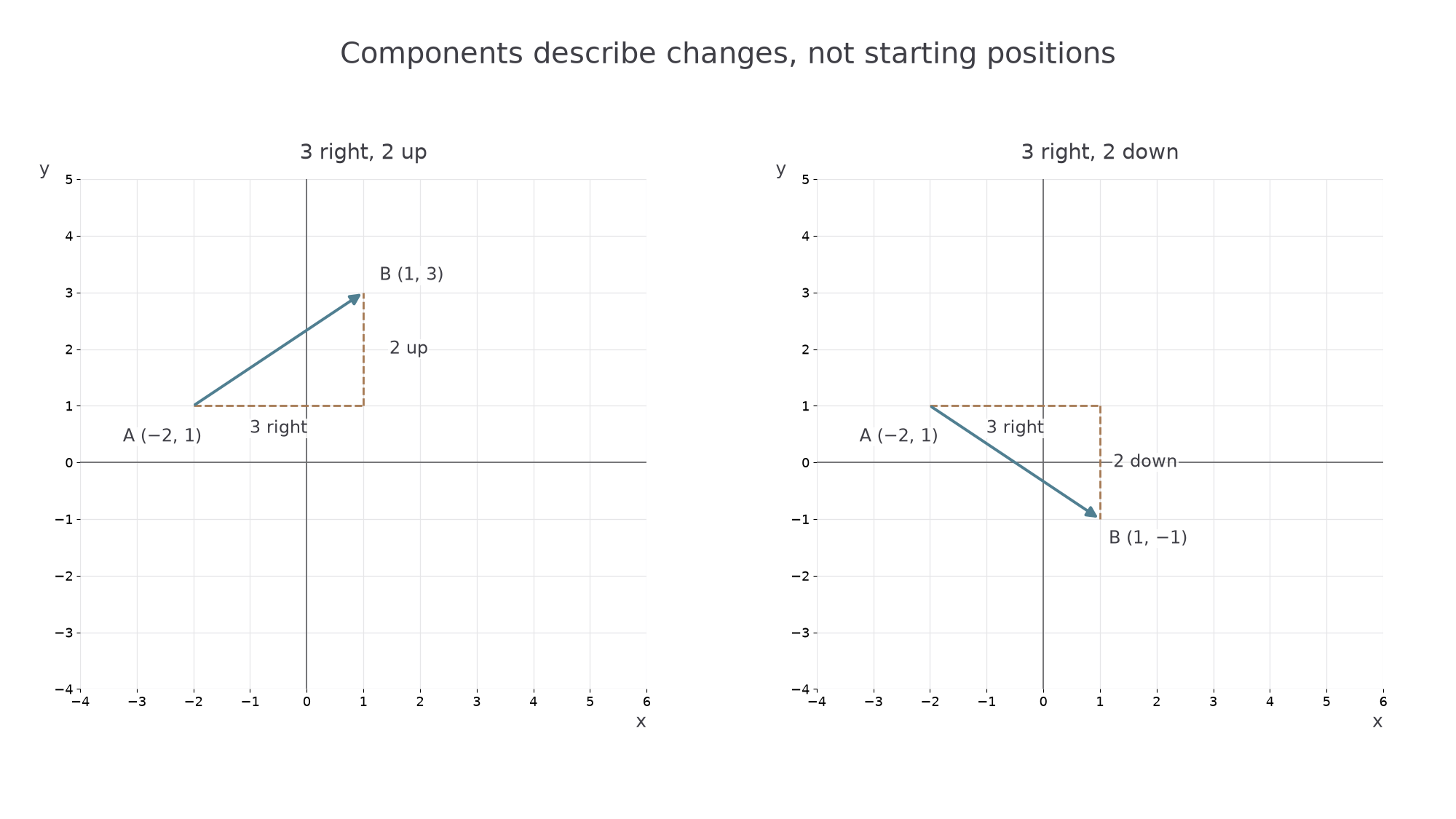
To draw a vector, mark any stated starting point, count the horizontal and vertical components, then draw a straight arrow from start to finish. The dashed component steps help you count; the diagonal arrow is the vector. To read an existing arrow, subtract start coordinates from finish coordinates, in that order.
Worked example 1: reading an upward move
Question. An arrow goes from to . Write as a column vector and describe how to draw it from .
Plan. Find each change, then check that applying the move reaches .
Answer. Move three right and two up from , then draw the arrow to .
Check. , the stated endpoint.
Change only the endpoint's vertical coordinate. The horizontal component stays the same but the vertical component changes sign.
Worked example 2: reading a downward move
Question. An arrow goes from to . Write as a column vector and describe how to draw it.
Plan. Again subtract start from finish in each coordinate.
Answer. Draw an arrow from three right and two down to .
Check. . Reversing the arrow would reverse both signs, not just one.
Any translated copy of the same directed arrow is an equal vector. Its position on the grid is free unless a starting point is specified.
Adding and subtracting vectors
Adding two vectors combines two successive moves into one displacement from the original start to the final finish.
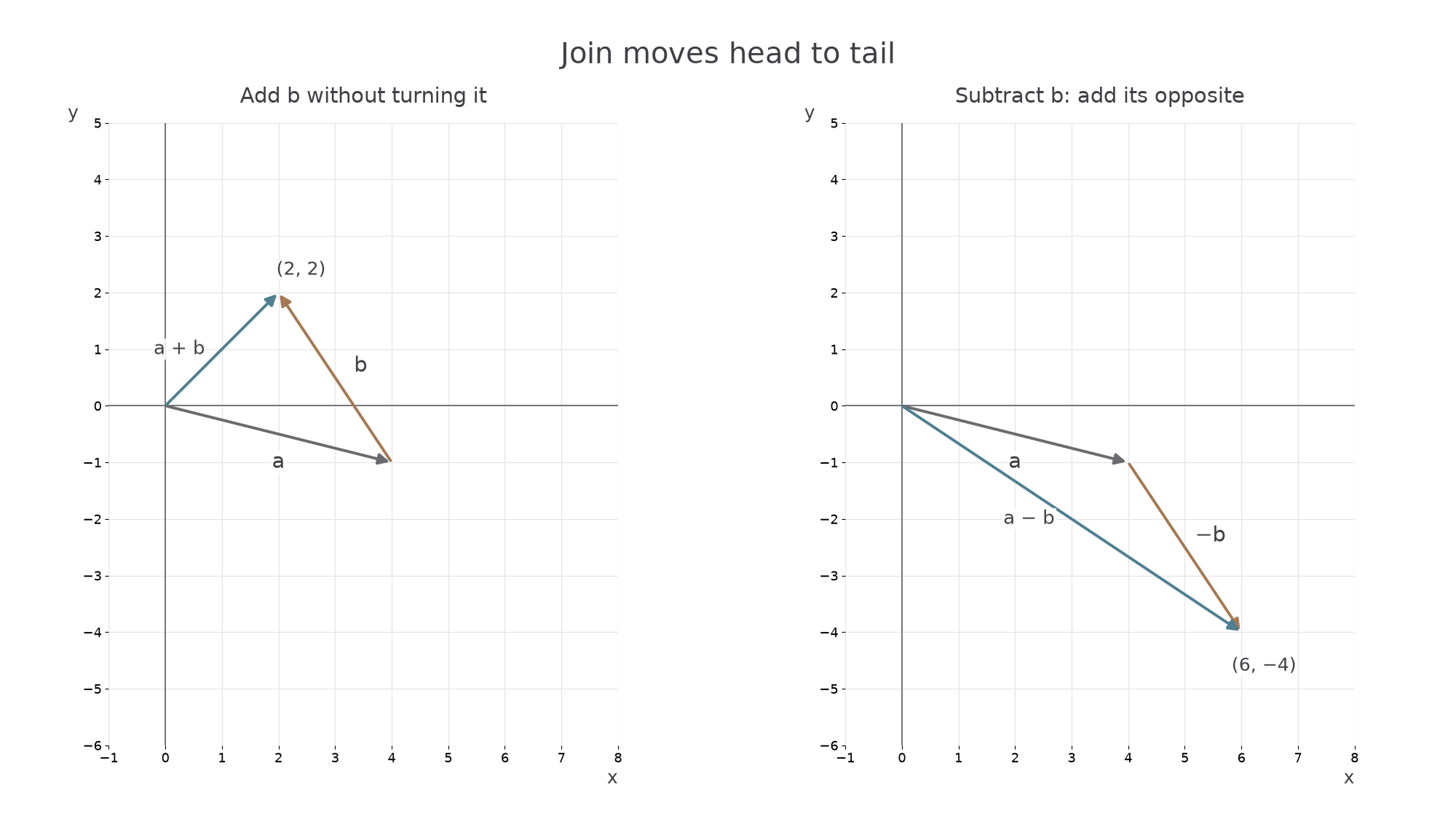
For example, moving four right and one down, then two left and three up, produces a total move two right and two up. The horizontal and vertical changes combine separately.
Vector addition and subtraction
Subtracting a vector means adding its opposite. The opposite reverses both components.
Not on the 2027 formula sheet: understand the component rule.
On a diagram, put the tail of the second arrow at the head of the first. The arrow from the first start to the last finish is the resultant. Vectors may be slid into position without rotating or resizing them.
[DIAGRAM: asset_name: Head-to-tail addition and subtraction; asset_slug: vector-add-subtract; caption: For subtraction reverse the second move before joining it head to tail.; description: Two equal-scale coordinate panels with first vector a equal four comma negative one. The addition panel follows it with b equal negative two comma three and shows resultant two comma two. The subtraction panel follows it with negative b equal two comma negative three and shows resultant six comma negative four. All arrows carry direction heads.]
Continue this lesson.
You’re previewing NovaLearn without an account. Create a free account to read the rest.
Create free account