2.01b - Multiplying and dividing fractions
Can dividing make a positive number larger? Learn to multiply fractional amounts, divide by using reciprocals, and combine fraction operations with brackets, mixed numbers and negative signs.
Multiplying fractions
How many eighths fit into three quarters? Keep that question in mind while we first look at taking a fraction of a fraction.
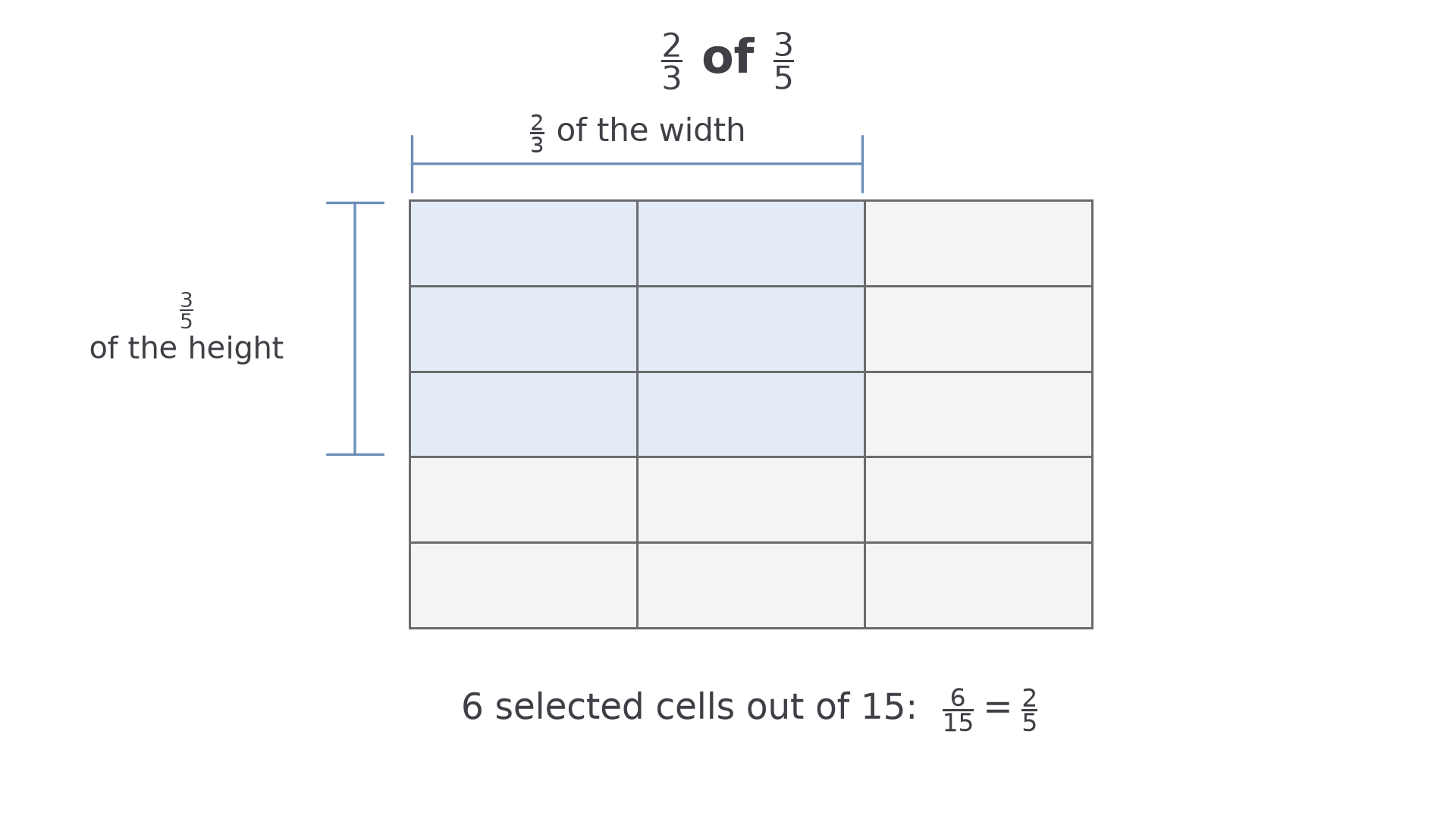
Suppose you need of of a sheet. Divide the whole sheet into three equal columns and five equal rows. There are fifteen equal cells. Taking two columns and three rows selects six cells, so the required amount is .
[DIAGRAM: asset_name: A fraction of a fraction; asset_slug: fraction-product-grid; caption: Two thirds of three fifths selects six of fifteen equal cells, or two fifths of the whole.; description: A rectangle split into three equal columns and five equal rows. The left two columns are marked two thirds, and the top three rows are marked three fifths. Their six-cell overlap is shaded blue. The remaining cells have pale neutral fills, with the fifteen-cell whole clearly outlined.]
Multiplying fractions
Multiply numerators together and denominators together. A common denominator is not needed.
Not on the 2027 formula sheets: learn it.
You may cancel a common factor from any numerator and any denominator before multiplying, because the whole expression is one product. This can keep the arithmetic small. A whole number can be written over ; convert a mixed number to an improper fraction first. For example, . Products are not confined below one.
Worked example 1: cancelling within a product
Question. Work out .
Plan. Combine the factors, cancel the common factor of three, then multiply.
Answer. .
Check. The grid gives six cells out of fifteen; cancelling gives the same .
Change only the sign of the second fraction. The sizes of the factors stay the same; the sign of the product changes.
Worked example 2: a negative factor
Question. Work out .
Plan. Use the sign rule and cancel exactly as before.
Answer. .
Check. Its magnitude is , as in the first example, and positive times negative must be negative. Multiplying both negative factors instead would give a positive product.
Cancellation works on factors of a product, not on terms separated by addition.
Watch out
For , cancelling the threes is valid. For , the plus sign prevents that cancellation; it is a different operation and needs equal-sized fractional units.
Keep the negative sign while you cancel factors.
Dividing by a fraction
Division asks how many groups of the divisor fit into the dividend. Since , there are six eighths in three quarters: . Dividing a positive number by a positive fraction smaller than one makes it larger, because you are counting smaller units.
Reciprocal
The reciprocal of a nonzero number is the number that multiplies with it to give . The reciprocal of is , because . Zero has no reciprocal.
Why multiply by a reciprocal to divide? For , first count fifths by multiplying by . Each required group contains two fifths, so divide that count by . Together these steps multiply by .
Dividing fractions
Here , and : both fractions must exist and the divisor must be nonzero. Keep the first fraction and multiply by the reciprocal of the second.
Not on the 2027 formula sheets: learn it.
Use an inverse check: answer times divisor should equal dividend. A zero dividend is allowed when the divisor is nonzero, giving zero; division by zero is undefined.
Worked example 3: dividing by a proper fraction
Question. Work out .
Plan. Multiply by the reciprocal of the divisor, then simplify.
Answer. , or .
Check. , the original dividend.
Change only the sign of the divisor. Its reciprocal is also negative.
Worked example 4: dividing by a negative fraction
Question. Work out .
Plan. Multiply by and retain the negative sign.
Answer. , or .
Check. . The two negative factors make a positive dividend.
For a mixed-number divisor, convert before taking its reciprocal. For example, the reciprocal of is ; you do not turn over the fractional part alone. Thus . Checking recovers the dividend.
Watch out
. Only the divisor is replaced by its reciprocal. Turning over both fractions changes the dividend too.
Use an inverse multiplication to check your result.
Signed and mixed calculations
When a calculation combines operations, decide its structure before calculating. Convert mixed numbers, complete brackets, then carry out multiplication and division before addition and subtraction.
Adding fractions still requires equal-sized units: . Multiplication does not need a common denominator. For a sum followed by multiplication, brackets decide whether the multiplication applies to one term or the entire sum.
Worked example 5: a bracket followed by multiplication
Question. Work out .
Plan. Convert the mixed number, add inside the bracket, then multiply.
Answer. .
Check. Multiplying the result by gives , the bracket's value. That reverses the final multiplication.
Change only the outside operation to division. The bracket is unchanged, but the final factor becomes a reciprocal.
Worked example 6: a bracket followed by division
Question. Work out .
Plan. Complete the same bracket, then multiply by .
Answer. , or .
Check. , the bracket's value, so division has been reversed correctly.
For signed mixed calculations, combine these same decisions. In , convert the first term to , do the product , then add to get . No brackets surround the sum, so the product comes first.
Watch out
Do not cancel across a bracket that still contains a sum. In , finish the bracket before cancelling factors in the resulting product.
The opening question now has a reasoned answer: , because three quarters contain six groups of one eighth. Division can increase a positive value when its divisor lies between zero and one.
Quick Recap
- Multiply numerator by numerator and denominator by denominator; cancel common factors when useful.
- Divide by multiplying by the reciprocal of the nonzero divisor.
- Convert mixed numbers before multiplying, dividing or taking reciprocals.
- Complete brackets first, and keep signs attached to their numbers.
Dividing by a small positive fraction counts small groups, so the count can exceed the original number.