9.04b - Negative scale factors
Can an enlargement send a shape to the opposite side of its centre? In this Higher lesson a negative scale factor does exactly that. You will separate the factor's sign from its size, construct negative images and recover the centre and factor from corresponding shapes.
Negative factors reverse direction
A vertex is three squares right and two squares up from a centre. Multiplying both offsets by negative two puts its image six left and four down: the direction reverses as well as the distance changing.
Negative enlargement
For a negative scale factor and a point , the original point , centre and image lie on one straight line, with and on opposite sides of . The centre itself stays fixed. The distance is , where means the factor's non-negative magnitude.
The sign decides which side of the centre to use. The magnitude decides how far to go. Thus makes a twice-sized image across the centre, while makes a half-sized image across the centre. The centre itself remains fixed.
Worked example 1: a positive factor for comparison
Question. Find the image of , centre , scale factor .
Plan. Multiply the offset from by the positive factor.
Answer. .
Check. The centre, original and image have offsets in the same ratio , so the image lies on the same ray.
Change only the sign of the factor. Its magnitude remains two.
Worked example 2: the same magnitude, opposite side
Question. Find the image of , centre , scale factor .
Plan. Multiply each offset by negative two, then add the centre back.
Answer. .
Check. From to the total horizontal change is . One third of that change reaches , leaving twice that distance on the opposite side. Both vertical offsets have the same signed ratio .
A negative enlargement is equivalent to a positive enlargement of magnitude and a rotation about the same centre. It is not a reflection: a half-turn keeps the clockwise order of labelled vertices. In particular, factor is exactly a half-turn and preserves size.
Watch out
A negative factor does not mean a negative side length. Lengths remain positive and scale by . The minus sign records the opposite side of the centre.
Reverse a different centre offset.
Constructing a negative enlargement
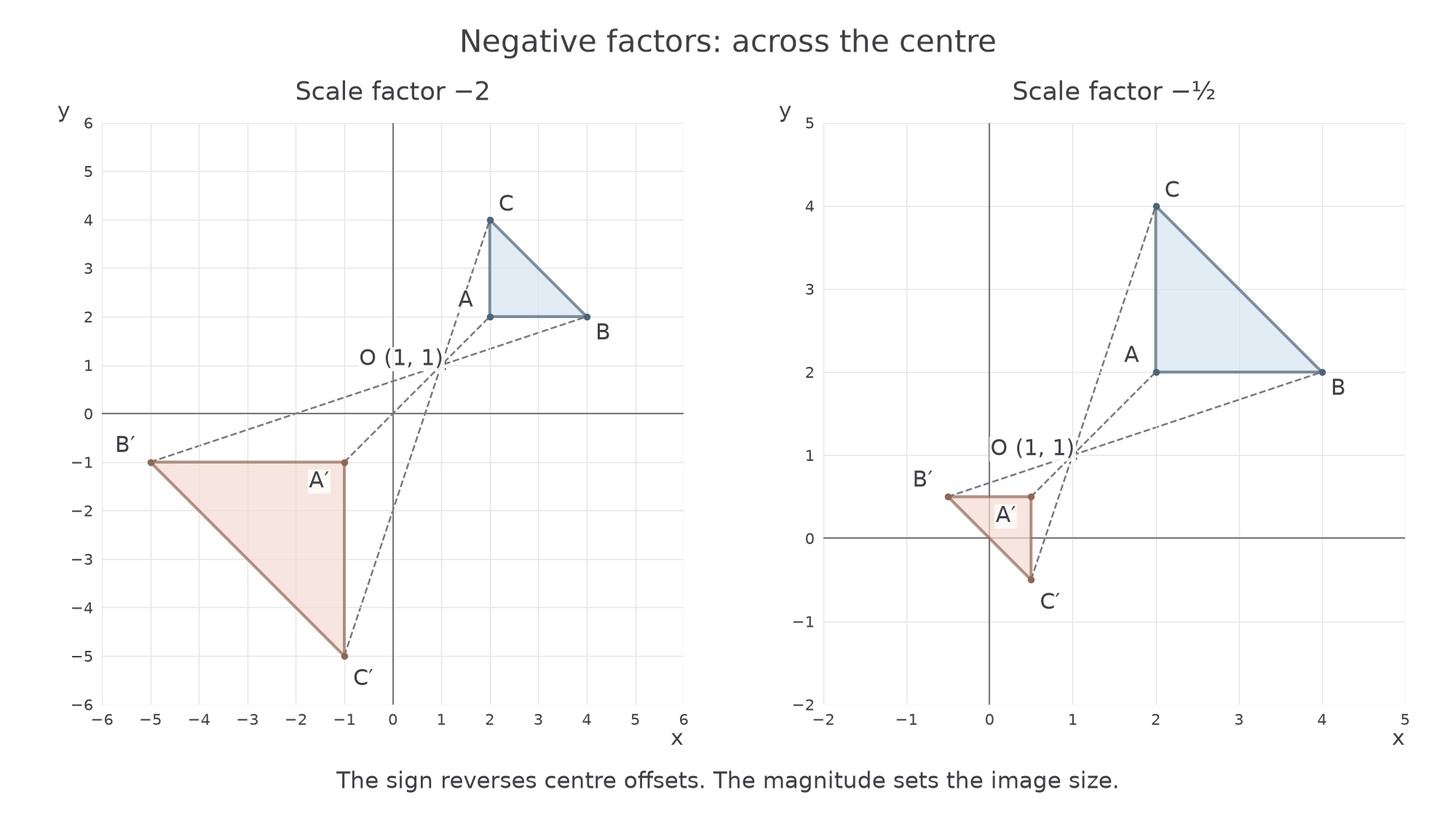
To construct a negative image of a whole shape, extend each centre-to-vertex line through the centre and mark the new point on its opposite ray.
Use to scale the distance. For a factor with magnitude less than one, the opposite image is nearer the centre than the original point is, but still on the other side. Do this for every vertex before joining the image in corresponding order.
[DIAGRAM: asset_name: Negative whole and fractional enlargements; asset_slug: negative-scale-factors; caption: Both negative images lie across the centre, but their sizes depend on the factor magnitude.; description: Two coordinate panels show original triangle A two comma two, B four comma two, C two comma four and centre one comma one. The first shows scale factor negative two and the second negative one half. Every vertex line extends through the centre to the corresponding image, with clear original and image labels.]
Worked example 3: a negative whole-number factor
Question. Enlarge , , , centre , scale factor .
Plan. Reverse and double every centre offset.
Answer. , , .
Check. The image horizontal leg is units, twice the original . From centre , is one right and one up, while is two left and two down.
Change only the factor to . The images are still across the centre, but the shape becomes smaller.
Worked example 4: a negative fractional factor
Question. Enlarge the same triangle, centre , scale factor .
Plan. Reverse and halve every centre offset.
Answer. , , , respectively.
Check. The image legs are unit, half the original . Each original and image lie on opposite sides of the centre, so the factor is negative rather than positive one half.
Continue this lesson.
You’re previewing NovaLearn without an account. Create a free account to read the rest.
Create free account