8.05a - Parts of a circle
Which part of a wheel does a spoke follow, and which part does a tyre follow? Learn the names of the straight lines, curved lines and regions in a circle, so that a diagram tells you exactly what to measure.
Radius, diameter and circumference
A bicycle spoke runs from the hub towards the rim, while the tyre goes all the way round. Those are different parts of the same circular shape.
Imagine a point fixed at the hub. Every point on the rim is the same distance from it. This equal distance is what makes the outline a circle, rather than an oval.
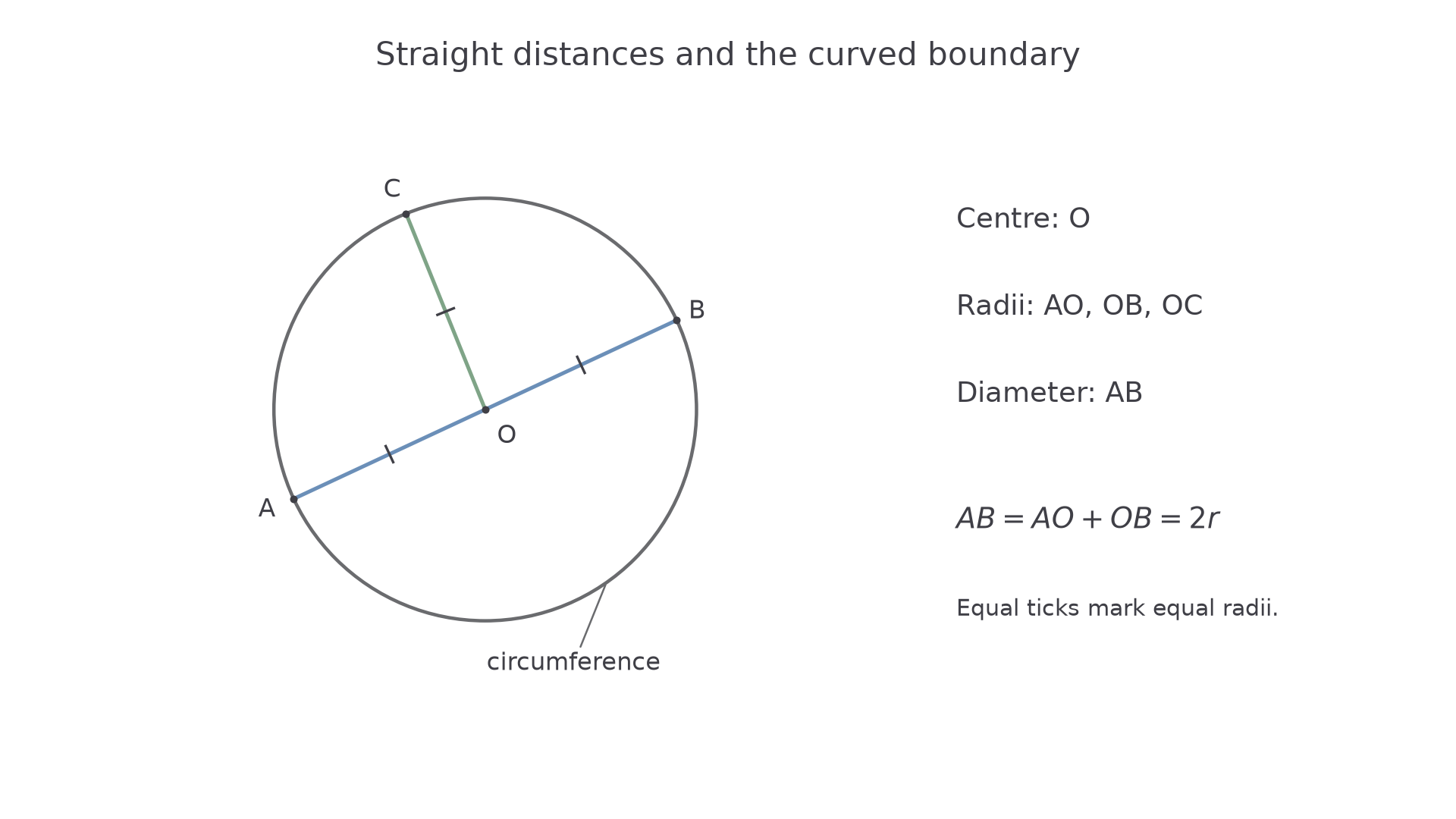
[DIAGRAM: asset_name: Radii and a diameter; asset_slug: circle-radii-diameter; caption: A diameter joins two points on the circle through the centre. Every radius has the same length.; description: An exact circle with centre O. A sloping diameter AB passes through O. A separate radius OC ends on the circumference. The two halves AO and OB and the radius OC are identified as equal radii. The curved outline is labelled circumference.]
Centre, radius and circumference
The centre is the fixed point equally far from every point on the circle. A radius is a straight line segment from the centre to the circle, or its length. The circumference is the curved boundary of the circle, or the distance all the way round it.
The filled-in region inside the boundary has an area. The circumference is its boundary, not that area. The plural of radius is radii.
Diameter
A diameter is a straight line segment joining two points on the circle and passing through its centre. It contains two radii, so its length is .
It does not matter whether a diameter is horizontal, vertical or sloping. Passing through the centre is the deciding condition.
Worked example 1: two radii make a diameter
Question. A circle has radius . Find its diameter.
Plan. Join two radii in a straight line through the centre.
Answer. The diameter is .
Check. Half of is , the original centre-to-edge distance.
Now reverse which length is given. The relationship stays the same.
Worked example 2: finding the centre-to-edge distance
Question. A circle has diameter . Find its radius.
Plan. Split the diameter into its two equal radii.
Answer. The radius is .
Check. Two lengths of span the full diameter.
You can recognise the radius without needing to calculate the distance round the circle.
Watch out
The statement “a radius goes from one side to the other” confuses radius and diameter. A radius starts at the centre. A diameter has both ends on the circle and passes through the centre.
Try reversing the relationship with a new diameter.
Chords and tangents
A straight line can join two points on a circle, or it can touch the circle at just one point. The names describe these different jobs.
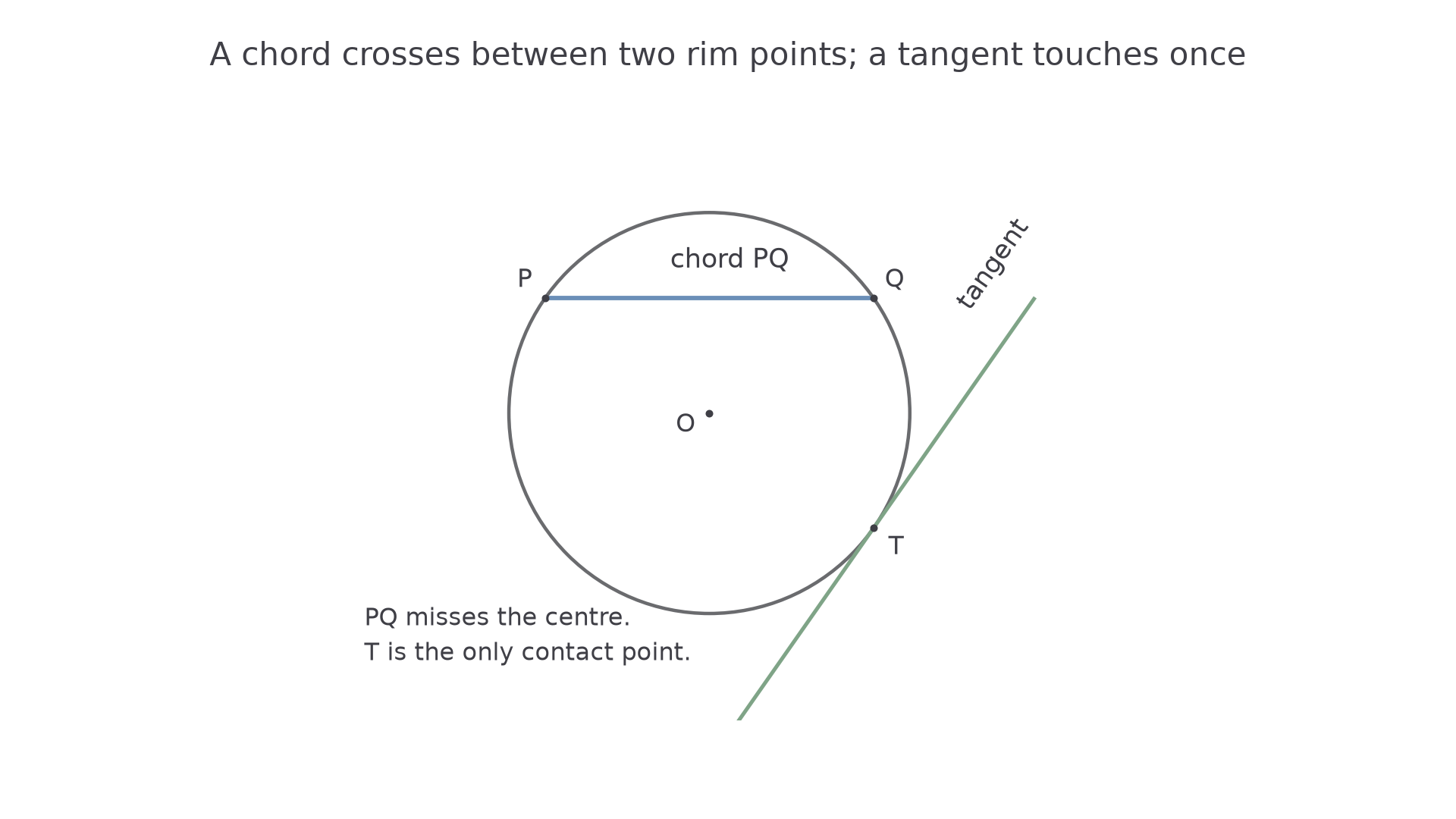
[DIAGRAM: asset_name: A chord and an oblique tangent; asset_slug: circle-chord-tangent; caption: The chord has two endpoints on the circle. The tangent line touches it at T only.; description: An exact circle with centre O. A chord PQ lies above the centre and does not pass through O. An oblique line touches the circle at T in its lower-right part and is labelled tangent. The tangent is extended in both directions.]
Chord and tangent
A chord is a straight line segment with both endpoints on the circle. A tangent is a straight line which touches a circle at exactly one point, called the point of contact.
The chord in the picture is not a diameter because it misses the centre. A diameter is a special chord: it satisfies the two-endpoint rule and also passes through the centre. A radius is not a chord because one endpoint is at the centre, inside the circle.
Continue this lesson.
You’re previewing NovaLearn without an account. Create a free account to read the rest.
Create free account