10.04a - Volume and surface area of prisms
Can two differently shaped containers hold the same amount? Learn to calculate the volume of cuboids, right prisms and cylinders, then unfold their surfaces to work out how much material a container needs.
Constant cross-sections and volume
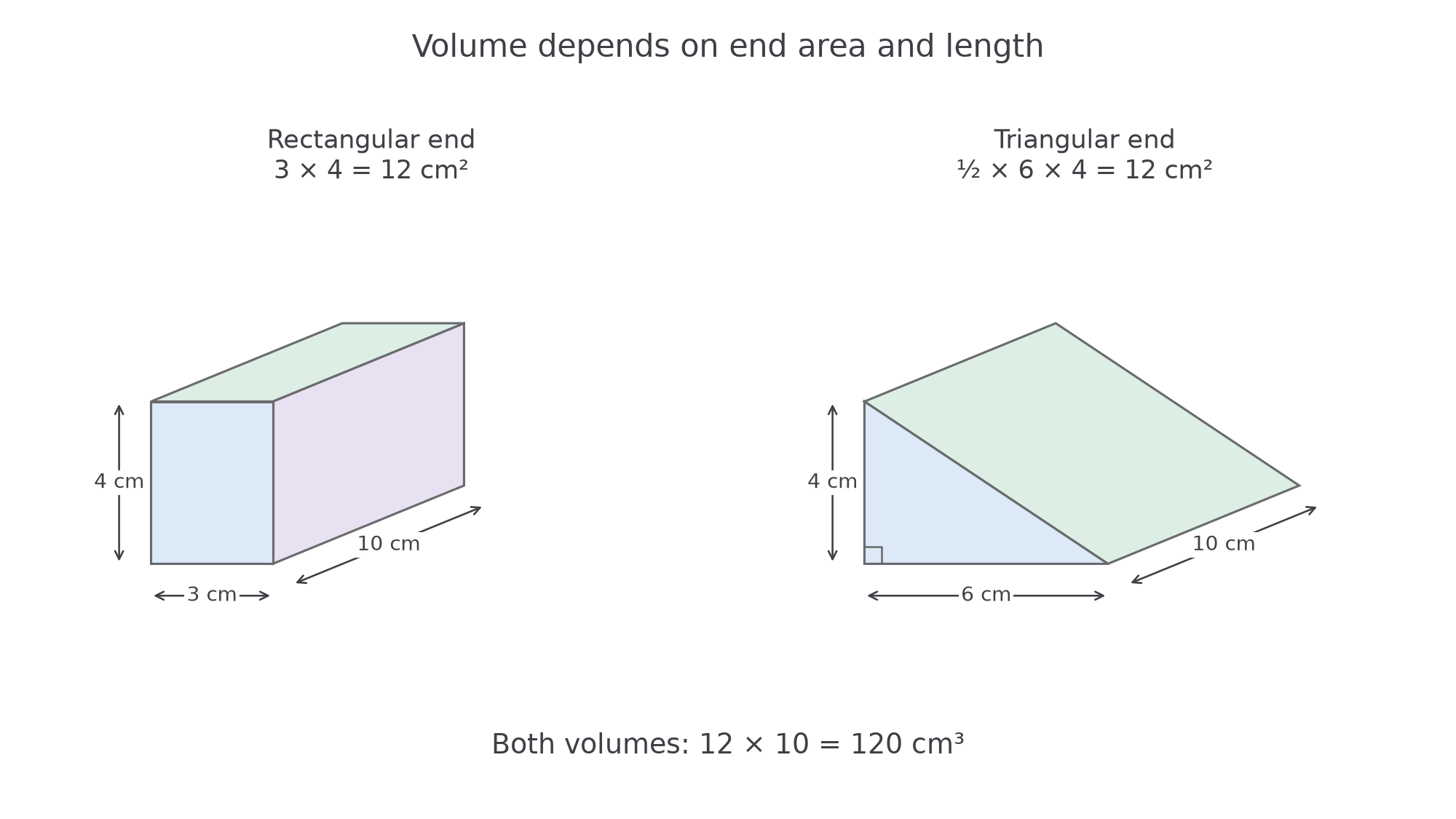
A rectangular container and a triangular container both have cross-sectional area and length . Which holds more? Imagine filling each with ten layers, each one centimetre thick. Every layer contains , whatever its outline.
A cross-section is the shape exposed by slicing through a solid. A right prism has congruent parallel end faces and the same cross-section throughout its length, with its length perpendicular to those ends. The cross-section we use is parallel to the ends. A pyramid narrows towards its top, so it does not obey this rule.
[DIAGRAM: asset_name: Equal sections give equal volumes; asset_slug: prism-cross-sections; caption: Each solid has a cross-sectional area of twelve square centimetres and a length of ten centimetres.; description: A right rectangular prism has end dimensions three by four centimetres. A right triangular prism has triangular end base six centimetres and perpendicular height four centimetres. Both lengths are ten centimetres and their ends are shaded.]
Volume of a right prism
Here is the constant cross-sectional area and is the perpendicular distance between the ends. Volume is measured in cubic units. This formula is on both 2027 formula sheets.
The layer argument works for fractional lengths too: half a centimetre contains half as much as a one-centimetre layer. Convert all lengths to compatible units before finding an area or volume.
Worked example 1: a rectangular cross-section
Question. A cuboid has an end measuring by and length . Find its volume.
Plan. Find the end area, then multiply by the distance through which that end extends.
Answer. .
Check. Count unit cubes instead: rows of , repeated in layers, gives cubes.
Change only the cross-section: keep its area and the prism length fixed. The volume will stay the same even though the outline changes.
Worked example 2: a triangular cross-section
Question. A right triangular prism is long. Its triangular end has base and perpendicular height . Find its volume.
Plan. Use the triangle's area as the cross-sectional area.
Answer. , equal to the cuboid's volume.
Check. This triangle is half a -by- rectangle. Its prism is half a cuboid of volume , giving .
For an L-shaped prism, find the end area by adding or subtracting rectangles, then multiply once by the length. The length is not necessarily the longest number shown on a diagram.
Watch out
The triangle's sloping side is not its perpendicular height. Use the distance at right angles to the chosen base when calculating its area.
Identify the end before using the length.
Cylinders as prisms
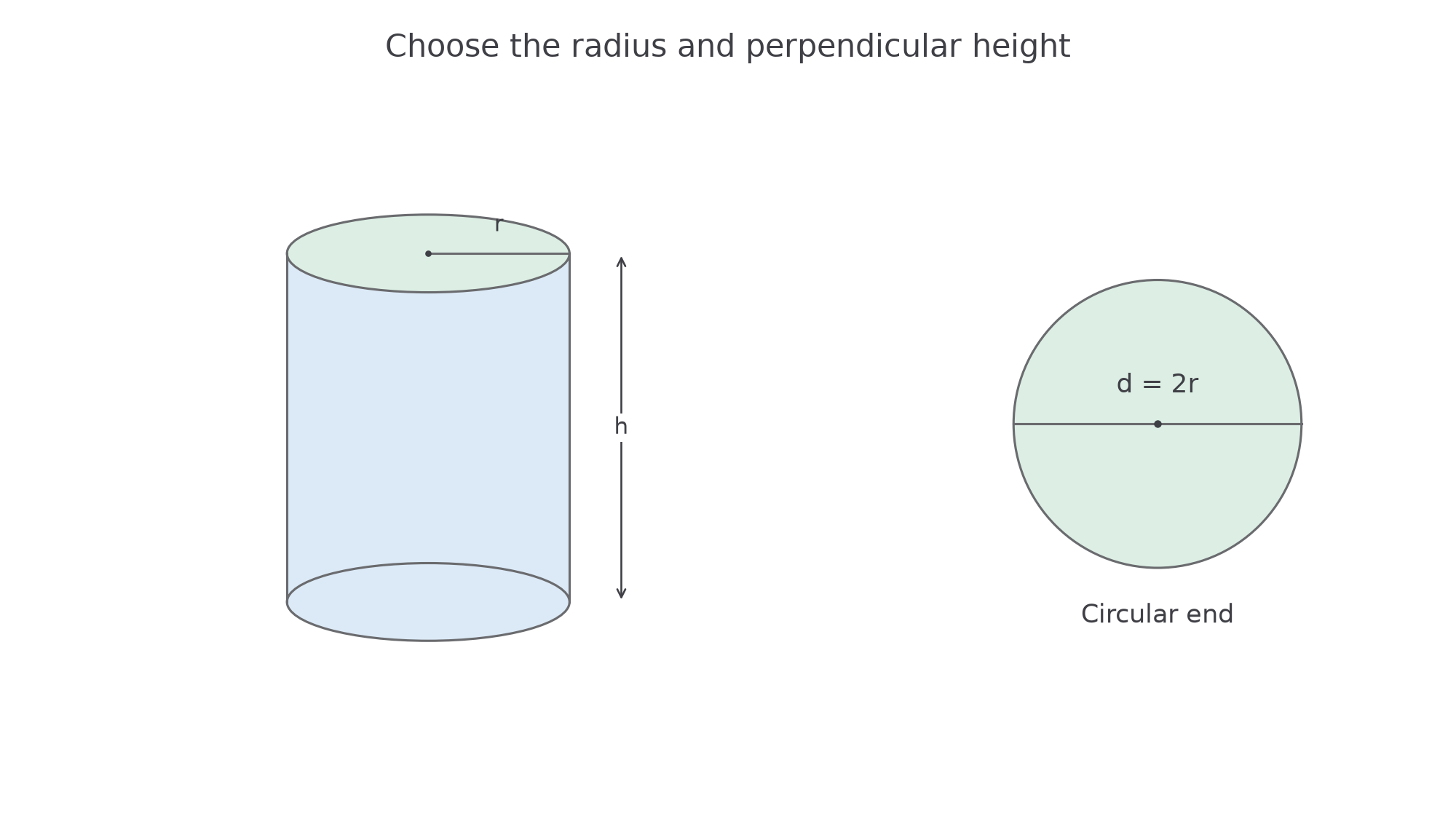
A cylinder has a constant circular cross-section. Although a cylinder is not a polygonal prism, the same cross-sectional-area method works for a right circular cylinder: imagine repeating identical circular layers.
[DIAGRAM: asset_name: A cylinder and its circular section; asset_slug: cylinder-measures; caption: Radius lies across the circular end. Height measures the perpendicular distance between the ends.; description: A right circular cylinder with radius r and perpendicular height h. A separate circular end shows a diameter through the centre labelled d equals two r.]
Cylinder volume
Here is the radius and is the perpendicular height. It follows from circle area multiplied by height. Circle area and prism volume are on both 2027 formula sheets.
The cylinder need not be standing upright on the page. What matters is choosing the circular cross-section and the perpendicular distance between its ends. Keep exact until the last line.
Worked example 3: radius supplied
Question. Find the volume of a cylinder of radius and height . Give the exact answer and an answer to significant figures.
Plan. Square the radius for the circular area, then multiply by the height.
Answer. , or to significant figures.
Check. Since , the volume lies between and . Our answer does.
Change only the way the circular width is stated. A diameter must be halved before it is squared.
Worked example 4: diameter supplied
Question. Find the exact volume of a cylinder of diameter and height .
Plan. Convert diameter to radius, then apply the same volume formula.
Answer. . The dimensions describe exactly the previous cylinder.
Check. The circular end fits inside a -by- square. The volume must be below , which it is.
You can reverse the calculation too. Divide the given volume by the circular area to recover the height. This uses a positive radius, so the area is nonzero.
Worked example 5: finding an unknown height
Question. A cylinder has volume and radius . Calculate its height.
Plan. Divide volume by cross-sectional area.
Answer. .
Check. , recovering the given volume.
Change only the radius, keeping volume fixed. Halving the radius quarters the end area, so the cylinder must be four times as tall.
Continue this lesson.
You’re previewing NovaLearn without an account. Create a free account to read the rest.
Create free account