9.03a - Geometric proof with vectors
Can two different routes prove that points lie on one straight line or that two sides are parallel? You will use directed journeys, scalar multiples and ratios to turn a diagram into a geometric argument that works for every allowed position.
Writing directed journeys
To travel from to , you can go directly or go back through a convenient point . Both journeys have the same displacement, even if their travelled distances differ.
Write and . Going gives , so .
[DIAGRAM: asset_name: Direct and indirect directed journeys; asset_slug: directed-vector-paths; caption: Going back along OA contributes negative a before the move b.; description: A general triangle OAB with directed arrows OA labelled a, OB labelled b and AB labelled b minus a. A second panel reverses the direct arrow to BA and labels it a minus b. The sides are not parallel or equal and O is not on AB.]
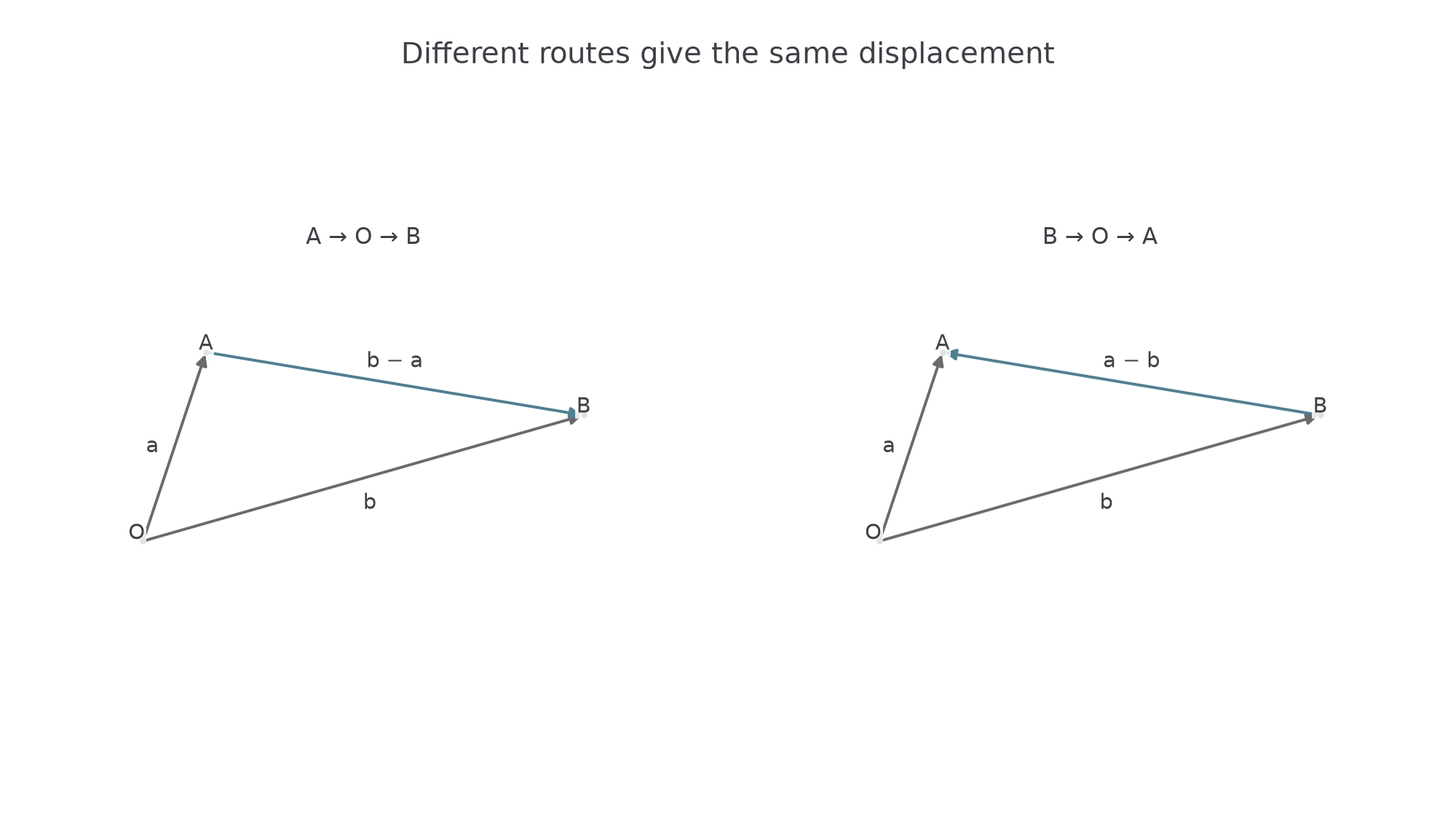
Journeys between position vectors
If and , then
A vector from one point to another is finish position minus start position, using the same reference point .
Not on the 2027 formula sheet: derive it by following the arrows.
A position vector means a vector from the chosen reference point to a point. Changing the reference point changes the position vectors, but not the displacement between the two points. A closed journey returns to its starting point, so its vector sum is .
Worked example 1: a journey through the reference point
Question. and . Express in terms of and .
Plan. Follow , respecting each arrow's direction.
Answer. .
Check. The closed journey totals .
Change only the direction of the requested journey. Every displacement must reverse, including both terms.
Worked example 2: reversing the direct journey
Question. For the same points, express in terms of and .
Plan. Travel .
Answer. .
Check. , so the two moves undo each other.
Letters such as and describe whole vectors, not lengths. Do not turn a subtraction into an unsigned distance.
Proving lines parallel
Two nonzero vectors are parallel exactly when one is a nonzero scalar multiple of the other.
If , multiplying by changes length and possibly reverses direction, but it does not introduce a new line direction. Require and , : the zero vector has no direction. For two distinct supporting lines this proves they are parallel. If they share a point, the same calculation instead places them on one line.
Key idea
“Both expressions contain and ” proves nothing about direction. Factor one single scalar multiplying the whole other vector.
Consider a non-degenerate triangle , so its side vectors and are not parallel. Mark on and on at the same fraction of the way from .
[DIAGRAM: asset_name: Equal fractions on triangle sides give a parallel segment; asset_slug: parallel-vector-segments; caption: The same fraction multiplies both side vectors and therefore the connecting vector.; description: Two exact non-degenerate triangles OAB. In the first M and N are midpoints of OA and OB so MN is one half of directed AB. In the second M and N are one third of the way from O on their sides so MN is one third of AB. All vector arrows follow M to N and A to B.]
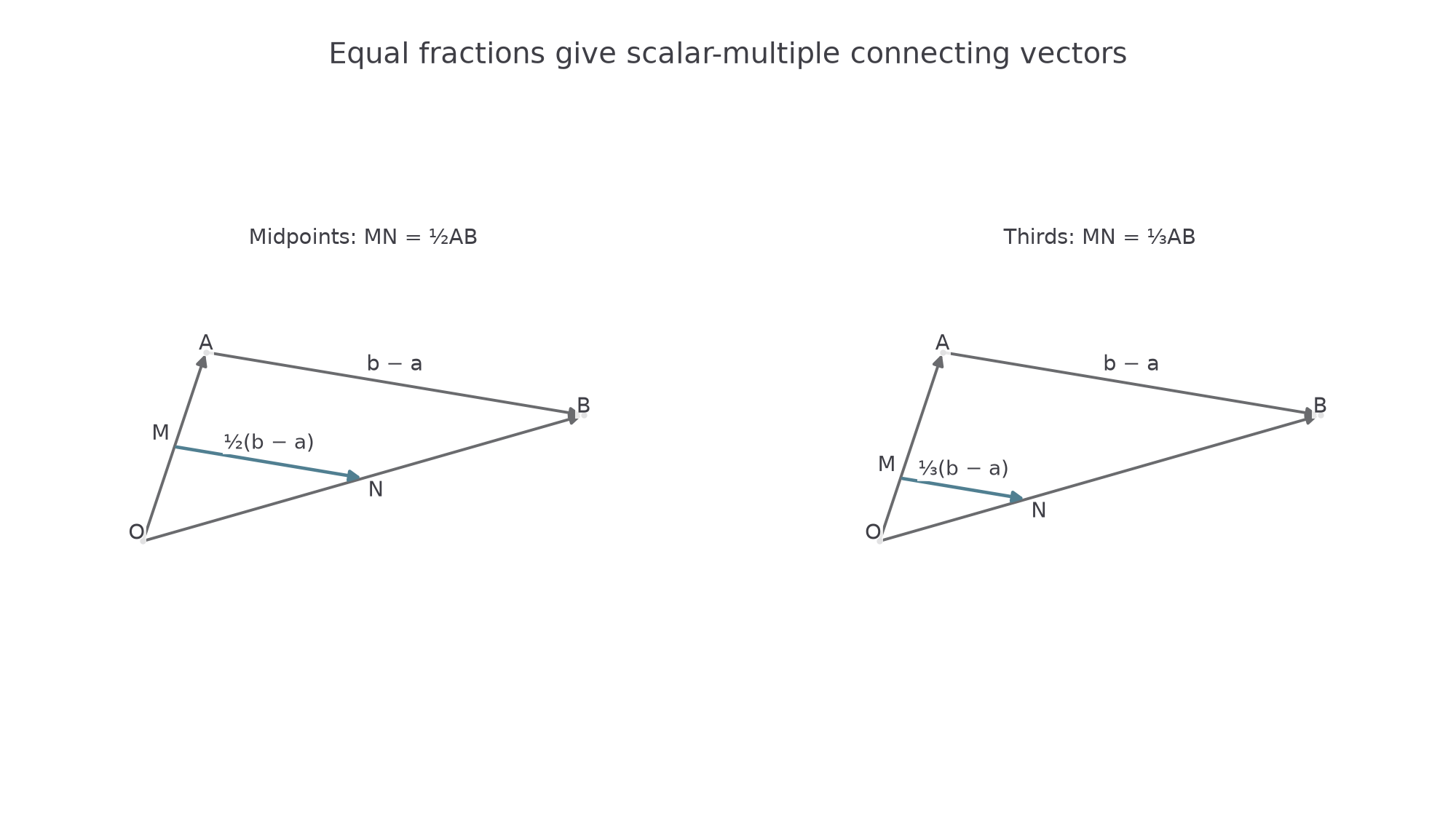
Worked example 3: proving the midpoint segment parallel
Question. and are the midpoints of and in non-degenerate triangle . Prove using vectors.
Plan. Express both directed segments and show a scalar-multiple relationship.
Answer. The nonzero segment vector is a scalar multiple of , so the distinct lines and are parallel.
Check. Their lengths have ratio , which agrees with the midpoint similarity result. The proof itself holds for every non-degenerate triangle, not only a measured drawing.
Change only the common fraction along the two sides. Both coefficients must change together.
Worked example 4: using thirds instead of halves
Question. and in non-degenerate triangle . Prove .
Plan. Subtract the position vectors and factor their common fraction.
Answer. The vectors are nonzero scalar multiples, so .
Check. Relative to the midpoint case, both endpoint positions and the connecting vector are scaled by . Its direction remains unchanged.
A negative scalar would also establish parallel directions, with the arrows reversed. A statement about lengths alone would miss that directed relationship.
Proving points collinear
To prove three distinct points lie on one straight line, compare two directed vectors with a common starting point.
Collinear
Points are collinear when they lie on one straight line. For distinct , , , showing proves collinearity: the two parallel directions both pass through , so they are the same line.
Positive places and on the same ray from . Negative puts them on opposite rays. If , lies between and ; if , lies between and . Values or make two points coincide, so exclude them when the question specifies three distinct points.
Continue this lesson.
You’re previewing NovaLearn without an account. Create a free account to read the rest.
Create free account