6.02d, 10.05d - The sine rule
Find distances across a triangle without a right angle. The formula in 6.02d comes from a shared perpendicular height; 10.05d uses it to find sides and angles, including the cases where two different triangles fit the same measurements.
Why the sine rule works
Two surveyors stand apart at and . They measure the angles towards a tree at : and . Can they find the distance without reaching the tree? There is no right angle in their triangle, but we can create two right-angled triangles with one perpendicular.
First recall a familiar triangle: sides , and lie opposite angles , and . Dividing each side by the sine of its opposite angle gives every time. The matching of opposites is the important feature.
Opposite side and angle
In triangle , side is opposite angle , side is opposite angle , and side is opposite angle . An opposite side does not touch the vertex of its angle.
Draw a perpendicular of height from to the line . The two right-angled triangles express the same height in two ways.
[DIAGRAM: asset_name: A shared height gives the sine rule; asset_slug: sine-shared-height; caption: The same perpendicular height equals both b sin A and a sin B.; description: An acute triangle ABC with AB horizontal, C above the base and D the perpendicular foot. AC is b, BC is a, AB is c and CD is h. A second panel has obtuse angle A and D on the extension of BA, showing that the height remains b sin A.]
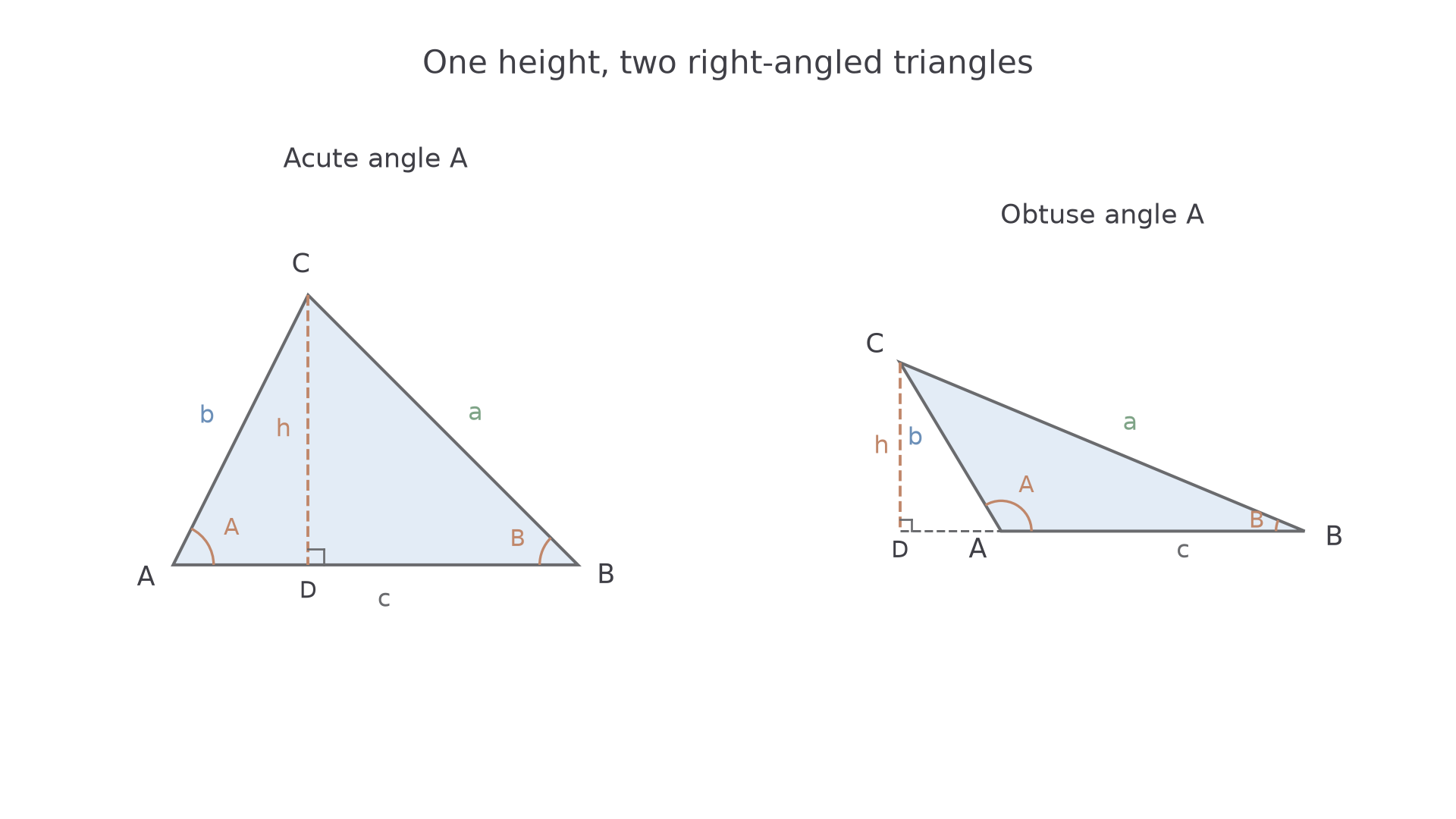
For an obtuse angle, the perpendicular can meet an extended side. The small right-triangle angle is . A reflected right triangle has the same height, giving , so the argument still works. Dropping a height from a different vertex gives the third equal ratio.
Sine rule
For any non-degenerate triangle, with each side opposite its matching angle,
Sides are positive and each interior angle lies strictly between and . The reciprocal form, , is equivalent.
In the June and November 2027 Higher Tier Formulae Sheet.
Try the relationship on exact values before using calculator decimals.
Worked example 1: three equal ratios
Question. A triangle has , , , with opposite sides , , . Work out the common sine-rule ratio.
Plan. Match each side with its opposite angle, then use the exact sines.
Answer. All three ratios are .
Check. Pythagoras gives , confirming that these lengths fit the stated right-angled triangle.
Double every side while keeping the angles fixed. This changes the common ratio, although the trigonometric values stay the same.
Worked example 2: scaling the triangle
Question. The opposite sides for the same three angles are now , and . Work out the common sine-rule ratio.
Plan. Divide the new sides by the same exact sines.
Answer. The common ratio is .
Check. The triangle is an enlargement with scale factor . A ratio consisting of a length divided by a fixed number should also double: .
The ratio is equal within one triangle; it is not the same fixed number for every triangle.
Watch out
The expression mismatches the labels. Trace across the triangle from the angle to its opposite side before writing a ratio.
Use one opposite pair to find the common ratio in a fresh triangle.
Finding sides with the sine rule
To find a side, use one complete opposite side–angle pair and the angle opposite the unknown side.
If two angles are known, find the third using the angle sum . Write just the two ratios you need, rather than carrying all three through the calculation. All angles here are in degrees: check the calculator mode.
Rearranging for a side
If and are a known opposite pair and is known,
The labels can be changed to match the triangle. The sine rule is in the 2027 Higher formula sheet; this is its rearrangement.
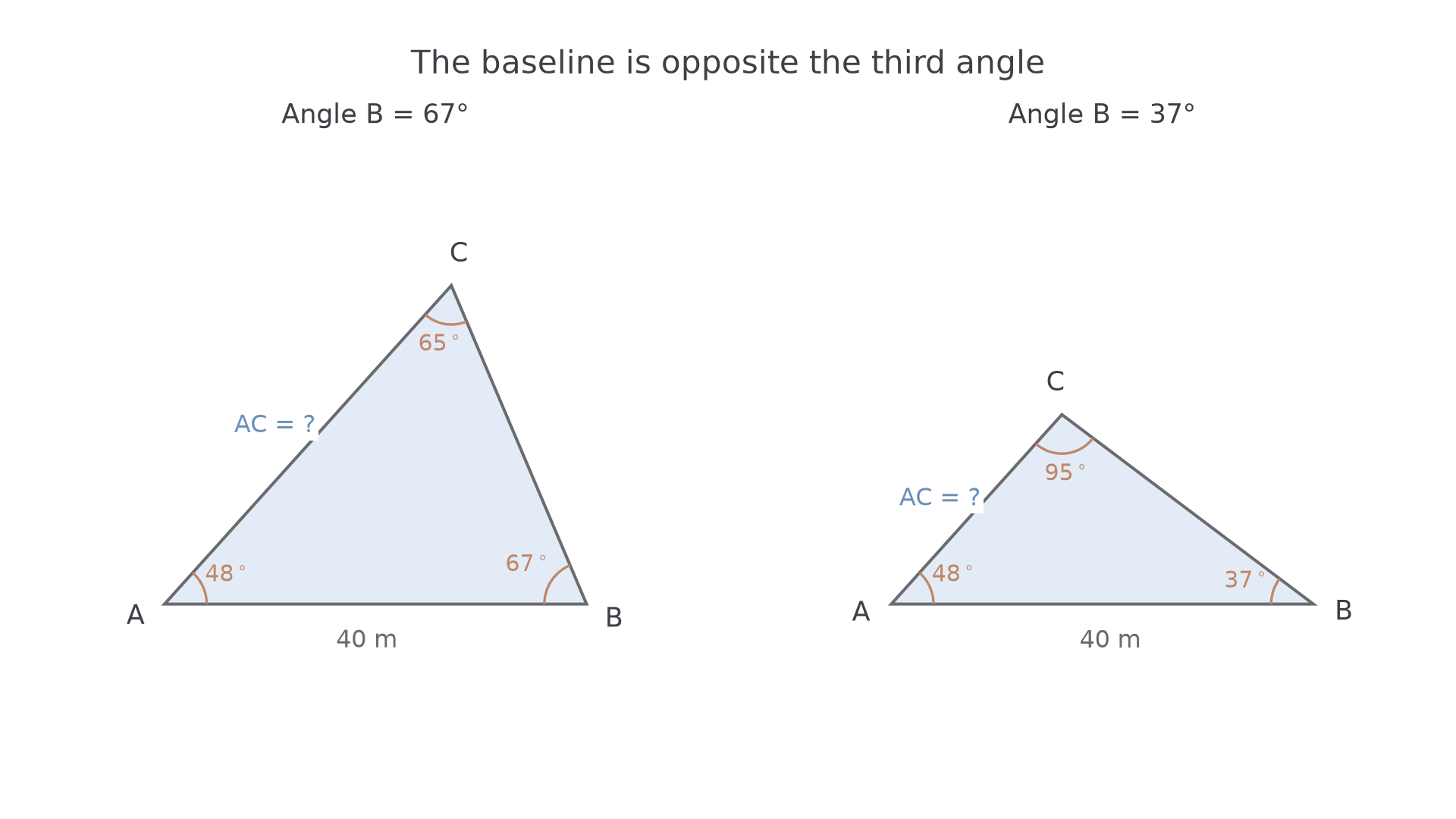
We can now answer the surveyors' distance question. Remember that is opposite , while the measured baseline is opposite .
Worked example 3: a distance across a triangle
Question. , and . Find to significant figures.
Plan. Find , then match with and with .
Answer. to significant figures.
Check. is slightly larger than , so its opposite side should be slightly longer than . The result has that size.
Change only the measured angle at , keeping the baseline and angle at . The third angle changes too, so both sines in the calculation must be updated.
Worked example 4: a different sightline
Question. , and . Find to significant figures.
Plan. Find the new angle opposite the baseline before using the sine rule.
Answer. to significant figures.
Check. The baseline is now opposite the largest angle, , so it should be longer than . The remaining side is , and , as a triangle requires.
A sketch helps prevent the label swap that would invert this result.
[DIAGRAM: asset_name: Survey triangles with matched opposite pairs; asset_slug: sine-survey-pairs; caption: AC is opposite B, while the 40 m baseline is opposite C.; description: Two accurately constructed triangles have AB equal to 40 metres and angle A equal to 48 degrees. The first has angle B 67 degrees and C 65 degrees. The second has B 37 degrees and C 95 degrees. AC is highlighted in each and all three vertices are labelled.]
Exam tip
Keep the full calculator value until the final answer. If another side is needed later, use the stored value rather than the rounded displayed answer.
Find the third angle first in the next triangle.
Continue this lesson.
You’re previewing NovaLearn without an account. Create a free account to read the rest.
Create free account