7.03a - Translating and reflecting graphs
An equation can move a whole graph without changing its shape. Track a few key coordinates to identify vertical and horizontal translations, then reflections in the coordinate axes. These are Higher-tier skills, and you can use them directly with equations without special function notation.
Moving a graph vertically
Why does move a parabola left, even though its equation contains a plus sign? First compare the simpler case of adding a number to every output.
On , the point comes from the input and output . On , the same input gives . Its image is : the point moves up three units.
Graph translation
A translation moves every point by the same horizontal and vertical amounts. Adding to every output moves a graph vertically by : a point becomes .
Positive moves upwards; negative moves downwards. Horizontal coordinates stay fixed. For a sketch, move useful anchors such as a turning point and intercepts, then keep the original shape.
Worked example 1: translating upwards
Question. Sketch from , identifying the translation, turning point and vertical intercept.
Plan. Add three to the vertical coordinate of every point.
Answer. Translate up units. The upward-opening parabola has turning point and vertical intercept , and no horizontal-axis intercept.
Check. Its smallest output is , so the absence of horizontal intercepts makes sense.
Change only the sign of the added constant. The direction reverses.
Worked example 2: translating downwards
Question. Sketch from , identifying the translation, turning point and vertical intercept.
Plan. Subtract three from every vertical coordinate.
Answer. Translate down units. The turning point and vertical intercept are ; the graph crosses the horizontal axis at .
Check. Substituting gives . At , the output is , matching the moved vertex.
The diagram shows points moving vertically, rather than the curve becoming narrower or wider.
[DIAGRAM: asset_name: Vertical translations of a parabola; asset_slug: vertical-translations; caption: Adding or subtracting three moves every point vertically by the same amount.; description: Two coordinate panels compare y equals x squared with y equals x squared plus three and with y equals x squared minus three. Turning points are labelled and vertical arrows show their three-unit translations.]
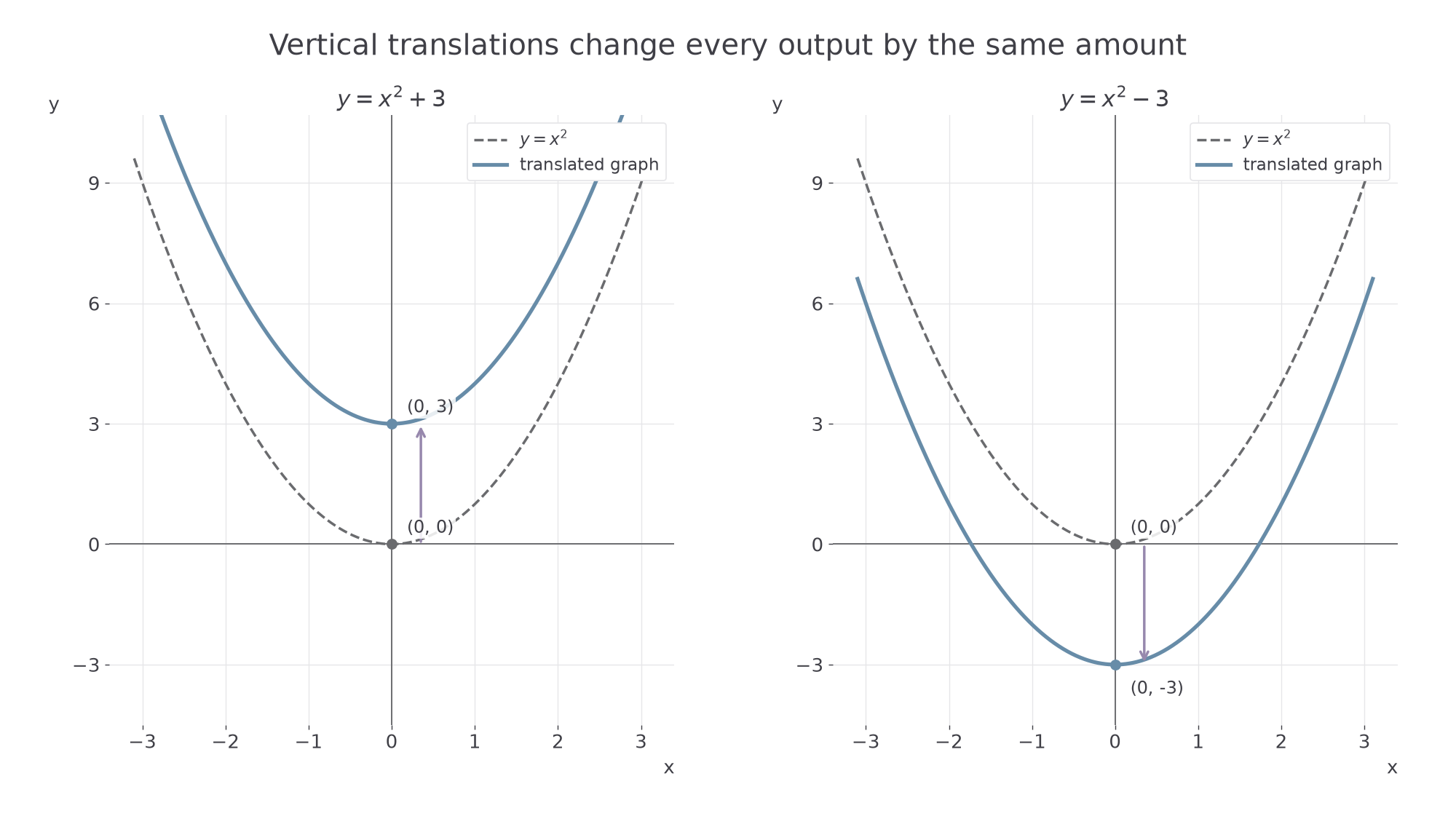
The same rule works for other shapes. For , the original outputs from to become outputs from to ; every angle stays fixed. A given graph without an equation can be moved by the same coordinate rule.
Watch out
Adding outside the square changes the output: moves up three. Do not change it to , which changes the input and moves horizontally.
Move a point and the turning point by the same amount.
Moving a graph horizontally
A change inside the expression tells you which input now produces an old output.
In , the output zero occurs when the expression being squared is zero: , so . The old turning point therefore moves to . In , the corresponding input is , so the graph moves left.
Key idea
Replacing every in an equation's right side by moves the graph right by . An old point becomes , because the new input must satisfy .
This also explains negative shifts: replacing by moves left by three. Solve for the new input rather than trusting the sign by itself.
Worked example 3: moving a graph to the right
Question. The graph is translated to . Sketch the new graph, identifying its turning point and the image of .
Plan. Make the new input give the old input: .
Answer. Translate right units. The new upward-opening parabola has turning point , image point and vertical intercept .
Check. Substituting gives , the old output at . The shift preserves each output.
Change only the sign inside the bracket. The vertical offset stays .
Worked example 4: moving the same graph to the left
Question. Translate to . Sketch the new graph, identifying its turning point and the image of .
Plan. Solve to locate each old output.
Answer. Translate left units. The turning point is , the image point is , and the vertical intercept is .
Check. At , the bracket is and the output is . Also the vertex occurs when the square is zero, at .
Continue this lesson.
You’re previewing NovaLearn without an account. Create a free account to read the rest.
Create free account