8.03a–8.03c - Angles on lines
A single marked angle can determine several others without a protractor. Use turns, straight lines and parallel lines to calculate missing angles, explaining the geometrical reason for each step.
Angles at a point and on a line
Two parallel rails are crossed by a diagonal bar. If one angle is , can you find the other seven angles? We will reach that question after establishing two totals which make angle calculations possible.
Imagine facing in one direction, turning through several adjacent angles, and ending where you started. You have made one complete turn. Stopping in the opposite direction instead gives half a turn.
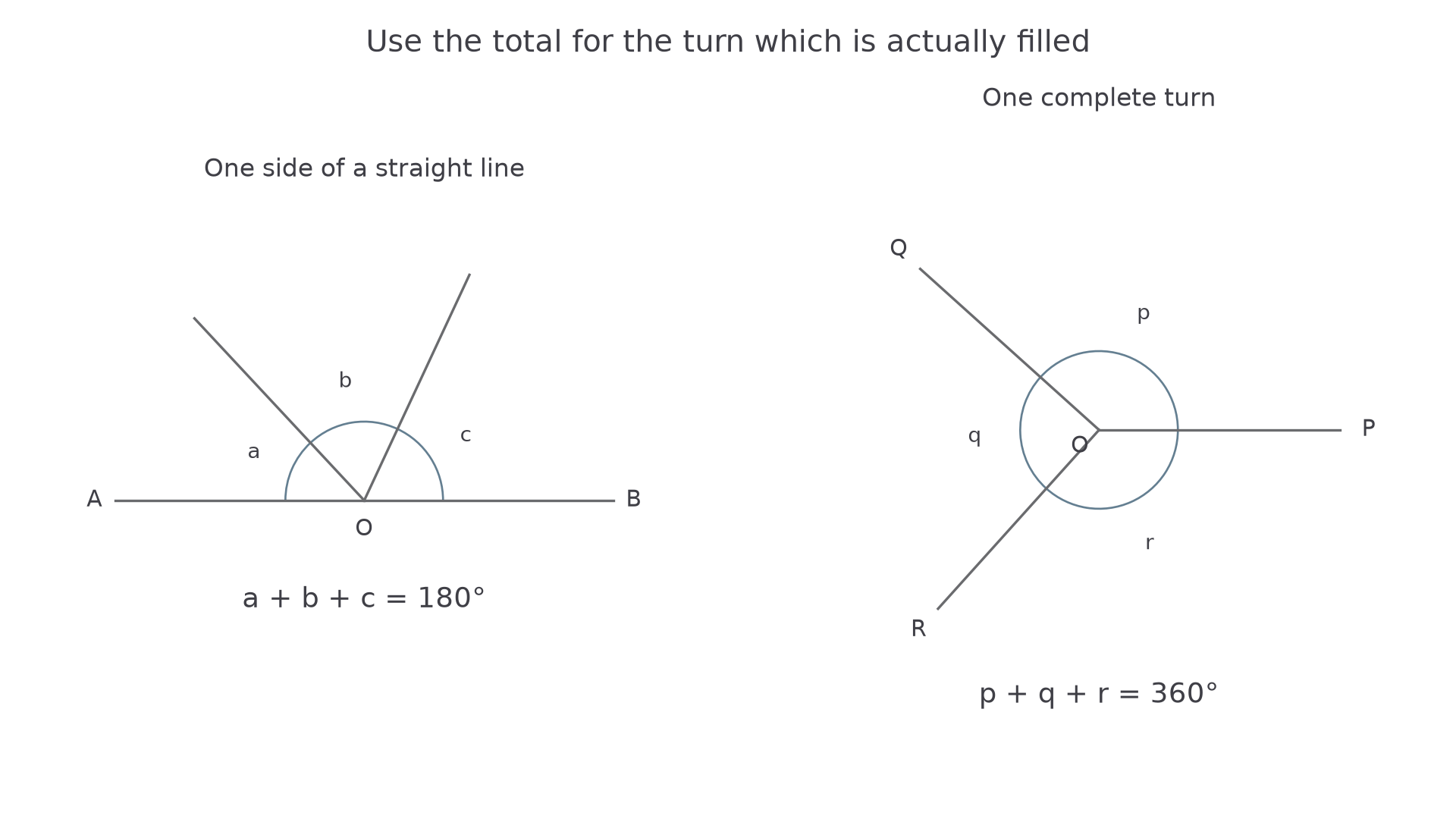
[DIAGRAM: asset_name: A half turn and a full turn; asset_slug: half-and-full-turns; caption: Add adjacent angles which exactly fill the stated turn.; description: The first panel has a straight line AOB with two rays above it dividing the half turn into angles a, b and c. The second has three rays OP, OQ and OR dividing a complete turn into adjacent angles p, q and r. Arcs identify all regions, no region is counted twice.]
Angle totals
Adjacent angles at a point on one side of a straight line sum to . Angles filling one complete turn at a point sum to .
These totals are not on the 2027 formula sheet: learn them.
The angles must fill the turn without gaps or overlaps. Two angles which merely share a vertex need not total .
Worked example 1: filling a straight angle
Question. In the half-turn diagram, and . Find .
Plan. Subtract both known angles from the straight-line total.
Answer. .
Check. , so the three angles exactly fill the half-turn.
Change only . Since the total stays fixed, making one angle ten degrees larger must make the missing angle ten degrees smaller.
Worked example 2: a larger known angle
Question. In the same half-turn arrangement, and . Find .
Plan. Use the same straight-line total with the new value of .
Answer. .
Check. . Compared with the first example, rose by ten and fell by ten.
For a full turn, change the total rather than the subtraction method.
Worked example 3: filling a full turn
Question. In the full-turn diagram, and . Find .
Plan. Remove the known angles from a complete turn.
Answer. .
Check. , and the remaining angle is positive and smaller than a straight angle.
Now change only , keeping the quarter-turn .
Worked example 4: the same complete turn
Question. In the full-turn arrangement, and . Find .
Plan. Subtract the new known total from .
Answer. .
Check. ; the ten-degree increase in has reduced by ten degrees.
Choose the total from the geometry before doing arithmetic.
Watch out
For the complete-turn diagram, uses the wrong total. A straight line is half a turn; the three labelled regions fill a full turn.
Use the full-turn arrangement for this fresh calculation.
Vertically opposite angles
When two straight lines cross, each passes through the intersection rather than stopping there. Opposite angles then have a special equality.
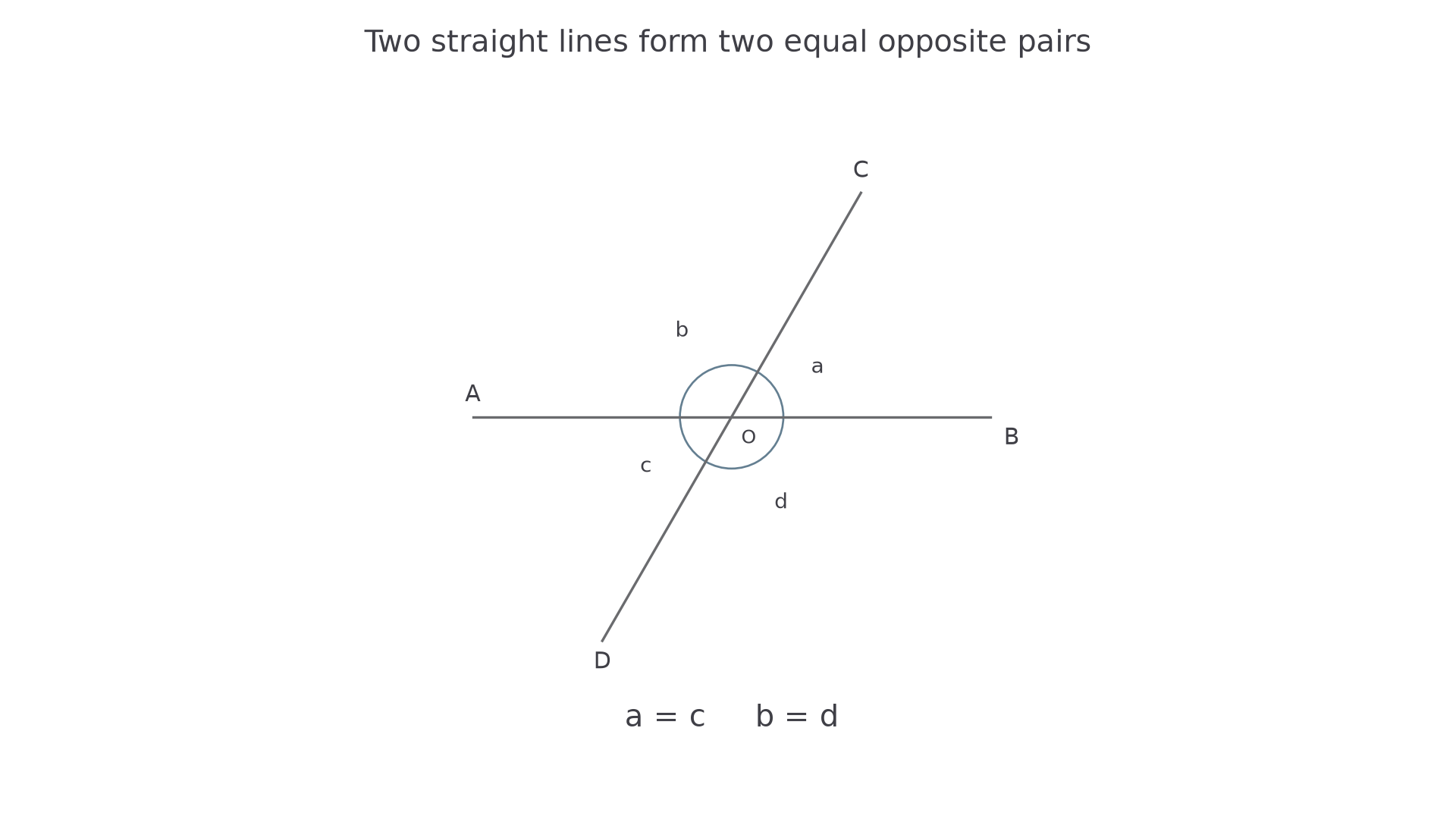
[DIAGRAM: asset_name: Four angles at an intersection; asset_slug: intersecting-angles; caption: Opposite regions are equal, neighbouring regions on a line total 180 degrees.; description: Straight lines AOB and COD cross at O. Going anticlockwise from ray OB, the four regions are labelled a, b, c and d. Angles a and c are vertically opposite, as are b and d. The diagram is schematic, with labelled rays and no numerical measurements.]
Vertically opposite angles
Vertically opposite angles are the opposite angles formed by two intersecting straight lines. They are equal: and . “Vertically” does not mean they must appear above and below each other on the page.
Why are they equal? Both and are straight angles. Thus . Subtract the common to obtain . The same argument proves . Adjacent angles are supplementary, meaning they sum to ; they are not generally equal.
Worked example 5: two different angle sizes
Question. In the intersection diagram, . Find and .
Plan. Use opposite-angle equality first, then the straight line.
Answer. and .
Check. The fourth angle is also . All four total degrees.
Change only the value of ; the opposite pairs stay in the same positions.
Worked example 6: equality comes from position
Question. In the same arrangement, . Find and .
Plan. Copy to its opposite, then subtract from .
Answer. and .
Check. . The acute pair grew by ten degrees while the obtuse pair shrank by ten.
Do not copy an angle into a neighbouring region just because both touch the same intersection.
Watch out
The line is not justified by vertically opposite angles: and are adjacent. Only when the lines are perpendicular are all four angles .
State both the value and the relevant equality.
Angles on parallel lines
A transversal is a line crossing two other lines. When those two lines are parallel, their common direction creates further equal angles.
Continue this lesson.
You’re previewing NovaLearn without an account. Create a free account to read the rest.
Create free account