10.02a, 10.03a–10.03c - Perimeter and polygon area
Does cutting a notch out of a shape always increase its perimeter? Trace rectilinear boundaries (10.02a), then build the area rules for triangles (10.03a), rectangles and parallelograms (10.03b) and trapezia (10.03c). Choose perpendicular heights, use square units and work backwards to missing dimensions.
Perimeter of rectilinear shapes
A rectangular card has a piece cut from it. Is its edge now longer? The answer depends on where the cut is made, so follow the boundary rather than guessing from the amount of card left.
Perimeter
The perimeter is the total length of a shape's boundary. A rectilinear shape has straight edges in perpendicular directions. An inward corner can have a interior angle; its edges still meet perpendicularly. Perimeter uses length units such as centimetres, not square centimetres.
Choose a starting corner and trace one full circuit. Count each boundary side once. Find missing lengths from horizontal and vertical totals: a closed route travels equally far right and left, and equally far up and down. An interior dividing line is not part of the outside perimeter.
For a rectangle with length and width , opposite sides are equal, so
This rectangle rule is not on the 2027 formula sheet: learn it. Use consistent units and positive side lengths.
[DIAGRAM: asset_name: How notch position changes perimeter; asset_slug: notch-perimeters; caption: A corner cut replaces two old edge lengths by equal new ones. An interior notch adds two new depth edges.; description: Two exact rectilinear shapes from rectangles ten centimetres wide and seven centimetres high. Left: a four-by-three corner rectangle is removed at the top right. The remaining six boundary lengths are ten, four, four, three, six and seven centimetres. Right: a central top notch is four centimetres wide and three centimetres deep, with top shoulders three centimetres each. Its boundary lengths total forty centimetres. Dashed grey outlines indicate the removed original edges.]
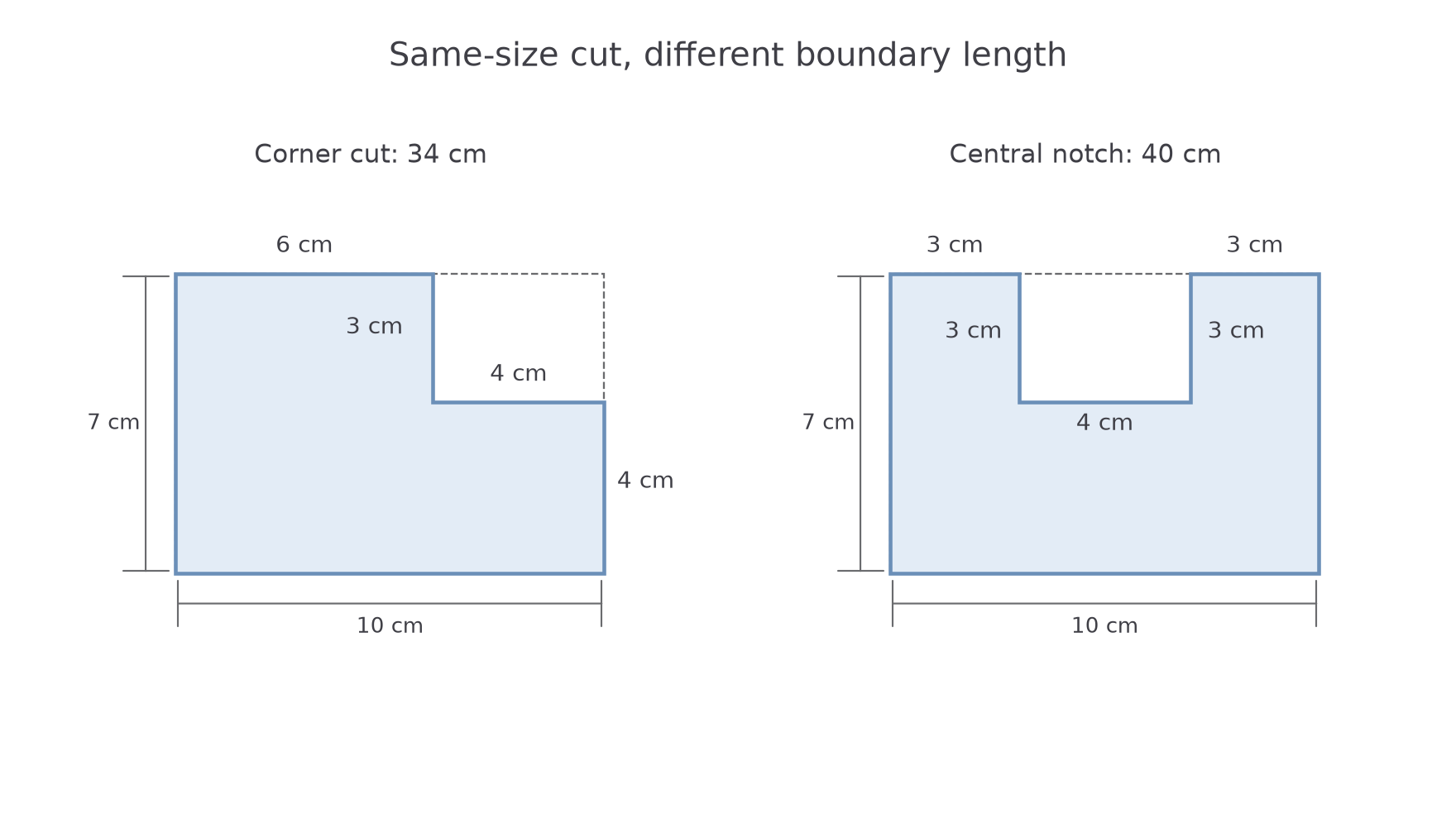
Worked example 1: cutting a corner
Question. A by rectangle has a wide, deep piece removed from its top-right corner. Find the remaining perimeter.
Plan. Find the shortened outside edges, then trace the six boundary sides.
Answer. .
Check. The original perimeter was . Removing outside lengths 4 and 3 adds inside lengths 4 and 3, so the perimeter is unchanged.
Move only the cut: keep the same width and depth, but place the notch in the middle of the top edge. Two extra depth edges now appear.
Worked example 2: cutting into the middle
Question. The same by rectangle has a central notch wide and deep cut from its top edge. The two shoulders are each . Find its perimeter.
Plan. Trace the outer sides and all three sides of the notch.
Answer. .
Check. The cut removes 4 cm from the old top but replaces it with another 4 cm plus two depths of 3 cm. Therefore .
The opening question has a surprising answer: cutting away the same-size piece can leave perimeter unchanged or make it larger. Area lost does not determine edge length gained.
Rectangle and parallelogram area
Area measures how much surface a flat shape covers. A rectangle along its base and high contains four rows of eight one-centimetre squares: .
Area
Area is measured in square units. One square centimetre is the area of a square with side length . Perimeter measures the boundary; area measures the surface within it.
A parallelogram can be turned into a rectangle by moving a triangular piece from one end to the other. No area is added or lost. Its base length stays the same, and its height is the perpendicular gap between its parallel sides, not the length of a sloping side.
[DIAGRAM: asset_name: Rectangle and parallelogram with equal areas; asset_slug: parallelogram-cut-slide; caption: Cut the triangular end from the parallelogram and slide it to the other side to make an 8-by-4 rectangle.; description: Left panel shows a rectangle with base eight centimetres and height four centimetres. Right panel shows a parallelogram with base eight, perpendicular height four and sloping side five centimetres. A dashed vertical cut three centimetres from its left edge separates a pale triangle. A matching dashed destination on the right shows the cut-and-slide rectangle. A right-angle marker distinguishes the height from the slant.]
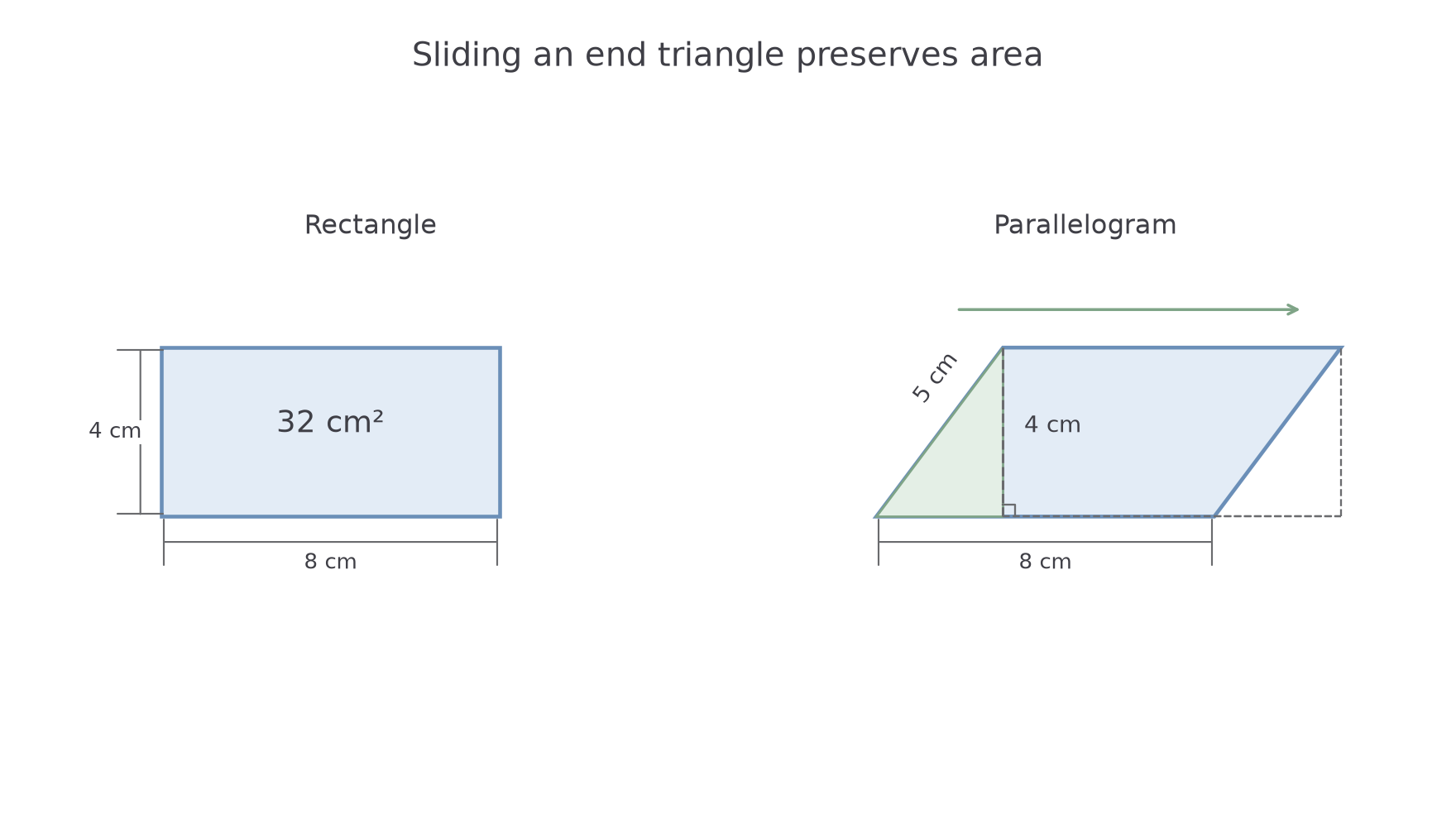
Rectangle and parallelogram area
Here is the base and is the perpendicular height, measured in the same length unit. Positive lengths give the area in square units. These formulae are not on the 2027 formula sheet: learn them.
Tilting the sides without changing the base or perpendicular gap does not change the area.
Worked example 3: a rectangle
Question. Find the area of a rectangle with base and height .
Plan. Count the unit-square rows using base times height.
Answer. .
Check. Four rows of eight unit squares give squares.
Change only the shape: slide the top side horizontally, preserving the base and vertical gap. The new sloping side is not the height.
Worked example 4: a parallelogram
Question. A parallelogram has base , perpendicular height and sloping side . Find its area.
Plan. Use the perpendicular height with the chosen base.
Answer. .
Check. Cutting and sliding the end triangle makes the by rectangle, whose area is also . The sloping length 5 does not enter the area calculation.
To find a missing height, reverse the multiplication: from , divide by the positive base to get . For example, area and base give ; substituting recovers 45. Similarly, when the height is positive.
Watch out
For the pictured parallelogram, multiplies the base by a slant. The correct height is the perpendicular gap, so the area is .
Now work backwards from a different area.
Continue this lesson.
You’re previewing NovaLearn without an account. Create a free account to read the rest.
Create free account