1.02a - Factors, multiples and primes
Number names tell you how numbers are built and how they relate. You will use place value, classify odd, even and prime numbers, distinguish factors from multiples, and connect squares and cubes with their roots.
What each digit is worth
Can the digit five be worth more than the digit nine? In , the five represents and the nine represents . A digit's position determines its value.
In our decimal system, each place is ten times the place immediately to its right. Moving left gives ones, tens, hundreds, thousands; moving right from the ones gives tenths, hundredths and thousandths. The decimal point marks the boundary between whole units and fractions of a unit.
Place value
Place value is the value a digit has because of its position. For example, contains three hundreds, no tens, four ones, no tenths and seven hundredths. Zero holds an empty place so the other digits keep their values.
The number can be expanded as . Leaving out a zero is safe only when it does not change another digit's position: , but .
Worked example 1: a digit in the thousands place
Question. What is the value of the digit in ?
Plan. Count places leftwards from the ones digit.
Answer. .
Check. Removing its contribution leaves , with a zero in the thousands place.
Keep the digits in order and change only the decimal point's position. The digit four now occupies the tens place.
Worked example 2: the same digit in a different place
Question. What is the value of the digit in ?
Plan. Locate the ones place immediately before the decimal point, then move one place left.
Answer. .
Check. Removing forty leaves , with no tens contribution.
The opening comparison is settled: a smaller digit can represent a greater amount. Read both the digit and its place.
Watch out
In , the six means six hundredths, not six tenths. . The zero after the decimal point holds the tenths place.
Read the decimal point before naming the place.
Odd, even and prime numbers
An integer can be sorted by whether it divides into pairs, and a positive integer can also be sorted by its exact divisors.
An even integer is divisible by two with no remainder. An odd integer leaves one unpaired unit when a positive collection is split into pairs; more generally, odd integers have the form “an even integer plus one”. Even integers end in , , , or ; odd integers end in , , , or . Zero is even because , and negative integers can be odd or even too: is even and is odd. These labels apply to integers, not numbers such as .
Prime number
A prime number is a positive integer greater than one with exactly two positive factors: one and itself. A factor divides a number exactly. For example, is prime because its positive factors are and . The number is not prime: it has only one positive factor.
A positive integer greater than one that is not prime is composite. For example, , so has the extra factor . Zero and one are neither prime nor composite. All primes other than are odd: a larger even number has as an extra factor. But being odd does not guarantee being prime.
Worked example 3: separating odd from prime
Question. From , write down the odd numbers and the prime numbers.
Plan. Use the final digit for oddness, then count positive factors for primality.
Answer. Odd: . Prime: .
Check. has one positive factor; has . Neither belongs in the prime list. Both and have only one and themselves.
Change only the last number to . Its oddness remains, but its factors change.
Worked example 4: an odd composite number
Question. From , write down the odd numbers and the prime numbers.
Plan. Classify oddness and primality separately.
Answer. Odd: . Prime: .
Check. The factors show directly that is composite.
The useful surprise is that is the only even prime, while plenty of odd numbers are composite.
Watch out
“Odd” and “prime” describe different properties. is odd but composite; is even and prime; is odd but not prime.
Classify both properties in the next number.
Factors and multiples
If , then three and six are factors of eighteen, and eighteen is a multiple of both three and six.
Factor and multiple
A factor, also called a divisor, of a positive integer divides it with no remainder. A multiple of a number is obtained by multiplying it by an integer. Thus is a factor of , and is a multiple of .
Unless a question says otherwise, lists of factors of a positive whole number mean its positive factors. They have a largest member: the number itself. Positive multiples continue without end. Zero is also a multiple, since , but “the first three positive multiples” excludes zero. Negative multiples exist too.
Find all positive factors in pairs. Test , then , then , and continue until the pairs begin to reverse. This prevents missing a factor.
Worked example 5: factors and multiples of twelve
Question. List all positive factors of and its first three positive multiples.
Plan. Find exact factor pairs, then multiply twelve by one, two and three.
Answer. Factors: . First three positive multiples: .
Check. Each listed factor divides twelve exactly. Testing repeats the pair , so no new pair is needed.
Change only the starting number to eighteen. The same two procedures still do different jobs.
Worked example 6: factors and multiples of eighteen
Question. List all positive factors of and its first three positive multiples.
Plan. Pair exact divisors, then count in eighteens.
Answer. Factors: . First three positive multiples: .
Check. Neither nor divides eighteen; at , the factor pairs reverse. Each multiple divided by eighteen gives , or .
A common factor is a factor of each of two or more numbers. Comparing our lists, are common factors of and . A common multiple is a multiple of each: is one because . So are and . Later you will choose the highest common factor and lowest positive common multiple for particular problems.
Watch out
is a factor of ; is a multiple of . Reversing those words reverses the relationship.
Keep the two lists separate.
Squares, cubes and roots
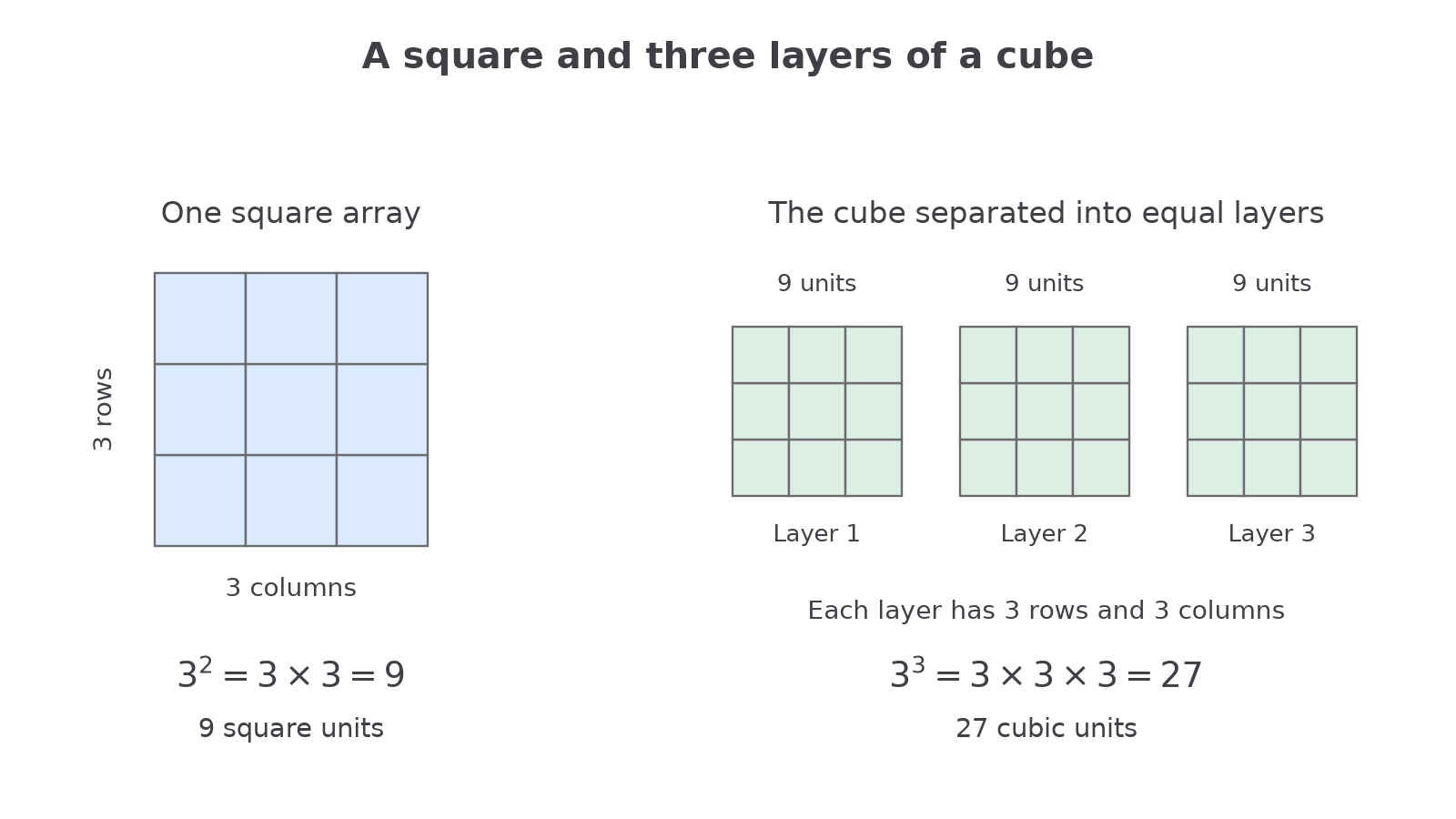
A square array with three rows and three columns contains nine units; three layers of that array contain twenty-seven units.
[DIAGRAM: asset_name: A square and three equal layers; asset_slug: square-cube-units; caption: Three squared counts nine units, and three cubed counts three layers of nine.; description: A three-by-three square array of nine pale blue units is shown on the left. On the right, three separate three-by-three layers show twenty-seven pale green units in total, representing a cube of side three units. Labels identify three rows, three columns, nine square units and three layers of nine equals twenty-seven cubic units.]
Square and cube
The square of a number is the number multiplied by itself: . Its cube uses three equal factors: . The raised number counts equal factors; it is not a multiplier.
A root reverses a power. asks for the nonnegative number that squares to nine, and asks for the number that cubes to twenty-seven.
Worked example 7: a square and its root
Question. Work out , then .
Plan. Multiply two sixes, then reverse that operation.
Answer. and .
Check. Six rows of six contain units.
Keep the starting number six and change only the power from square to cube. Its matching root changes too.
Worked example 8: a cube and its root
Question. Work out , then .
Plan. Use three equal factors, then find the number that produces that cube.
Answer. and .
Check. and , leaving three equal factors of six.
Zero is a square and a cube: . A negative number has a nonnegative square, such as , but a negative cube, such as . The principal square root symbol selects the nonnegative root: , although both and square to nine. There is no real square root of a negative number.
Watch out
, not . A cube means three equal factors, not multiplication by three.
Use the power and root in opposite directions.
Quick Recap
- A digit's place determines its value; zeros can hold empty places.
- Even and odd describe integers. A prime has exactly two positive factors; one is not prime.
- Factors divide a number exactly; multiples are whole-number steps of that number. Common factors or multiples belong to both numbers.
- Squares use two equal factors and cubes use three; roots reverse the corresponding powers.
Yes, five can be worth more than nine: in , their contributions are and .