6.05a - Inverse and composite functions
An inverse function reverses a rule, while a composite function applies rules in succession. Use words, expressions and machine diagrams to build these processes, keep their order straight and decide when a reverse rule gives one unambiguous answer.
Higher only.
Reversing a function
Can you undo “subtract 4, then multiply by 3” by adding 4 and dividing by 3 in that order? Start at 6: the forward rule gives . Adding 4 and then dividing by 3 gives , so it has not recovered the input. We must reverse the order as well as the operations.
The forward process turns the input into an output. Reversing it starts from that output and recovers the original input. For this machine, first divide by 3, then add 4. Starting from output 6 gives , as required.
Inverse function
An inverse function reverses a function: it takes an original output back to its original input. It must give exactly one recovered input for each original output being considered. Operations are undone in reverse order.
We can express the inverse directly in terms of the given output, without special function notation.
Worked example 1: undoing a two-step rule
Question. A function subtracts 4 from its input and then multiplies by 3. Its output is . Write an expression for its original input in terms of .
Plan. Divide the output by three, then undo subtracting four.
Answer. The original input is .
Check. Put this input into the original rule: . Also, output 15 gives input 9, and .
Change only the sign of the first operation: add four rather than subtract four. The reverse order remains the same, but the last inverse operation changes.
Worked example 2: a changed first operation
Question. A function adds 4 to its input and then multiplies by 3. Its output is . Write an expression for the original input.
Plan. Undo multiplication first, then undo adding four.
Answer. The original input is .
Check. . At output 15, the recovered input is 1, and .
An equation gives the same result. If the first rule is , divide both sides by 3 and add 4 to obtain . Here remains the original input and remains its output; naming the variables clearly avoids swapping their roles by accident.
Watch out
The inverse of a rule is not its reciprocal. Reversing does not mean writing . It means recovering the input by undoing the operations.
Write a reverse expression using a new coefficient and constant.
Putting functions in sequence
The output of one function can become the input of another. Treat the whole first output as the next input, including its brackets.
Composite function
A composite function applies one function and then another. The second function acts on the first function's output. State the order explicitly: “A followed by B” means A acts first.
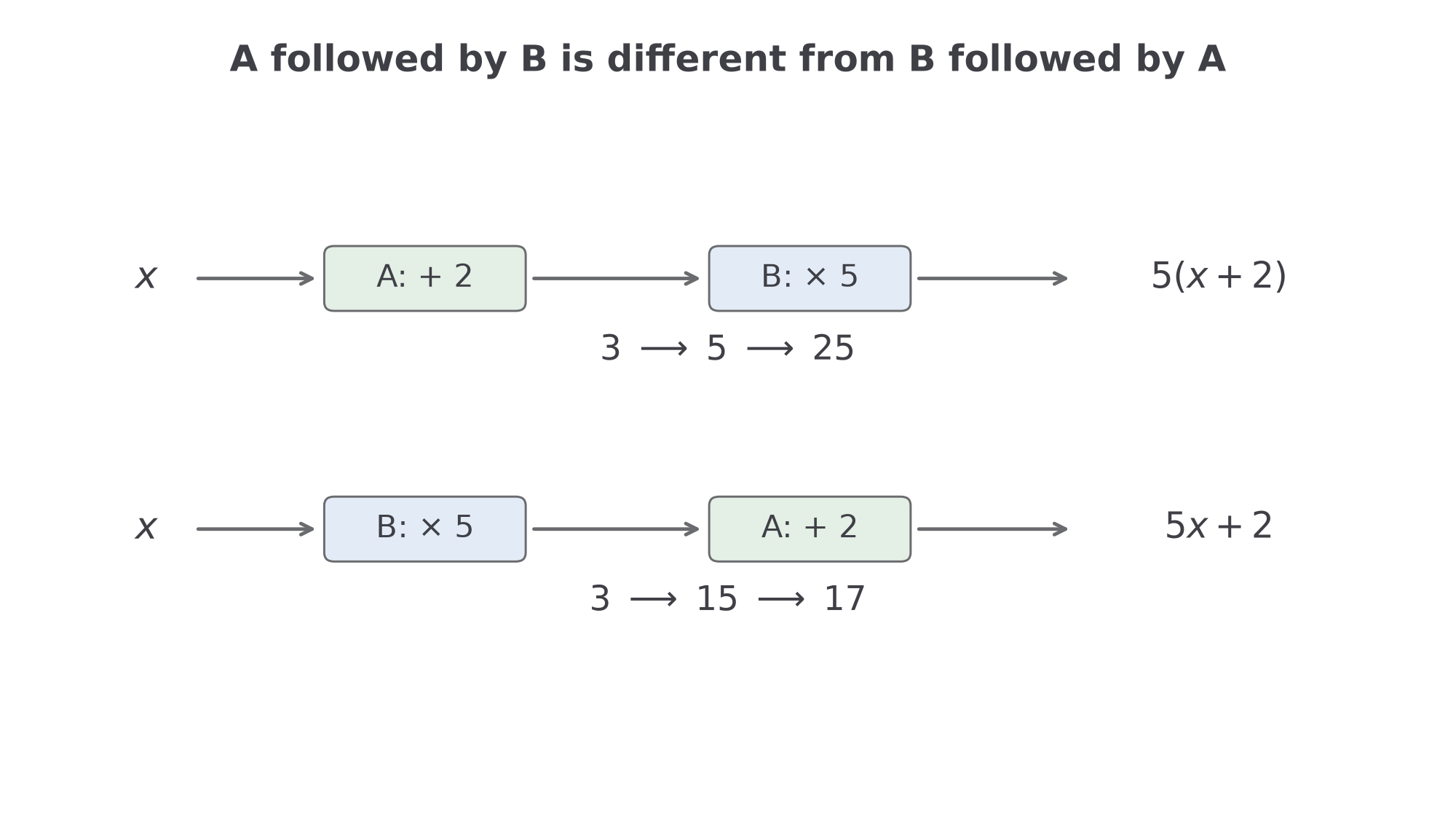
Let function A add 2, and function B multiply by 5. At input 3, A then B gives , but B then A gives . Using the same two functions does not guarantee the same composite.
[DIAGRAM: asset_name: Order in a composite function; asset_slug: composite-function-order; caption: A followed by B applies the whole output of A to B.; description: Two machine chains use function A add two and function B multiply by five. The upper chain applies A then B to input x, producing x plus two and then five times the bracket x plus two. The lower chain applies B then A, producing five x and then five x plus two. At input three the respective outputs are twenty-five and seventeen.]
Worked example 3: A followed by B
Question. Function A adds 2. Function B multiplies by 5. Write the rule for A followed by B as an expanded expression in input .
Plan. Write A's whole output as B's input, then expand.
Answer. The output is : multiply the original input by 5, then add 10.
Check. With , the two-stage machine gives , then 5. The combined expression gives .
Change only the order of the functions. The multiplication no longer acts on the added two.
Worked example 4: B followed by A
Question. Using the same functions, write the rule for B followed by A as an expression in input .
Plan. Multiply first, then feed that whole output to the adding function.
Answer. The output is .
Check. With , the original two functions give , then . The expression agrees. It is 8 below the first composite at every input because .
Continue this lesson.
You’re previewing NovaLearn without an account. Create a free account to read the rest.
Create free account