6.02d, 10.05b - Right-angled trigonometry
A ramp rises at a fixed angle: how does its height change when its length doubles? Similar right-angled triangles turn that question into three useful side ratios. Learn to choose a ratio, find missing lengths and angles, and connect a ground-level direction to a bearing.
Side ratios from similar triangles
Doubling a ramp's size doubles its rise and its horizontal run, but leaves its slope angle unchanged. Ratios of corresponding sides therefore stay the same.
Choose one acute angle and call it , read “theta”. The hypotenuse is opposite the right angle. The opposite side is across from . The adjacent side touches and is not the hypotenuse. The names opposite and adjacent depend on your chosen angle.
[DIAGRAM: asset_name: Similar triangles have equal side ratios; asset_slug: similar-triangle-ratios; caption: Scaling every side leaves the three ratios unchanged.; description: Two separate right-angled triangles show the same acute angle theta at their lower left vertices. The smaller has adjacent side 4, opposite side 3 and hypotenuse 5. The larger has corresponding sides 8, 6 and 10. Right angles and the reference angle theta are marked in both.]
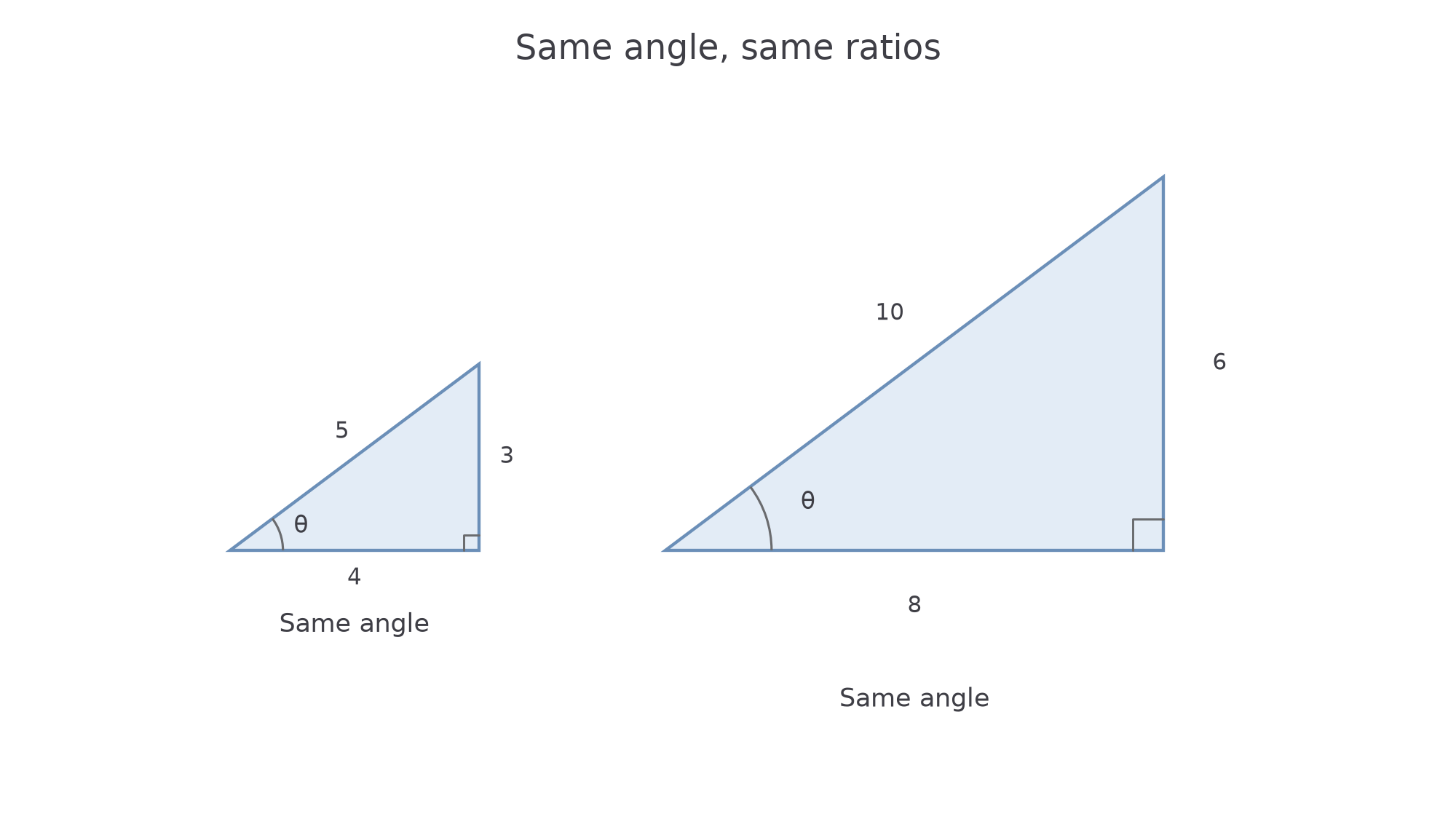
Two right-angled triangles with the same acute angle have all three corresponding angles equal, so they are similar. If a scale factor multiplies every side, it cancels in each ratio:
So the ratio depends on the angle, rather than the triangle's size. Trigonometry names these relationships between angles and side lengths.
Three right-angled ratios
For an acute angle in a right-angled triangle,
The abbreviations are read “sine”, “cosine” and “tangent”. SOH, CAH, TOA can help you remember the order of each fraction.
A ratio of lengths in the same units has no unit. Sine and cosine of an acute angle lie between 0 and 1 because either shorter side is less than the hypotenuse. Tangent can exceed 1 when the opposite side is longer than the adjacent side.
Worked example 1: naming the ratios
Question. A right-angled triangle has sides 3 cm, 4 cm and 5 cm. Angle is opposite the 3 cm side. Find its sine, cosine and tangent as fractions.
Plan. Identify each side relative to , then form the three ratios.
Answer. , , .
Check. Dividing the sine ratio by the cosine ratio gives , the same opposite-to-adjacent ratio.
Now double every length. The side lengths change, but the fractions simplify back to the same values.
Worked example 2: scaling the triangle
Question. The triangle is enlarged to sides 6 cm, 8 cm and 10 cm. Find the same three ratios for the angle opposite 6 cm.
Plan. Use corresponding sides and cancel the common scale factor.
Answer. All three ratios are unchanged.
Check. Each numerator and denominator doubled. The equal ratios agree with the unchanged angles of similar triangles.
If instead you choose the other acute angle, the 3 cm and 4 cm sides exchange names. The hypotenuse stays the 5 cm side. Always mark your reference angle before naming opposite and adjacent.
Choosing sine, cosine or tangent
Choose the ratio that connects the two sides you know or need; an unused third side need not be calculated.
First locate the right angle and name the hypotenuse. Next mark the acute reference angle and label opposite and adjacent. Finally choose from this table.
| Sides involved | Ratio |
|---|---|
| Opposite and hypotenuse | Sine |
| Adjacent and hypotenuse | Cosine |
| Opposite and adjacent | Tangent |
[DIAGRAM: asset_name: Opposite and adjacent depend on the angle; asset_slug: trig-reference-angle; caption: Changing the reference angle swaps the two shorter side names.; description: The same right-angled triangle ABC is shown twice with its right angle at C. In the first view angle A is marked, AC is adjacent, BC is opposite and AB is the hypotenuse. In the second view angle B is marked, BC is adjacent, AC is opposite and AB is still the hypotenuse.]
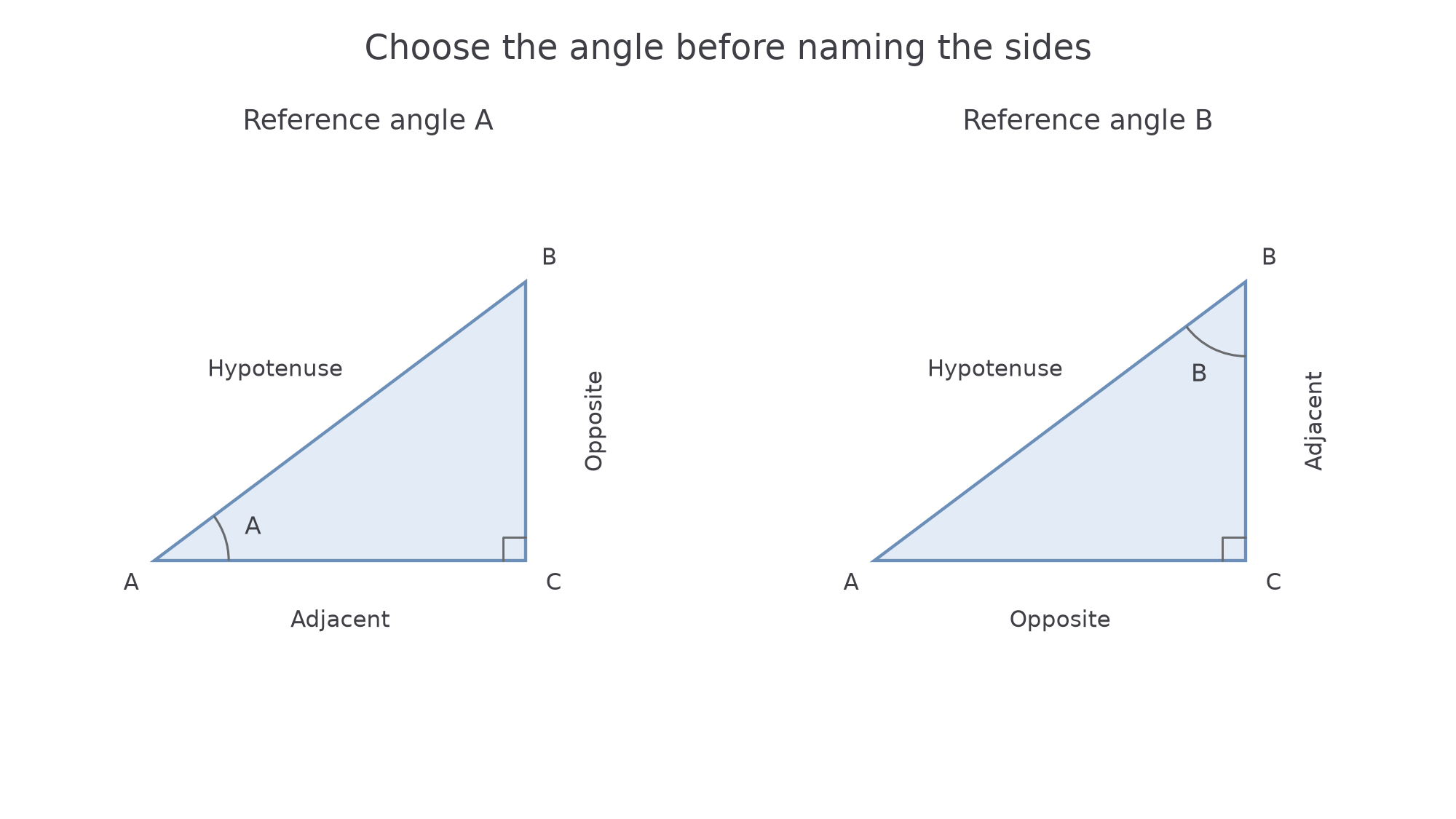
The direction the triangle points on the page is irrelevant. Its marked angle determines the names.
Worked example 3: opposite and hypotenuse
Question. Triangle ABC is right-angled at C. Angle A is , AB is 12 cm and BC is cm. Write an equation linking and the given values.
Plan. Identify the two sides relative to angle A.
Answer. .
Check. The unknown side is across from A, so a ratio using the adjacent side would introduce an unnecessary length.
Keep the triangle and data positions, but ask for AC instead of BC. Only the unknown side's role changes.
Worked example 4: adjacent and hypotenuse
Question. Triangle ABC is right-angled at C. Angle A is , AB is 12 cm and AC is cm. Write an equation linking and the given values.
Plan. AC touches A and is not the hypotenuse, so it is adjacent.
Answer. .
Check. The adjacent side is longer than the opposite side for this angle below . A calculator gives , agreeing with that comparison.
When both sides are shorter sides, tangent avoids the hypotenuse entirely. For instance, if the opposite side is and the adjacent side is 12, the equation is .
Choose before calculating
Write the side names first. Pythagoras connects three side lengths without using an acute angle; a trigonometric ratio connects an acute angle to a pair of sides. These methods answer different data situations.
Use the angle at the stated vertex, even if another one looks easier to label.
Finding an unknown length
A chosen ratio gives an equation; rearrange that equation before using the calculator.
Set the calculator to degrees, usually displayed as DEG. For example, is a useful mode check. Keep the calculator's unrounded value through the calculation and round the final length as requested.
If the unknown is above the fraction line, multiply by the denominator. If the unknown is below it, multiply both sides by that unknown first, then divide by the trigonometric value. Sine is a function of an angle, so is one complete numerical value.
Worked example 5: finding the opposite side
Question. A right-angled triangle has an acute angle and hypotenuse 10 cm. Find the opposite side to 3 significant figures.
Plan. Use sine, then multiply by the known hypotenuse.
Answer. .
Check. , matching . The side is shorter than 10 cm.
Continue this lesson.
You’re previewing NovaLearn without an account. Create a free account to read the rest.
Create free account