2.03a, 2.03b - Percentages of quantities
Which is larger: of , or of ? Understand percentages as parts per hundred, convert between number forms, find percentages of quantities and express one quantity as a percentage of another.
Parts per hundred
Would of be larger than of ? We will return to this comparison after giving the percentage sign a precise meaning.
Imagine a square split into one hundred equal cells. Shading twenty-five cells shades of the square. The whole square is ; the percentage describes a share of that whole.
[DIAGRAM: asset_name: Twenty-five parts per hundred; asset_slug: percent-hundred-grid; caption: Twenty-five shaded cells out of one hundred represent one quarter of the whole.; description: A ten-by-ten square grid with exactly twenty-five pale blue cells. Labels identify 25 out of 100, 25 percent, 0.25 and one quarter as the same proportion. The whole grid represents 100 percent.]
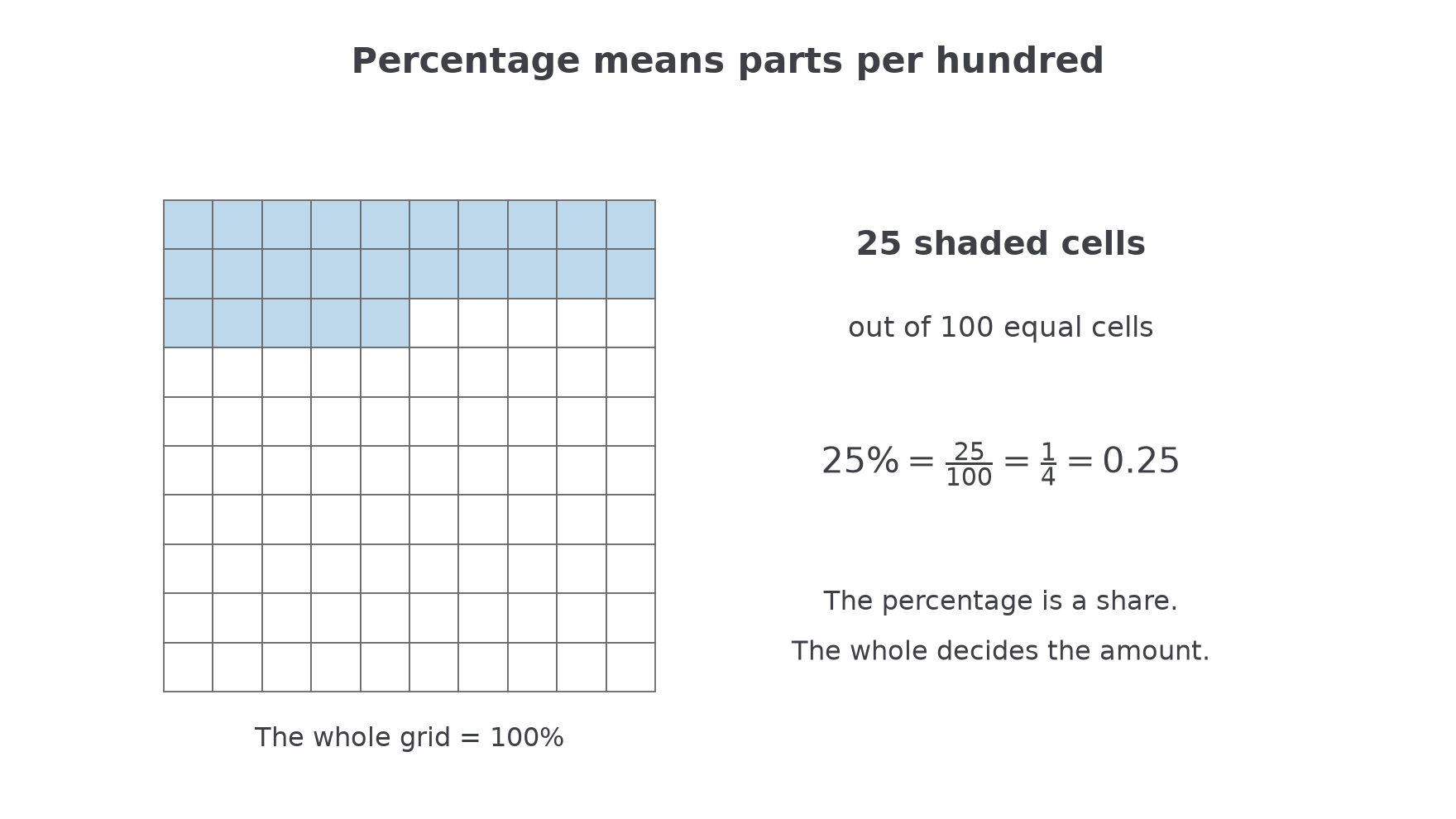
Percentage
A percentage is a number of parts per hundred. . For example, , and represents none of the whole.
The whole need not contain one hundred objects. of twenty counters is five counters, because a quarter of twenty is five. The percentage tells you the share; the amount depends on the size of the whole.
Percentages can exceed . A jug holding of a cup's volume holds one and a half cups. This does not mean of the jug is full: always identify which amount represents .
Key idea
Ask “one hundred per cent of what?” before using a percentage. The chosen whole controls the amount.
Check that you can distinguish the proportion from its amount.
Fractions, decimals and percentages
Fractions, decimals and percentages can name exactly the same proportion.
Since a percentage counts hundredths, multiply a decimal by to obtain its percentage number: . Reverse this by dividing the percentage number by : . To write a percentage as a fraction, put its number over , then simplify. Thus .
Worked example 1: a proportion below one
Question. Write as a decimal and a percentage.
Plan. Make a denominator of , then read both forms.
Answer. and .
Check. , and simplifies back to .
Change only the numerator from to . More than five fifths means more than one whole, so expect a percentage above .
Worked example 2: a proportion above one
Question. Write as a decimal and a percentage.
Plan. Use the same factor of to obtain hundredths.
Answer. and .
Check. , which is .
A fractional percentage is possible too: . The percentage sign already means “divide by one hundred”; do not divide twice.
Watch out
, not . In fact, , a much smaller proportion.
Convert a larger number of fifths using the same method.
A percentage of an amount
To find a percentage of an amount, multiply the amount by the fraction or decimal represented by that percentage.
For friendly percentages, use familiar fractions or build from , and . For example, of is . On a calculator, the direct calculation is , which gives the same result.
Percentage of an amount
Here is the chosen whole, with the same units as the answer. Not in the 2027 formula sheet: learn it.
The fraction method often makes a non-calculator calculation shorter.
Worked example 3: using a familiar fraction
Question. Work out of , without a calculator.
Plan. Use , then divide by eight.
Answer. .
Check. Eight lots of make , so this is one eighth of the whole.
Change only the percentage to . The whole stays ; a direct decimal multiplication is now convenient.
Worked example 4: a calculator percentage
Question. Calculate of .
Plan. Divide the percentage number by one hundred, then multiply by the amount.
Answer. .
Check. . The two shares are and , which total .
Now answer the opening question: of and of are both . More generally, : swapping the percentage number and the numerical amount leaves the product unchanged. It can make a calculation easier, such as of becoming of , which is .
Watch out
For of , multiply by , not . The latter is one hundred times too large.
Apply the same percentage to a new whole.
One amount as a percentage of another
To express one amount as a percentage of another, first decide which amount is the whole.
If you scored out of , the whole is , so your share is . Expressing this share in hundredths gives . This reverses “find a percentage of an amount”. Both amounts must use the same units; convert units first if necessary.
One amount as a percentage of another
The reference amount must be nonzero. Not in the 2027 formula sheet: learn it.
The denominator is a decision, not simply the larger of the two numbers.
Worked example 5: part of a larger whole
Question. Express as a percentage of .
Plan. Use as the whole and convert to hundredths.
Answer. .
Check. , so the percentage recreates the compared amount.
Change only the reference amount, to . The compared amount remains , so its percentage must now exceed .
Worked example 6: larger than the reference amount
Question. Express as a percentage of .
Plan. Divide by the stated reference amount, even though it is smaller.
Answer. .
Check. of is .
Keep the “of” amount in view when choosing the denominator.
Watch out
“ as a percentage of ” uses , not . Reversing the fraction answers a different question.
Compare a new amount with the same reference.
Quick Recap
- A percentage names parts per hundred of a chosen whole.
- Multiply a decimal by to obtain its percentage number; divide to reverse.
- Find a percentage of an amount by multiplying by its decimal or fractional form.
- Express one amount as a percentage of another by dividing by the reference amount, then multiplying by .
The opening amounts are equal: of and of both give .